[…] that some Democratic members had already called him. We covered why the Founders built that veto in “Mr. Veto”…

Written By TNT Staff, Posted on November 9, 2026

On the eve of Stephen Miller taking over as White House chief of staff, President Donald Trump told CBS News that his deportation policy “might be too tough” and floated working with Democrats on “some kind of legal status” for illegal immigrants who hold jobs. The interview, conducted by Ross Douthat and published as a full transcript, immediately revived the word “amnesty” among Trump’s own voters — the same week Miller, the architect of the administration’s hard border line, steps into the West Wing’s top staff job.
That pairing is the story. One day the president talks about softening removals. The next, the hardest-line immigration aide in the building runs the White House. Conservatives who voted for a closed border are entitled to ask which signal is real.
Trump gave himself an “A+” for “closing up the border,” citing his claim that “zero people came in through our southern border” over the last 17 months and repeating his longstanding figure that “25 million people” entered under Biden. Those numbers are the president’s claims in the interview, not independently verified figures in this article.
On removals, he drew a different grade. “For getting people out, I get very high marks for getting the bad ones out. But I get hurt because we also took people that had good jobs,” he said — people whose “one violation” was entering illegally. Asked whether deportation policy “went too far,” Trump answered: “I think it was too tough.” Pressed again — “It was too tough?” — he said, “I think it might be too tough, yeah.”
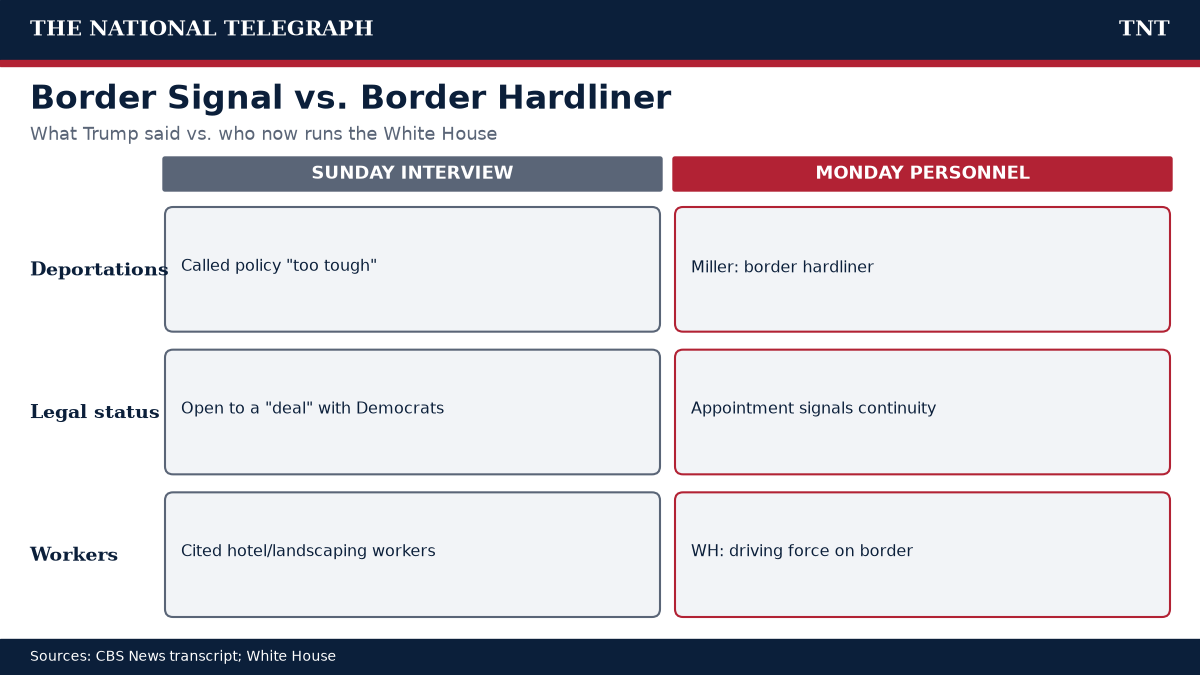
He described hotel and landscaping workers as examples of people a “large part of the country” thinks “should be allowed to stay,” and said a deal with Democrats is “actually doable.” When Douthat asked about “some kind of legal status” for those workers, Trump did not reject the framing. He said the “pretty far right” wants everybody removed, a middle group wants killers, rapists and drug dealers out while working a deal for long-settled workers, and “sanctuary city” jurisdictions protect criminals.
He also said Democrats have already called him about immigration, naming interest after Sen.-elect James Talarico of Texas and winners in South Carolina. None of that is an enacted statute. It is a presidential trial balloon after a midterm loss.
The White House announced on Nov. 6 that Miller would succeed Susie Wiles as the 33rd White House chief of staff, calling him a “driving force” behind the administration’s border policies. The Guardian reports Trump announced the change Friday and that Miller takes over chief of staff duties from Susie Wiles on Monday. The appointment was already the subject of a Nov. 7 TNT Staff report. What is new is the collision with Trump’s own words.

Miller’s promotion was sold as continuity, not retreat. Trump’s Sunday comments sound like a retreat dressed as pragmatism. Both cannot be the governing line at once. Either Miller is there to keep enforcement from becoming a negotiated legalization program, or the interview was the tell and the personnel change is cover for a post-midterm pivot.
Fairly stated: closing the border and removing criminals is what voters were sold. Relabeling workplace enforcement as “too tough” because some employers like cheap labor is a non-conservative turn — especially after a midterm defeat Democrats are already trying to cash in for broader legalization talk. A deal that starts with “good people” in hotels can end wherever Democratic negotiators drag it.
Trump is still president. He can set enforcement priorities. What he cannot do without a fight is pretend that “legal status” for people who broke immigration law is something other than a form of amnesty, or that putting Miller in the chief of staff’s chair washes that away. Watch the first legislative offer, not the branding. If the White House publishes terms that reward illegal entry while Miller is chief of staff, the Miller hire was optics. If Miller blocks that bargain, the interview was politics. Conservatives should demand the second outcome — and judge both men by which one they get.
Sources: CBS News transcript; White House; The Guardian.

 November 9, 2026 November 8, 2026

Leave a Reply