[…] convicted of first-degree criminal sexual conduct after sexually assaulting a 10-year-old girl. ICE deported him in July. The same…

Written By TNT Staff, Posted on November 22, 2026
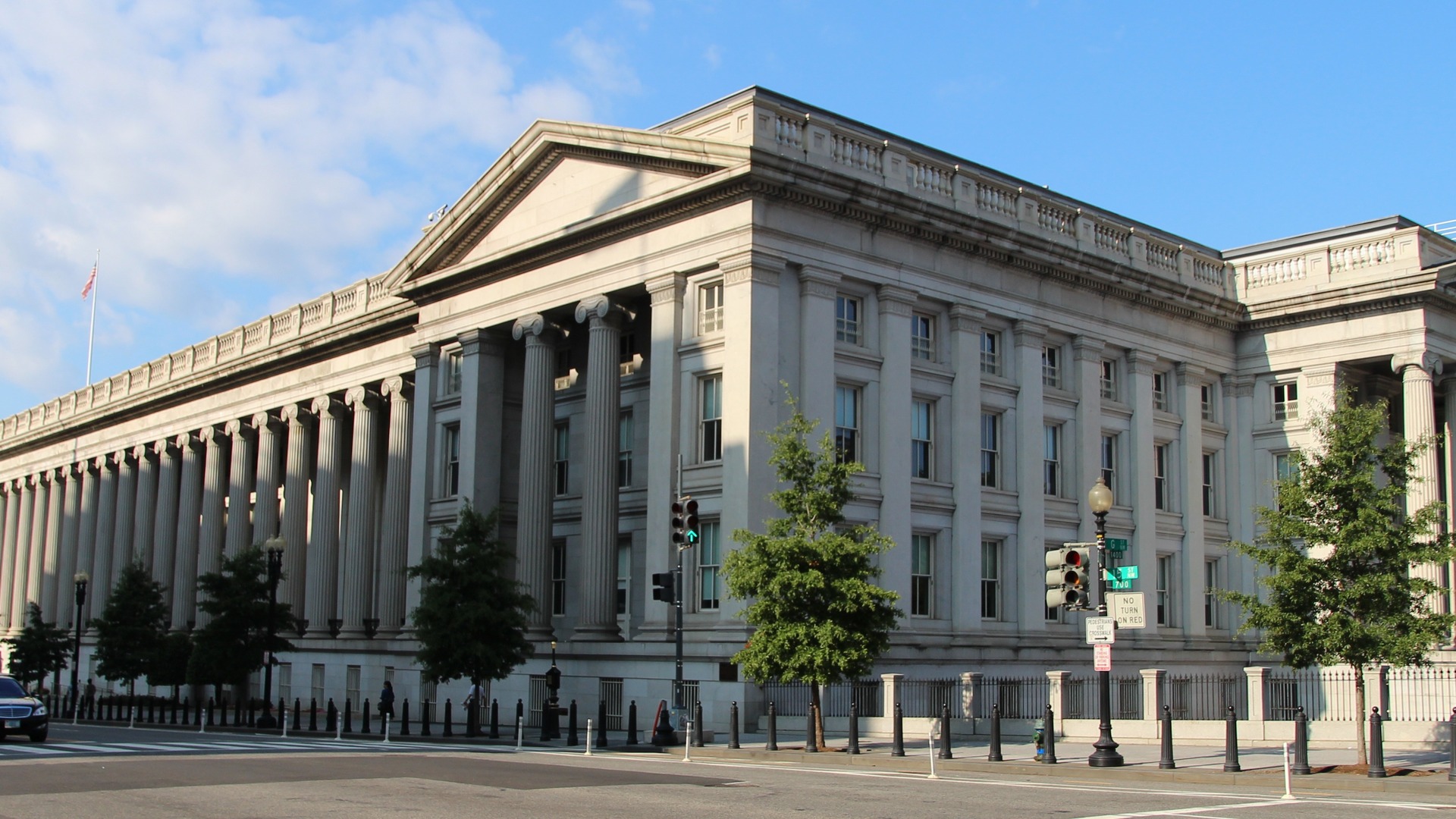
The compounds that run virtual-currency “investment” scams against Americans do not operate on their own. They have landlords, front companies and, on the Thai-Burma border, an armed group that the Treasury Department says supplies the guards. On Thursday, Treasury sanctioned the man it identifies as a Cambodia-based scam-compound operator, two of his companies, and two commanders of the Democratic Karen Benevolent Army, an ethnic armed group already on the sanctions list for protecting those compounds.
The Office of Foreign Assets Control said the designations target people “involved in operating and facilitating cyber scam centers in Southeast Asia,” including operators of compounds that target Americans through virtual-currency investment fraud and affiliates of armed groups that provide protection and support. “Under President Trump’s leadership, Treasury has aggressively targeted overseas scam compounds to protect Americans from fraud,” Treasury Secretary Scott Bessent said. “We will continue to use all available tools to disrupt and dismantle the networks that enable scam compounds to operate.”
The action was taken in furtherance of Executive Order 14390 of March 6, 2026, “Combating Cybercrime, Fraud, and Predatory Schemes Against American Citizens.” The designations themselves were made under Executive Order 13694, as further amended. OFAC said it coordinated with the FBI’s New York Field Office, the Justice Department’s Scam Center Strike Force, the Drug Enforcement Administration, and the Homeland Security Task Force and National Coordination Center.
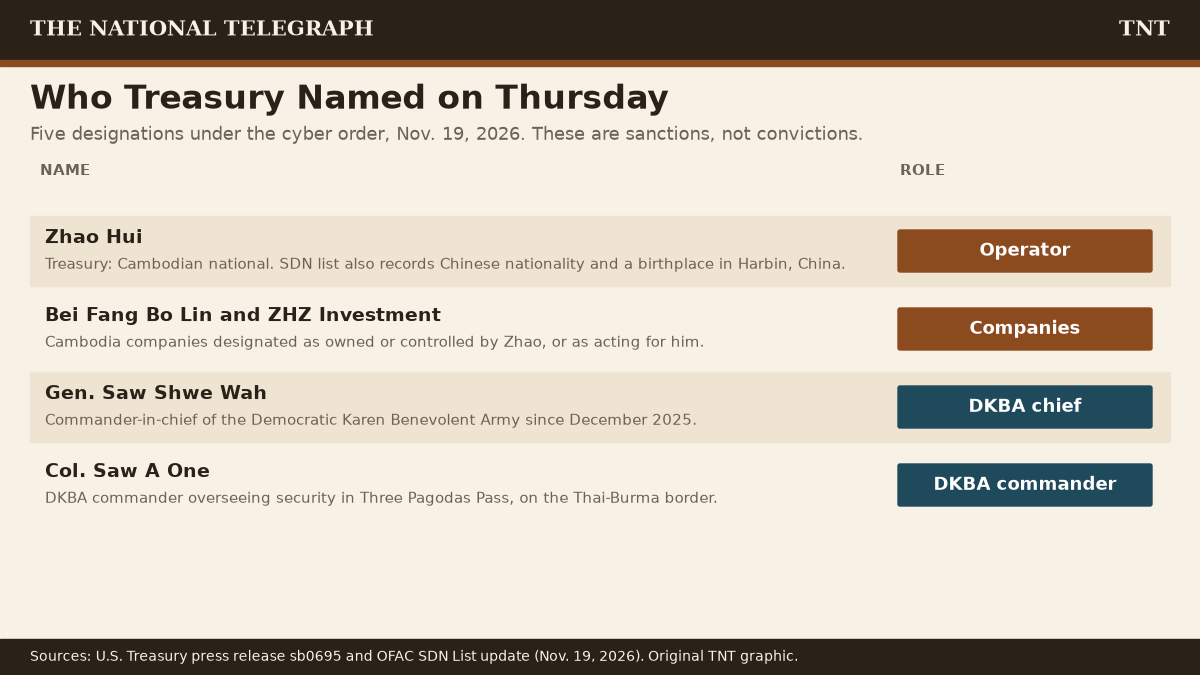
Treasury described Zhao Hui as a Cambodian national. The SDN List update also records a Chinese nationality, a birthplace in Harbin, China, and a location in Tokyo. According to Treasury, Zhao leased a scam center owned by the Prince Group Transnational Criminal Organization, which OFAC has already designated, and paid protection fees to that group’s designated leader, Chen Zhi. Zhao also owned and operated a separate scam compound in Cambodia, independent of Prince Group, where Treasury said he was directly involved in the operations and managed the leases. That compound “primarily targeted Americans and Europeans” and ran virtual-currency investment scams.
Prince Group is not a vague “online fraud ring.” In October 2025, Treasury designated it as a Cambodia-based transnational criminal organization led by Chen Zhi, whom that release also identified as a Cambodian national, and said the network “operates a transnational criminal empire through online investment scams targeting Americans and others worldwide.” OFAC then sanctioned 146 targets in the group. A U.S. government estimate cited in that release said Americans lost at least $10 billion to Southeast Asia-based scam operations in 2024. Treasury said U.S. losses to online investment scams had totaled more than $16.6 billion over the preceding years. Thursday’s action ties Zhao to that already-designated network and to a compound he ran on his own.
Zhao is chairman of the board of two Cambodia-based companies that OFAC also designated, as owned or controlled by him or as having acted for him: Bei Fang Bo Lin Construction Decoration Co., Ltd., a construction firm in Phnom Penh, and ZHZ Investment Consulting Co., Ltd., a management and consultancy company also in Phnom Penh.
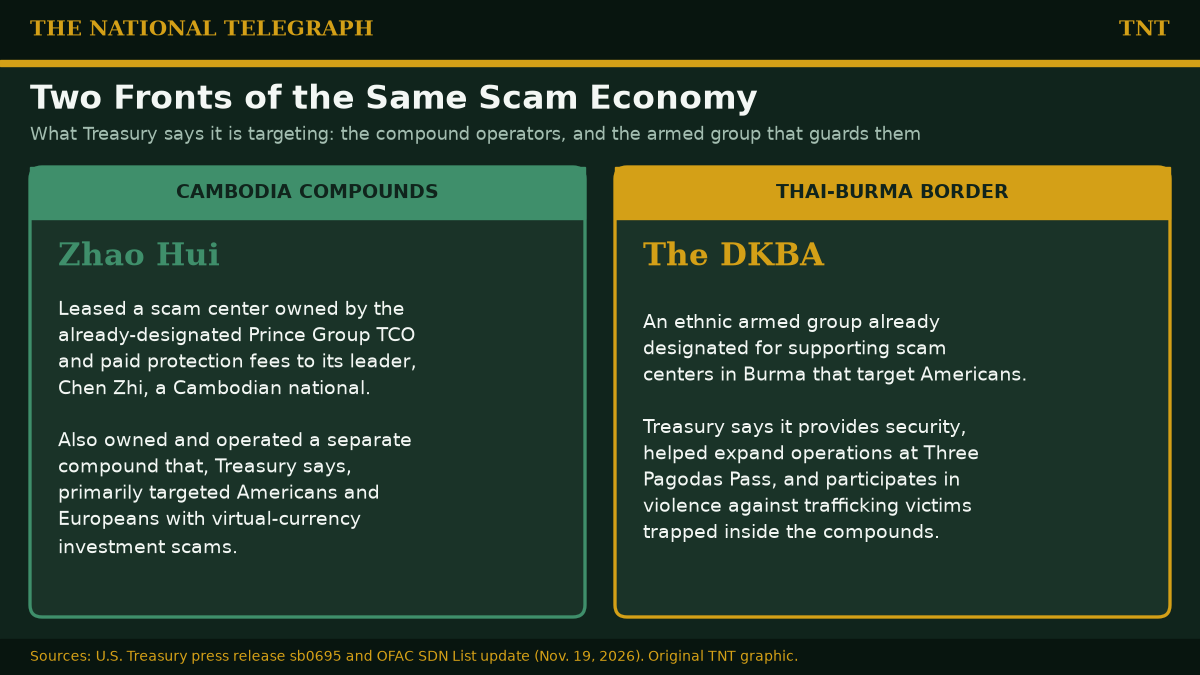
The other half of Thursday’s action is an armed group, not a cluster of freelance guards. Treasury said armed groups in Burma have, in recent years, “transformed a strip along the Thai-Burmese border into one of the world’s highest concentrations of scam centers.” The Democratic Karen Benevolent Army, or DKBA, is an ethnic armed group that OFAC had already designated for supporting cyber scam centers in Burma that target Americans with fraudulent investment schemes. “DKBA actors not only provide security for scam compounds and permit their continued operation, but also actively participate in violence against victims of human trafficking trapped inside the compounds,” Treasury said.
General Saw Shwe Wah has been the DKBA’s commander-in-chief since December 2025, Treasury said, replacing General Saw Steel, whom OFAC designated in November 2025. Colonel Saw A One is the DKBA commander who oversees security in the Three Pagodas Pass in Karen State, near the Thai border. Treasury said the area has seen a buildup of new buildings intended for telecom scam operations, with many scam actors entering with the DKBA’s help, and that the group also protects them. Saw A One “reportedly” owns a plantation where scam operations occur and has contracted for scam operations, the department said. Both men were designated for being leaders or officials of the already-blocked DKBA.
All property and interests in property of the designated people and companies that are in the United States or in the possession of Americans are blocked. Americans are generally barred from dealing with them, and any entity they own 50 percent or more is also blocked. The designations are financial sanctions, not criminal convictions.
Treasury is going after both ends of the operation: the man it says ran compounds that hunted American savings, and the commanders of the armed group it says keeps those compounds in business. The names are now on the same list.
Sources: U.S. Department of the Treasury, “Treasury Targets Cyber Scam Operators and Armed Group Facilitators in Southeast Asia” (sb0695, Nov. 19, 2026); OFAC Recent Actions and SDN List update, Nov. 19, 2026; U.S. Department of the Treasury, “U.S. and U.K. Take Largest Action Ever Targeting Cybercriminal Networks in Southeast Asia” (sb0278, Oct. 14, 2025).

 November 22, 2026 November 22, 2026
Leave a Reply