[…] Trump also repeated claims about Kansas and Michigan races that fact-checkers have challenged. Those include an unsupported suggestion that…

Written By TNT Staff, Posted on October 25, 2026
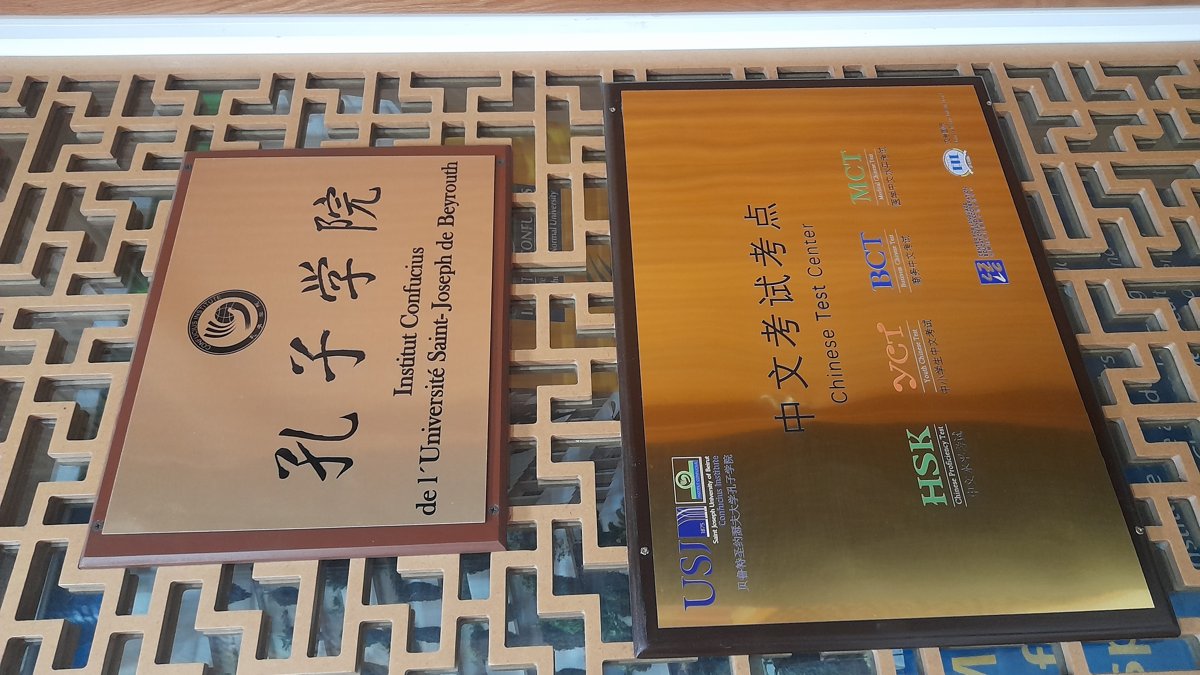
Featured photo: A Confucius Institute sign at a university campus (Saint Joseph University of Beirut). Photo: Marsupium, CC BY 4.0, via Wikimedia Commons.
The Pentagon has added Confucius Institutes, the Chinese government-backed centers that once dotted American campuses, to its list of institutions that threaten U.S. national security. Secretary Pete Hegseth says the department found 80 of them operating under new names at 30 universities, and has shut every one down.
“It turns out that 80 new propaganda cells across 30 universities had popped up using different names and different charters, but with the same mission, to steal intellectual property and to infiltrate the minds of American students,” Hegseth said in a two-minute video posted Friday on his official account. The video had passed 3.9 million views by Sunday, according to X.
He said that “within the last two months, we have systematically dismantled every single one of these organizations using the leverage that we have here at the War Department.”
The department has not named the universities or the organizations, and has not published the list. Those figures are Hegseth’s, and TNT could not independently check them.
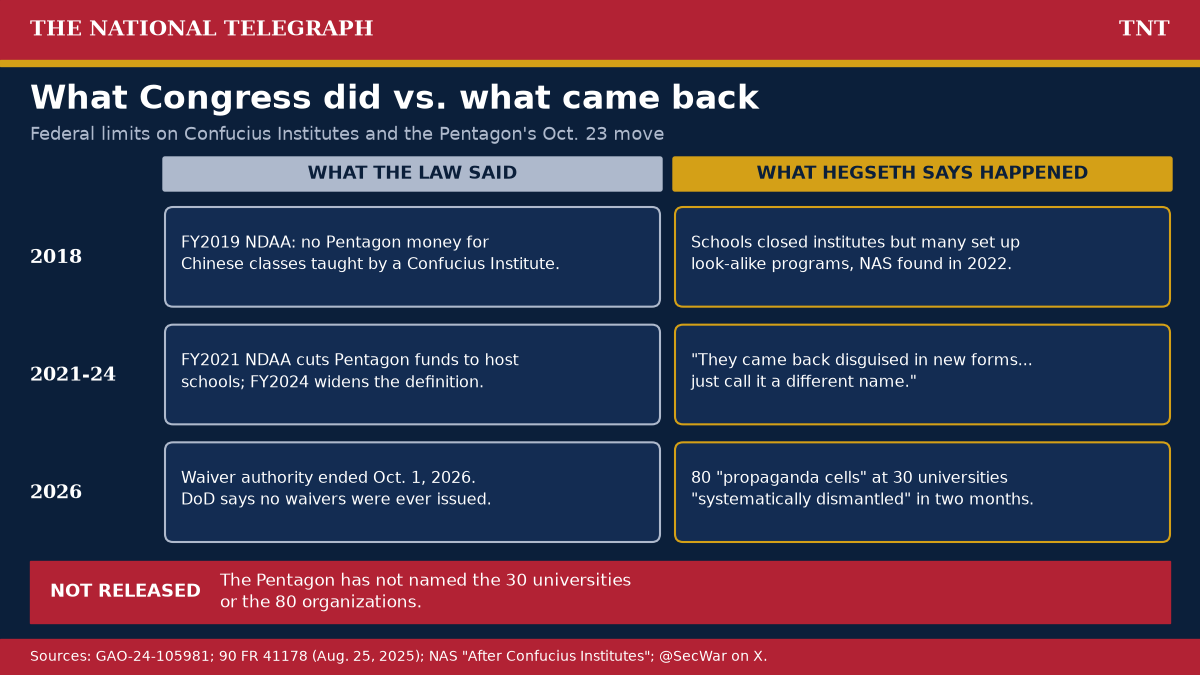
Hegseth compared the institutes to diversity programs that he says tried to survive at the Pentagon by changing their labels. “Congress banned them a few years ago, these Confucius Institutes,” he said. “But they came back disguised in new forms, just like DEI does. Just call it a different name.”
The record backs up the pattern, if not yet the specific numbers. Congress first went after the institutes in the defense bill for 2019, which barred Pentagon money for Chinese classes taught by a Confucius Institute. The 2021 bill cut off Pentagon funding to any school hosting one. The schools got the message. The Government Accountability Office found that the number of institutes fell from about 100 in 2019 to fewer than five by July 2023. More than 60% of schools it surveyed said the threat of losing federal money drove their decision “to a great extent.”
But closing an institute is not the same as cutting the tie. A 2022 report by the National Association of Scholars, After Confucius Institutes, found that 104 of 118 U.S. institutes had closed or were closing, and that at least 28 schools had replaced their institute with a similar program, while another 12 had sought to.
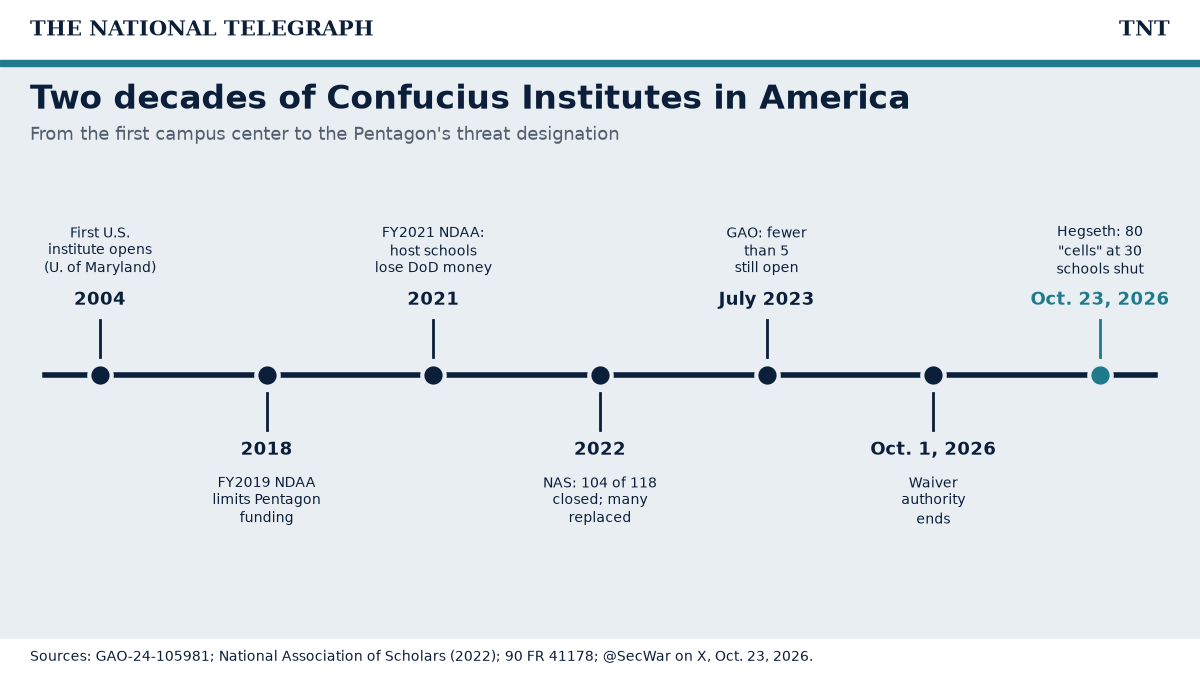
Congress tried to close that loophole. The 2024 defense bill widened the legal definition of a Confucius Institute and ended the Pentagon’s power to waive the funding ban as of Oct. 1, 2026, according to a Defense Department rule published last year. The department said then that it had never issued a waiver. Hegseth’s announcement came three weeks after that deadline passed.
The question is not how Beijing got in. It is why so many American universities opened the door.
The answer, mostly, is money and convenience. A Confucius Institute came with Chinese government funding, teachers and course materials for language and culture programs that schools did not want to pay for themselves. Universities that lecture the country about academic freedom signed agreements with an arm of a one-party state that jails dissidents and censors any talk of Tiananmen Square, Taiwan or Tibet. Few asked what Beijing expected in return.
When Washington put federal research dollars on the line, most schools closed their institutes within a few years. That tells you how much the programs were really worth to them. If Hegseth is right that 80 replacements quietly sprang up, the same schools chose to keep the relationship and change the sign on the door.
This is the right fight. The Chinese Communist Party treats American campuses as a source of research to take and young minds to shape, and the Pentagon has every right to stop funding schools that help it.
But taxpayers deserve to see the work. The Pentagon should name the 30 universities and the 80 programs, so parents, students and state lawmakers can judge for themselves. Naming them would also make it harder for the next rebrand to slip through.
The timing matters too. The South China Morning Post notes the crackdown comes weeks before President Trump’s planned trip to China and third meeting with Xi Jinping, whom he has called a “truly great” friend. A tough line on campus infiltration should not be traded away at the summit table. As Hegseth told universities: “Stay vigilant. Don’t allow these influences to come back in.”

[…] Trump also repeated claims about Kansas and Michigan races that fact-checkers have challenged. Those include an unsupported suggestion that…
[…] TNT reported Oct. 15, Omar’s official birth year used to be 1981. Emails reported by the New York Post…

Very well presented. Every quote was awesome and thanks for sharing the content. Keep sharing and keep motivating others.
 October 25, 2026 October 25, 2026
Leave a Reply