[…] and HB 1039, died on March 13, 2026. Byron Donalds, who won the governor’s race on Nov. 3, has…
Written By TNT Staff, Posted on November 16, 2026
Ten governments signed a pact in San Francisco on Sunday to protect the supply chains behind artificial intelligence. China was not one of them.
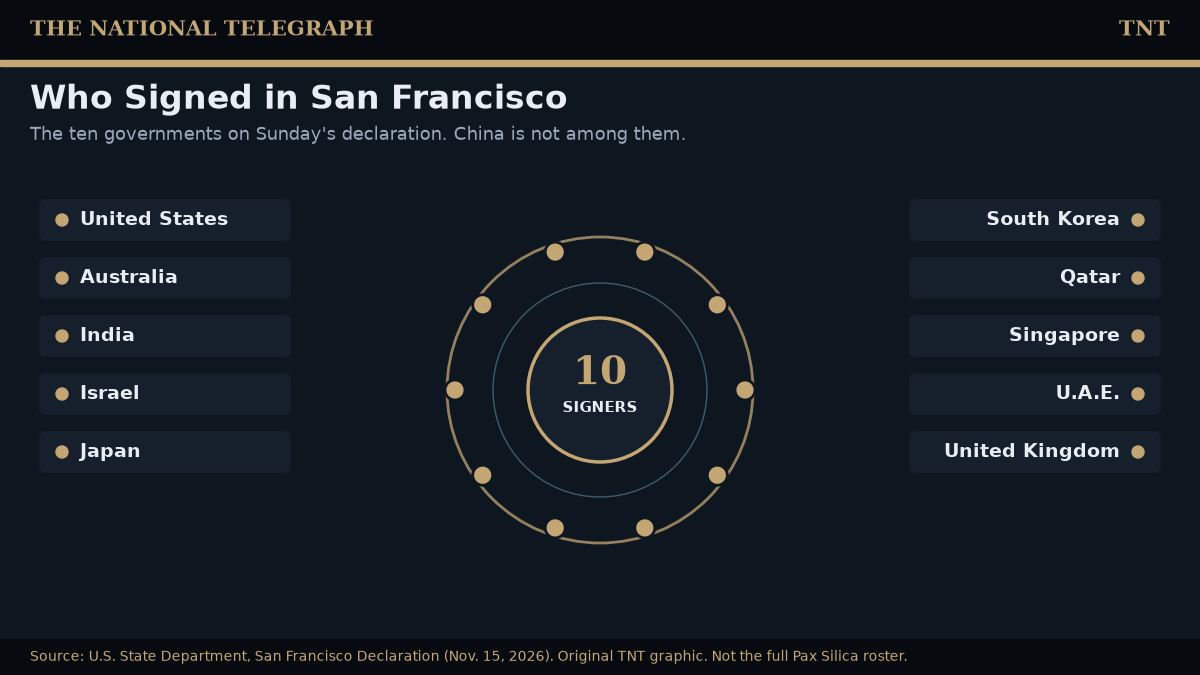
The United States and nine Pax Silica partners — Australia, India, Israel, Japan, South Korea, Qatar, Singapore, the United Arab Emirates and the United Kingdom — signed the San Francisco Declaration on the Secure Foundations of Enduring Prosperity. The signing took place at a Pax Silica Founders Retreat convened by Under Secretary of State for Economic Affairs Jacob Helberg, the State Department said in a Nov. 15 release.
The declaration does not name Beijing. It does name the problem. The governments said economic security is “fundamental to national security,” and that resilience is best achieved by “reducing excessive dependencies through diversified and trusted supply chains.” They pledged coordinated work against “economic coercion, supply chain disruptions, and non-market policies and practices,” and to protect “sensitive technologies and critical infrastructure from undue access, influence, or control.”
That is the language of a coalition that intends to stop depending on an adversary for the materials, chips, ports and power that make advanced AI possible. China is not among Sunday’s signatories, and it is not on the partner list on the State Department’s Pax Silica page.
Pax Silica is the State Department’s flagship effort on what it now calls Super Intelligence, or SI — a term the Sunday declaration says some participants use to mean artificial intelligence — and on the supply chains underneath it. The initiative was inaugurated on Dec. 12, 2025, when Helberg and representatives from Japan, Israel, Australia, Singapore and South Korea signed the original Pax Silica Declaration in Washington, the department announced the day before. The Australian government and Helberg also counted the United Kingdom among those initial signatories. Additional partners followed, including Qatar, the United Arab Emirates and, in February, India.
Israel was in the room on the first day. It was in the room again on Sunday.
The December launch, the State Department said, advanced “President Donald J. Trump’s call for a new era of economic statecraft that produces peace and security for America and its allies through the power of private investment, free enterprise, and economics.” Helberg has put the stakes in plain terms. “If the 20th century ran on oil and steel, the 21st century runs on compute and the minerals that feed it,” he said on the department’s Pax Silica page.
He has also been clear about the problem the coalition is built to solve. In a Dec. 16, 2025, on-the-record briefing, Helberg said “90 percent of the world’s rare earth minerals are controlled by a single player, which we all view as not being sustainable over the long term.” The partners, he said, were not competing with one another. “The only player with which we’re competing, with which we’re all competing with right now, is not Singapore, Korea, Japan, the UK, or Australia, or Israel. It’s someone else, and I think everyone understands who that is.” Asked in the same briefing about the United States and China in the AI rivalry, he said the strategy is “to create a competitive edge so steep, so insurmountable that no adversary or competitor can scale it,” and to “make America the arsenal of AI in this century.”
In official January remarks at the Hudson Institute, Helberg put the same point in sharper terms: “the supply chains of the AI revolution are being weaponized by our opponents as tools of political coercion. Dependency is being used as a leash.” Pax Silica, he said, is the response.
The December launch release also said the partnership “is not about isolating others—but about coordinating with partners who want to remain competitive and prosperous.” Sunday’s signatories are those partners. Beijing is still outside the room.
The San Francisco text is a declaration — a “common baseline,” in the State Department’s words, not a ratified treaty. It defines the “sensitive technologies” and “critical infrastructure” that underpin SI supply chains and calls their protection “a shared endeavor.”
Sensitive technologies, the governments said, include the goods, software, materials, knowledge, components and production tools “essential to SI supply chains,” whose theft or illicit transfer to “hostile actors” would confer a “meaningful military or intelligence advantage, or undue economic leverage.” Critical infrastructure includes the ports, terminals, transport, communications and logistics networks, the energy and communications systems they depend on, and the digital platforms that manage them.
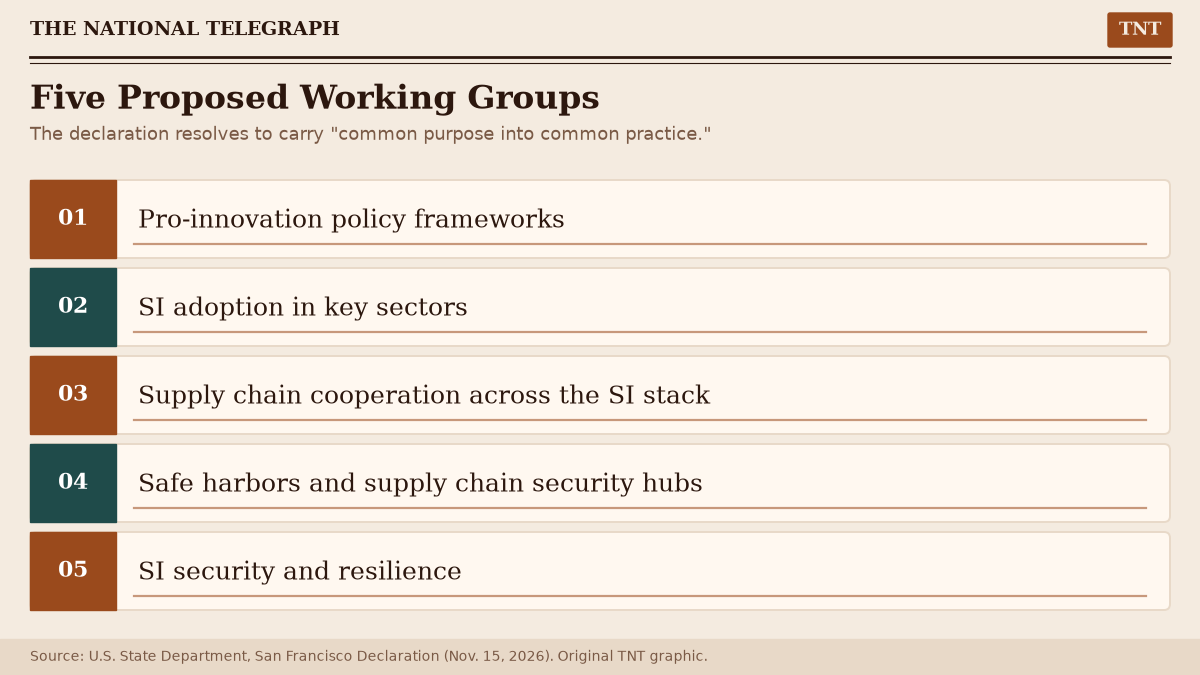
The parties resolved to establish working groups “so that common purpose may be carried into common practice.” The State Department listed five proposed groups: pro-innovation policy frameworks; SI adoption in key sectors; supply chain cooperation across the SI stack; safe harbors and supply chain security hubs; and SI security and resilience.
The broader Pax Silica roster has grown well beyond the original founders. The State Department’s current list includes countries in Europe, the Americas and Central Asia, and records that Taiwan has endorsed the declaration’s principles through a joint statement on U.S.-Taiwan economic security cooperation. Sunday’s document was signed by a narrower group — the United States and nine participants — at what the department called a Founders Retreat. State said the coalition is now “entering a new phase,” turning shared principles into “a working partnership with a common baseline and a path to act on it.”
Helberg has argued that the arrangement can do work older diplomacy could not. In February testimony before the House Foreign Affairs Committee, he said Qatar and Israel now “sit inside the same economic framework,” a path toward normalization “built not on shared ideology but on shared supply chains.” Both governments signed in San Francisco on Sunday, alongside India, the United Arab Emirates and the original East Asian and Pacific partners.
The test is whether the working groups produce more than communiqués — whether the partners actually diversify the minerals, energy, manufacturing and compute they now treat as strategic. No nation, the State Department said Sunday, “can secure the foundations of the SI era alone.” The countries that want to build those foundations together showed up in San Francisco. China did not.
Sources: U.S. State Department, “The San Francisco Declaration on the Secure Foundations of Enduring Prosperity” (Nov. 15, 2026); State Department, “Pax Silica” page; State Department, “Under Secretary Helberg Will Kick Off Pax Silica Summit with Landmark Declaration Signing” (Dec. 11, 2025); Australian Department of Industry, Science and Resources, Pax Silica Declaration publication (Dec. 13, 2025); State Department, Virtual Press Briefing with Under Secretary Helberg (Dec. 16, 2025); State Department, Remarks by Under Secretary Helberg at the Hudson Institute (Jan. 29, 2026); State Department, Helberg opening remarks, House Foreign Affairs Committee (Feb. 24, 2026, as delivered).

 November 16, 2026
 November 16, 2026
Leave a Reply