[…] Nobody has shown that El-Sayed knew about the posts. But TNT has covered El-Sayed’s record on the Muslim Brotherhood…

Written By TNT Staff, Posted on November 10, 2026
Detroit voters have elected a judge who isn’t allowed to be a judge. Kahlilia Davis won one of three open seats on the 36th District Court on Nov. 3 with 83,991 votes, finishing second, according to the City of Detroit’s unofficial results. In 2023 the Michigan Supreme Court suspended her for six years for misconduct and ordered that if she won an election in that time, she would be “debarred from exercising the power and prerogatives of the office.” That means she can’t take the bench until 2029.
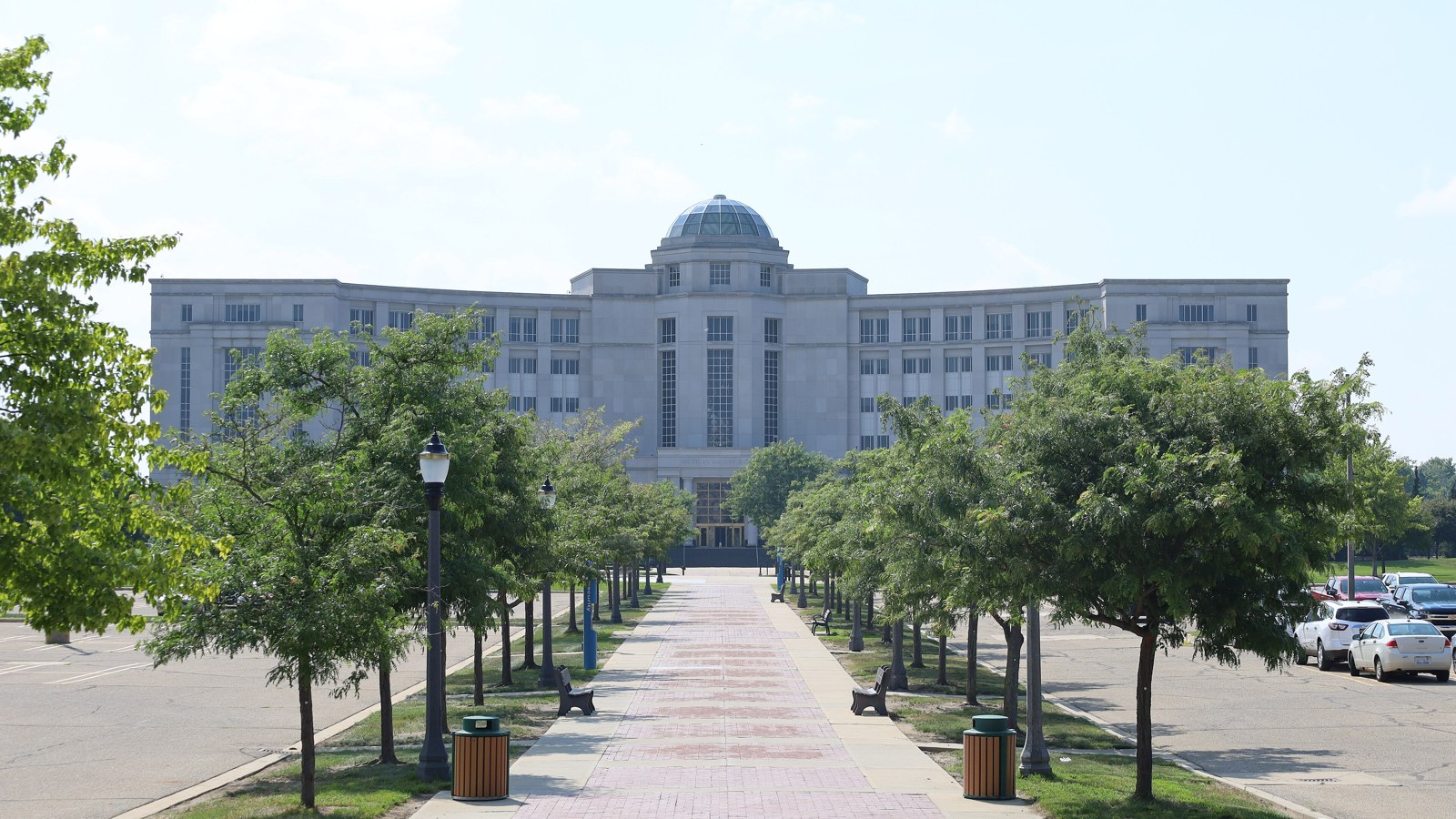
Michigan Hall of Justice, home of the Michigan Supreme Court, Lansing, 2025. Photo: Antony-22, CC BY-SA 4.0, via Wikimedia Commons. Cropped.
The court she was elected to doesn’t know what to do now. “We will be contacting the State Court Administrative Office to seek guidance regarding the election of Kahlilia Davis,” the 36th District’s chief judge said in a statement to WDIV. The administrative office declined to comment.
Davis was elected to the same court in 2016. By the time the Supreme Court ruled in June 2023, her term had expired, so the justices couldn’t remove her. They found she had “engaged in repeated, deliberate misconduct that besmirched the judiciary’s reputation and prejudiced the administration of justice,” calling for “the highest condemnation and harshest sanction.” WDIV summarized the findings: she intentionally disconnected courtroom recording equipment, used an unauthorized handicap parking placard and threatened colleagues with Bible verses.
She had already been kept off the 2022 ballot after admitting to a false statement on her candidate affidavit about unpaid campaign-finance fines. In 2024, Court of Claims Judge Christopher Yates ordered her removed from the ballot, writing that the Supreme Court “made clear that [Davis] cannot serve as a judge until 2029, even if she wins a judicial election.”
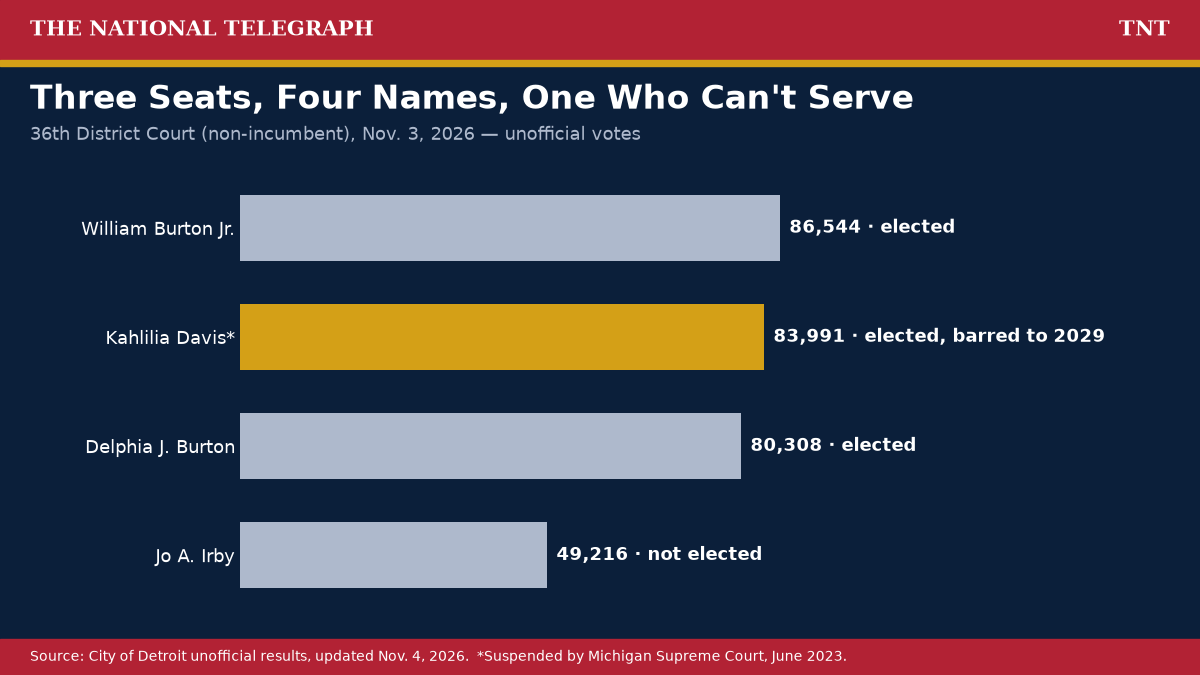
This year Davis sued Secretary of State Jocelyn Benson and won. In a June 11 opinion, Court of Claims Judge James Robert Redford held that the Supreme Court “did not rule that K. Davis was barred from running for election.” He also found she wasn’t bound by the 2024 ruling because she hadn’t been a party to that case. “The electorate’s constitutional right to support and vote for K. Davis, if they so choose, must be respected,” he wrote.
On the narrow legal question, Redford has a point. The suspension order bars Davis from serving, not from running, and the secretary of state’s office told the court in 2024 that nothing in Michigan’s election statutes lets it keep a candidate off the ballot over a disciplinary ruling. But Yates saw the result coming. The Supreme Court’s edict, he wrote, “is not self-executing,” and it depends on the other branches to enforce it. Now a seat on Detroit’s district court has gone to someone who is barred from filling it.
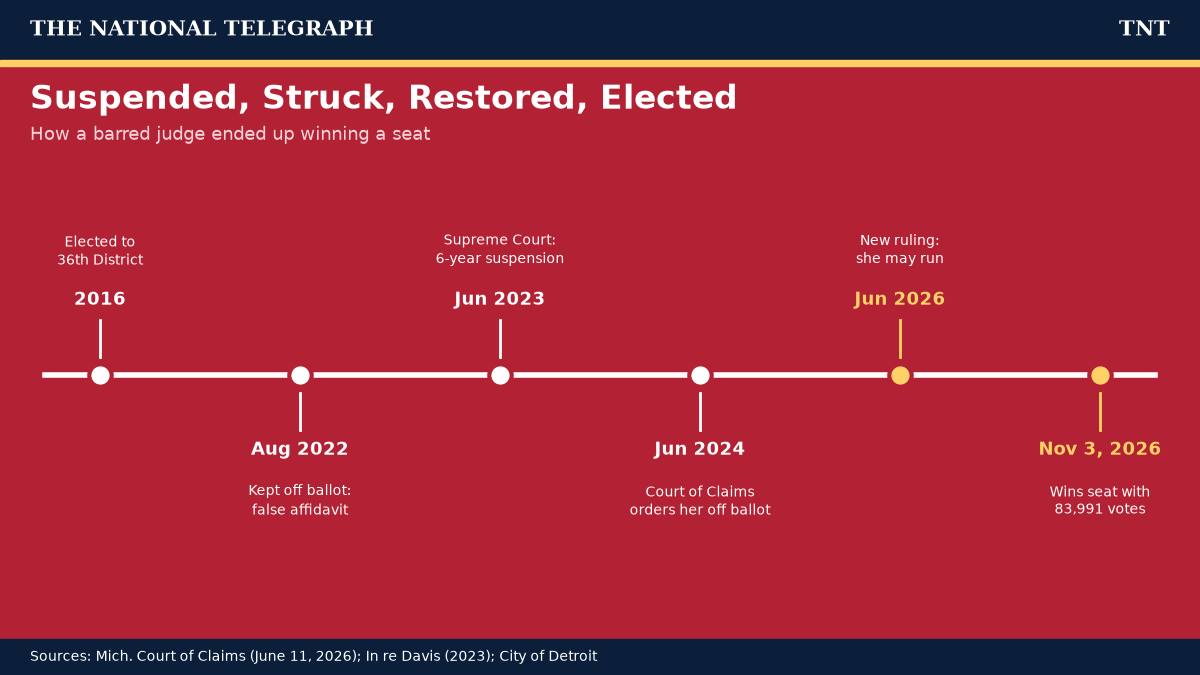
“They didn’t advertise that,” Detroit voter Jeffrey Williams told WDIV. “They should have let us know that she was suspended and wouldn’t be able to serve as a judge.” Judicial races are nonpartisan and low-information, and Detroit’s general elections are rarely competitive. Name recognition carries a lot of weight, and a former judge’s name is a head start. There were only four candidates for three seats. Without Davis on the ballot, the fourth candidate, Jo Irby, would have taken a seat. Instead she finished more than 31,000 votes behind the third-place winner.
The same ballot carried 34 names for five school board seats. A Chalkbeat and BridgeDetroit review found four candidates with felony convictions, including forgery, assault with intent to murder and assaulting a police officer. One of them, Darious Morris, sits on Detroit’s Board of Police Commissioners. Under Michigan law, none was disqualified, because the bar covers only recent convictions involving dishonesty or breach of the public trust while in government office. To be fair to Detroit voters, none of the four won. But voters had to rely on reporters to find out.
Voters are entitled to elect whom they want, and it isn’t anyone’s place to second-guess them. But they’re entitled to know what they’re voting on. Lansing has two clean options. It can make an active Supreme Court suspension a bar to judicial candidacy for the length of the suspension, which may require a constitutional amendment if the courts treat it as a new qualification for office. Or, at the very least, it can require the official ballot or the state’s voter guide to note when a judicial candidate is under a Supreme Court order barring her from serving.
A city where one party has dominated for decades doesn’t fail because its voters are foolish. It fails when nobody has a reason to tell them anything. The Supreme Court did its job in 2023. The election system made that ruling meaningless in 2026. Lawmakers who say they care about accountability should close the gap before the next judicial elections in 2028.
Sources: City of Detroit Department of Elections (unofficial results); Michigan Court of Claims, Davis v. Benson, No. 26-000091-MB; In re Davis, 511 Mich 1003 (2023); WDIV/ClickOnDetroit; Chalkbeat Detroit and BridgeDetroit.

 November 10, 2026 November 10, 2026

Leave a Reply