[…] Trump also repeated claims about Kansas and Michigan races that fact-checkers have challenged. Those include an unsupported suggestion that…

Written By TNT Staff, Posted on October 28, 2026

Featured photo: Empty refrigerated cases at a supermarket in Los Teques, Venezuela, March 29, 2014. Wilfredor, CC0, via Wikimedia Commons.
More Americans now have a good word for socialism than at any point in Gallup’s tracking. In its latest survey, Gallup found that 43% of U.S. adults view socialism positively, the first time the figure has topped 39% since the firm began asking in 2010. Capitalism held at 55%. Big business, at 35%, now trails socialism.
The young are leading the shift. Among adults 18 to 34, Gallup found 57% view socialism positively and 43% view capitalism positively. A Fox News poll of 1,202 registered voters, taken Oct. 9-12, put socialism’s favorable rating at 32% overall, tying its high since Fox first asked in 2019, and at 48% among voters under 30, according to the poll’s published crosstabs.
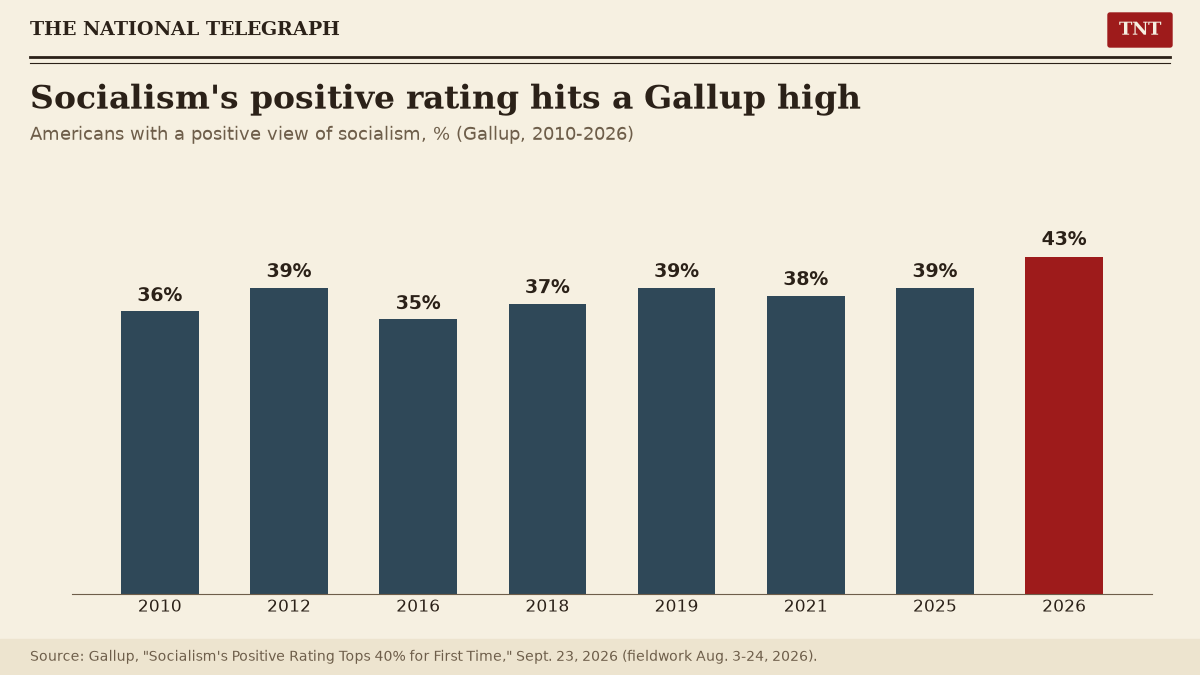
Gallup’s numbers show the growth is not coming from where most people would guess. Democrats’ positive rating of socialism has sat in the mid-60s since 2019, at 65% this year. Republicans are at 14%. The jump came entirely from independents, who went from 37% last year to 45% today, as their view of big business fell to a record low of 32%.
Gallup itself urges caution. Small business is viewed positively by 95% of Americans and free enterprise by 77%, including large majorities of Democrats and the young. That suggests many people who like the word “socialism” are really saying they are frustrated with corporations, rents and health-care bills, not that they want the state to own the means of production.
That is the problem. When Fox News Digital asked more than a dozen University of Michigan students to define socialism, the answers ranged from a government safety net and affordable health care to collective ownership of industry. Some admitted their generation may not fully grasp what it is embracing. Online, conservatives have spent the week arguing over whether schools and universities deserve the blame. Wherever the fault lies, the honest answer is to look at what socialism has actually done where it has been tried.
Venezuela sits on the world’s largest proven oil reserves, about 303 billion barrels, according to the U.S. Energy Information Administration. Under Hugo Chávez and Nicolás Maduro, the state took direct control of the oil company PDVSA and used it as a cash machine for social programs. The EIA says state control “reduced profit reinvestment,” and output collapsed to 742,000 barrels a day in 2023, a 70% decline from 2013.
The rest of the economy went with it. The International Monetary Fund estimates real GDP fell about 75% between 2013 and 2021, which it called “the single largest economic collapse for a non-conflict country in almost half a century.” The UN’s Economic Commission for Latin America and the Caribbean reached the same 75% estimate and recorded annual inflation of 1,198% as late as November 2021. Socialism’s defenders blame U.S. sanctions, but the IMF and ECLAC figures show the economy was already shrinking years before the major sanctions on PDVSA in 2019.
People voted with their feet. UNHCR counts nearly 7.9 million refugees and migrants from Venezuela worldwide, based on government figures as of December 2025, and the R4V platform counts nearly 7 million in Latin America and the Caribbean alone.
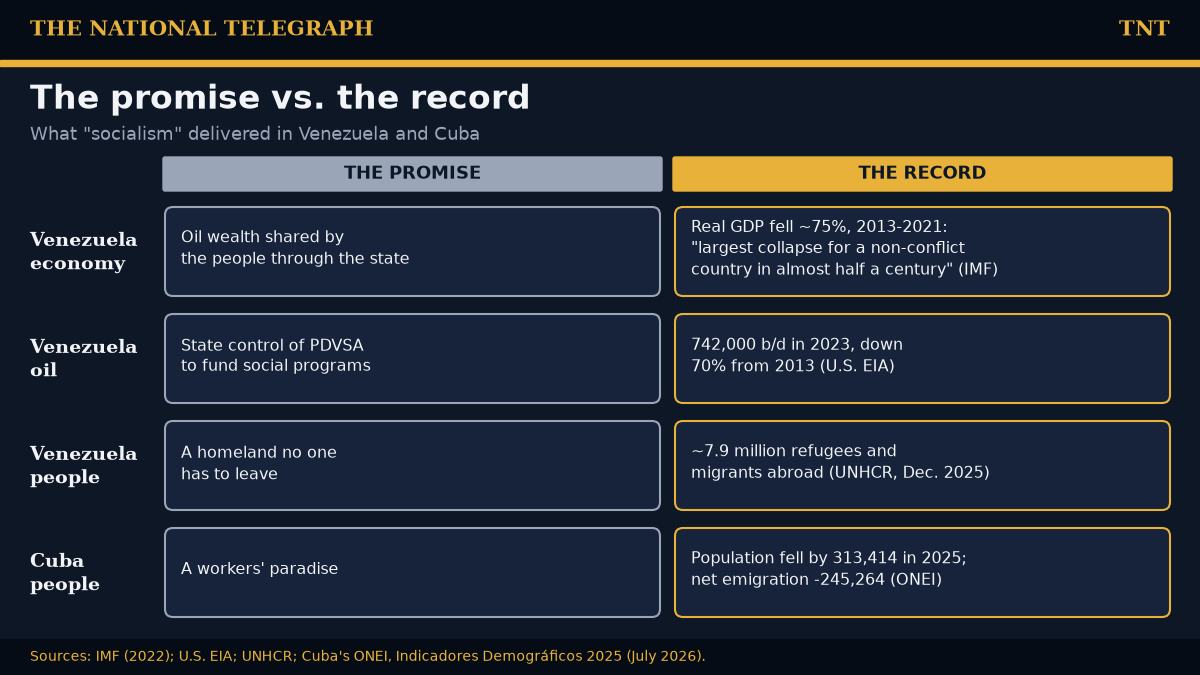
Cuba has had more than six decades to prove the model. Its own government’s numbers tell the story. According to the national statistics office, ONEI, Cuba’s population fell from 9,748,007 at the end of 2024 to 9,434,593 at the end of 2025, a loss of 313,414 people in a single year. Net emigration accounted for 245,264 of that. Deaths outnumbered births two to one, and infant mortality rose to 9.9 per 1,000 live births. This is a country at peace, emptying out.
Young Americans did not live through the Cold War, and few were taught what happened in Caracas or Havana. They do live with high rents, student debt and a health system that feels rigged, and politicians offer “socialism” as a free answer to all three. But the problems they name come mostly from too little competition and too much government in housing, college and medicine, not from too much free enterprise.
The fix is not to sneer at voters under 35. It is to make the case for markets, property and the small businesses they already love, and to tell them plainly what the system they are being sold did to Venezuelans and Cubans who believed the same promises.

[…] Trump also repeated claims about Kansas and Michigan races that fact-checkers have challenged. Those include an unsupported suggestion that…
[…] TNT reported Oct. 15, Omar’s official birth year used to be 1981. Emails reported by the New York Post…

Very well presented. Every quote was awesome and thanks for sharing the content. Keep sharing and keep motivating others.
 October 28, 2026 October 28, 2026
Leave a Reply