[…] rhetoric, Rubio’s “now is the time” message and the CIA’s offer to Cubans, on Oct. 25. This poll shows…

Written By TNT Staff, Posted on October 31, 2026
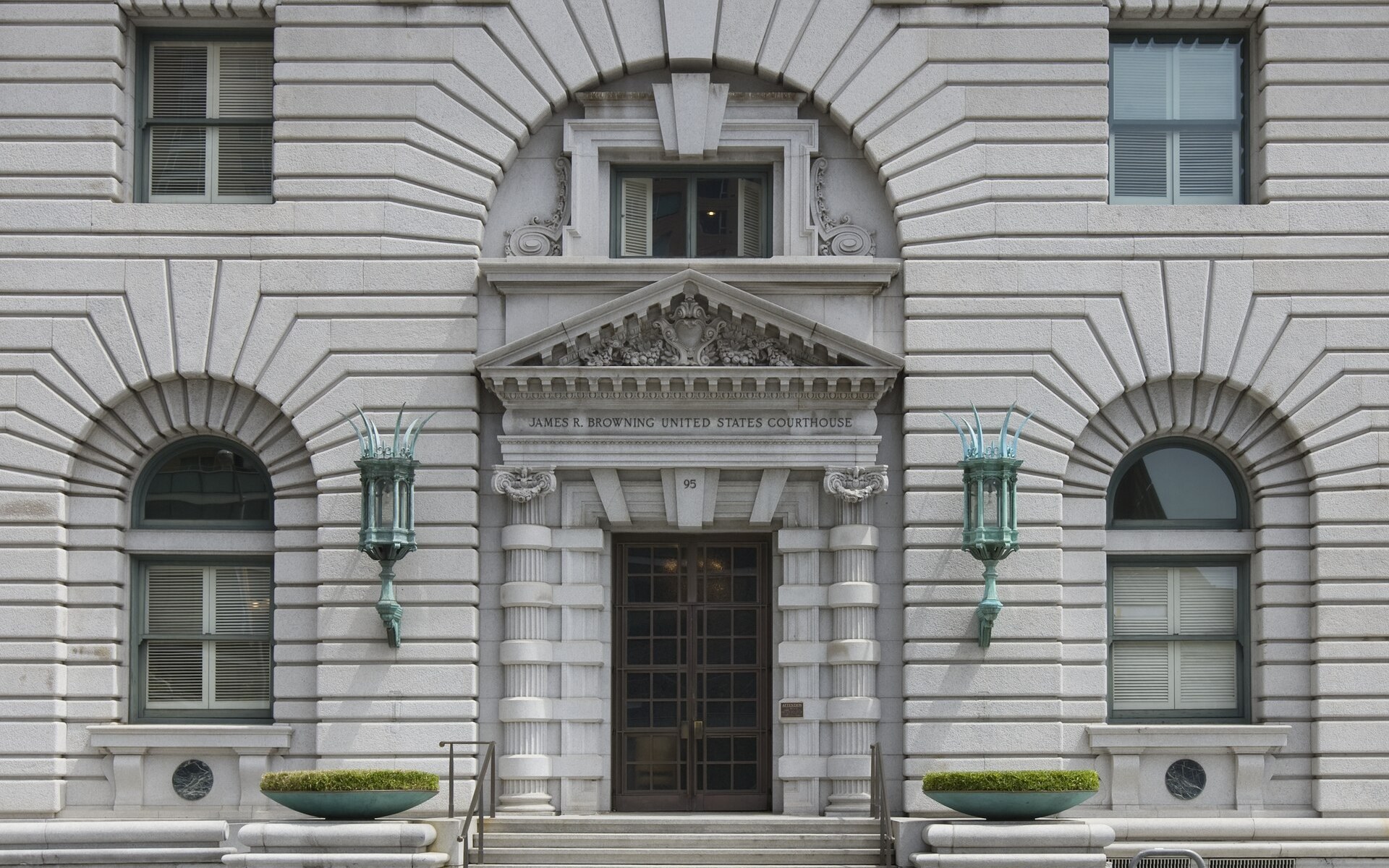
Featured photo: The James R. Browning U.S. Courthouse, home of the 9th Circuit, San Francisco. Carol M. Highsmith, Library of Congress, public domain, via Wikimedia Commons.
A federal appeals court on Friday refused, for the second time in a week, to make California set aside roughly 20,000 mail ballots the Trump administration says went to people who may not be U.S. citizens. The ballots will be counted along with everyone else’s unless the Supreme Court steps in before Tuesday’s election.
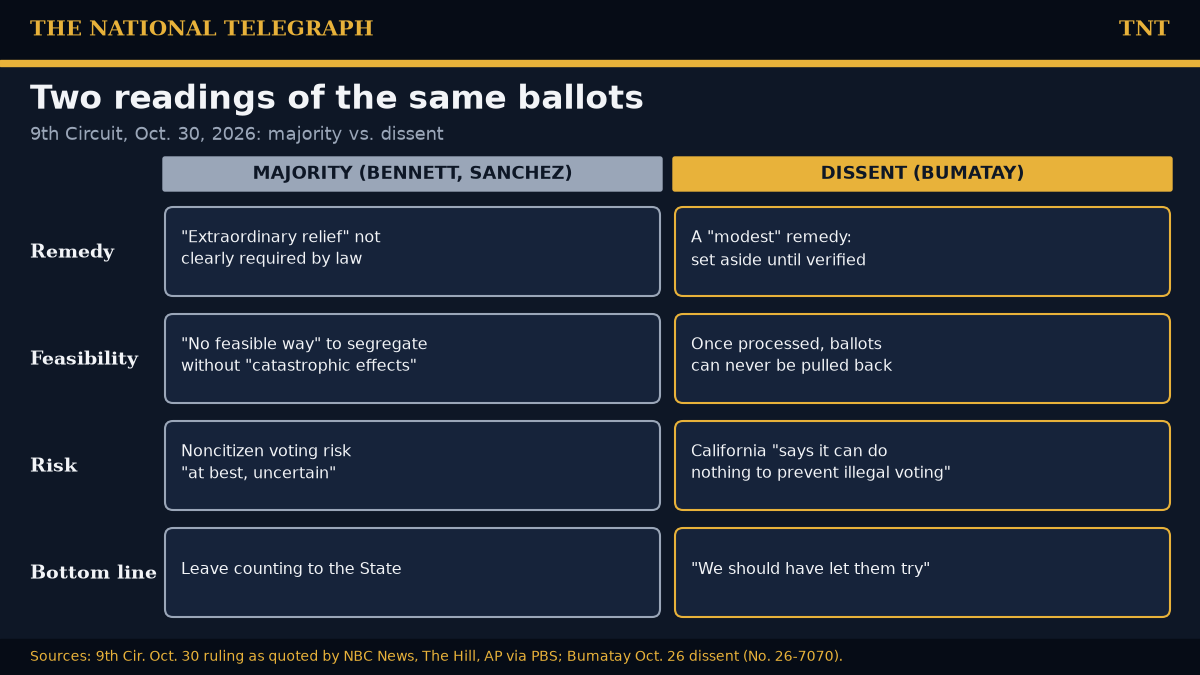
The 9th U.S. Circuit Court of Appeals panel ruled 2-1 that the “United States has not made the required showing that such extraordinary relief, during an ongoing election, is clearly required by law,” NBC News reported. “As the district court found — and we discern no clear error — there is no feasible way to identify and segregate the ballots of specific individuals without potentially catastrophic effects on the entire system,” the majority wrote, according to the Associated Press.
The majority was Judge Mark Bennett, a Trump appointee, and Judge Gabriel Sanchez, a Biden appointee. Judge Patrick Bumatay, also a Trump appointee, dissented.
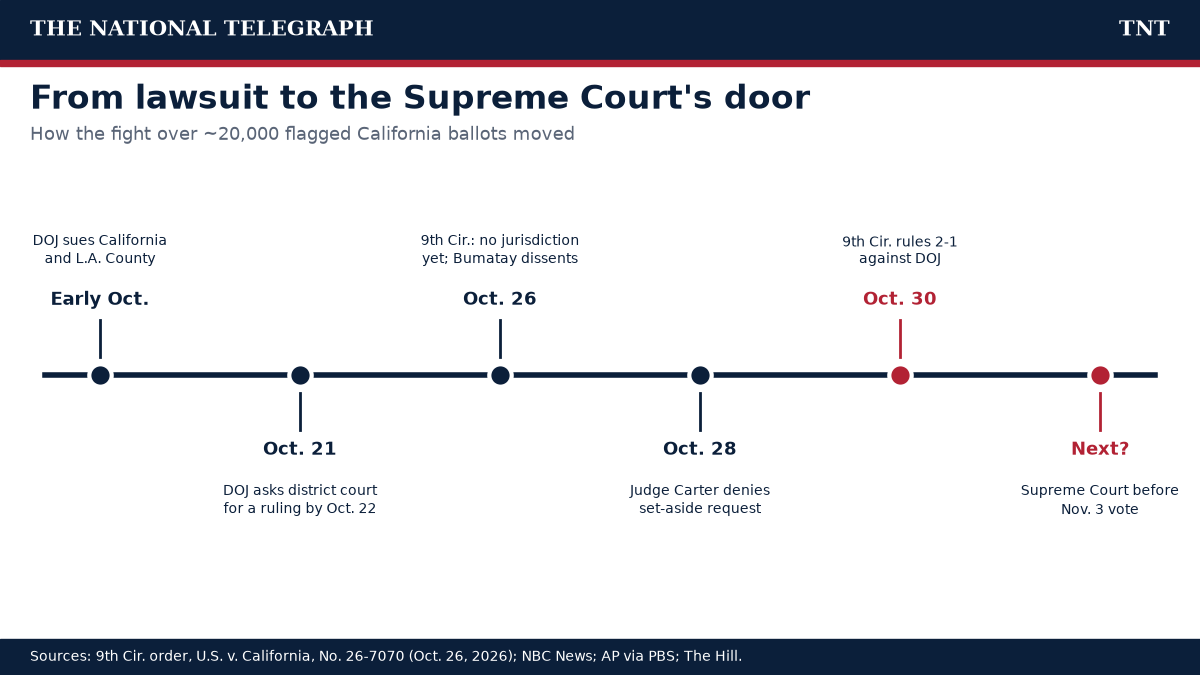
The Justice Department was not asking California to throw out a single ballot. It asked the state and Los Angeles County to set aside vote-by-mail ballots from people the federal government flagged as likely noncitizens, and to verify their citizenship, alone or with federal help, according to the court’s Oct. 26 order. Ballots from citizens would still count.
Bumatay called that a “modest” remedy. “The federal government and the States can work together. California decided long ago that aliens can’t vote in its elections. Today, the federal government merely seeks to safeguard that decision. We should have let them try,” he wrote, as quoted by NBC. “California says it can do nothing to prevent illegal voting,” he added, per the AP. “That undermines the federal government’s interest in promoting election integrity and preventing the dilution of lawful votes.”
In his first dissent, on Oct. 26, Bumatay laid out why timing matters. “Once those ballots are processed, it would be impossible to identify them, and they must be counted in the election,” he wrote in the court’s published order. He noted 331,000 mail ballots had already come in in Los Angeles County alone. Federal law, 18 U.S.C. § 611, already makes it a crime for a noncitizen to vote in a federal election.
The other side has a point the administration will have to answer. On Wednesday, U.S. District Judge David Carter called the request a violation of “longstanding constitutional principles mandating that states have control over their elections,” and questioned how the list was built, NBC reported. He pointed to Nevada, where the administration first flagged 15,903 registered voters as noncitizens, cut that to 6,218, then to 185 after a manual review; Nevada officials later said all 185 were citizens. California officials say the 20,000-name list likely includes many citizens.
The majority agreed the noncitizen-voting risk was “at best, uncertain,” The Hill reported, and in its first ruling called the emergency “at least in part, a self-constructed one” because the government waited so long to sue.
That last criticism lands. If Washington believed thousands of noncitizens were on California’s rolls, the time to press the issue was months ago, not 13 days before an election. But the fix the court rejected was a pause, not a purge. Setting ballots aside until citizenship is checked cancels no lawful vote. Mixing them in with everyone else’s makes the question unanswerable forever.
Justice Department lawyers have said before that they would appeal to the Supreme Court, the AP reported. The department did not immediately say whether it would file an emergency application after Friday’s ruling, per NBC. With the vote on Nov. 3, any appeal would have to move within days. Hours after the 9th Circuit ruled, a separate federal judge barred the department from intimidating election workers handling the ballots, the AP reported.
California says the ballots belong to its voters. Washington says some may belong to people who had no right to cast them. Only one of those claims can be tested once the envelopes are opened, and a 2-1 panel just decided not to test it.

 October 31, 2026
 October 31, 2026
Leave a Reply