[…] reported Wednesday on the Nov. 9 incident aboard United Flight 2174 from Newark to New Orleans. Authorities say […]

Written By TNT Staff, Posted on November 14, 2026
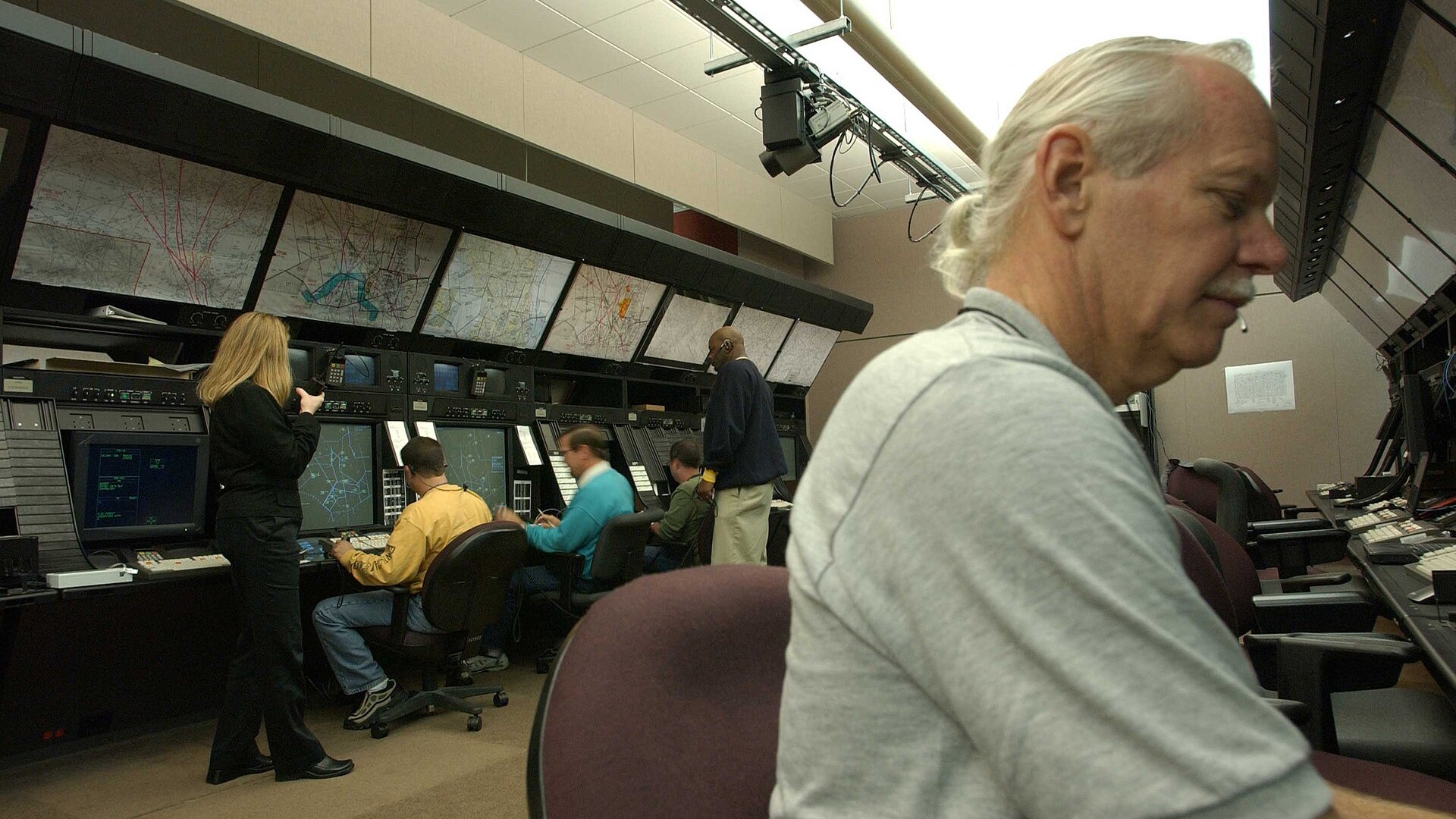
For about four and a half hours on Friday, almost nothing with wings left the ground in the United States. The cause wasn’t terrorists or a hostile government. According to the Trump administration, it was an air traffic control network still running on equipment that Congress has known for years was failing.
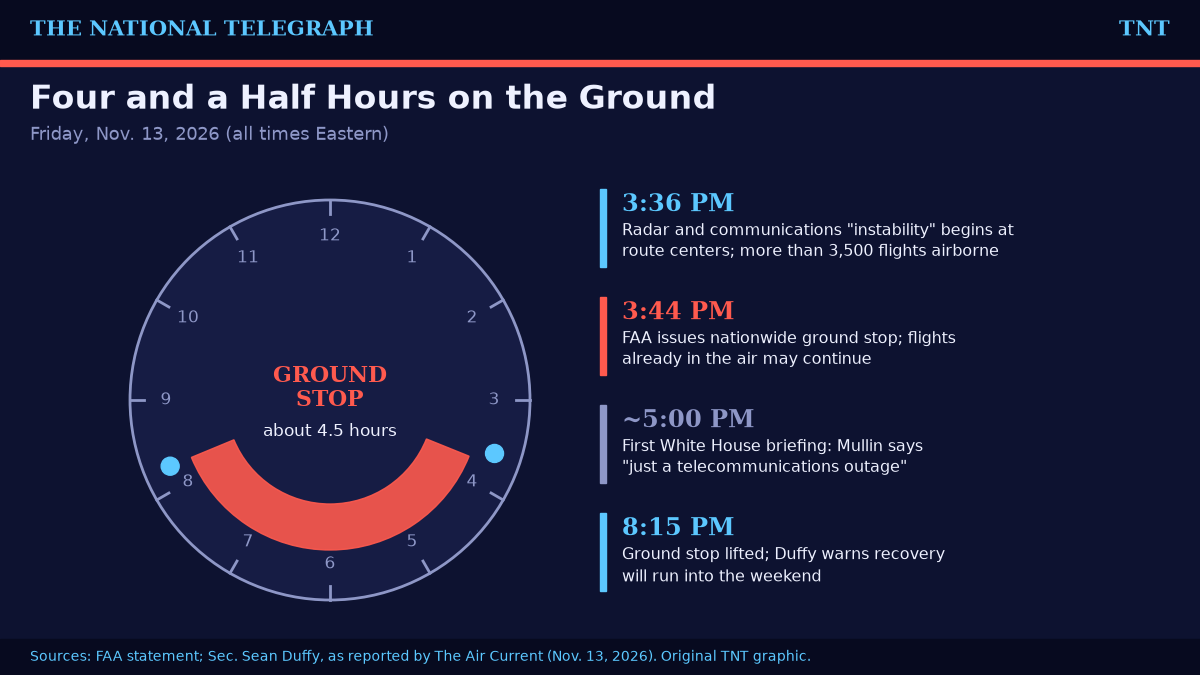
The Federal Aviation Administration issued a nationwide ground stop for all U.S. airports on Nov. 13 “following communication issues impacting multiple Air Route Traffic Control Centers,” the regional hubs that guide planes once they leave an airport’s airspace. Transportation Secretary Sean Duffy said radar and communications systems began showing “instability” at 3:36 p.m. Eastern, with more than 3,500 flights in the air. The stop went out at 3:44 p.m., according to The Air Current. Planes already airborne were allowed to finish their trips. Departures resumed at 8:15 p.m.
It was the longest nationwide ground stop since the Sept. 11, 2001, attacks. Thousands of flights were canceled, and Duffy warned the recovery would run into the weekend.
The first question everyone asked was whether America was under attack. Homeland Security Secretary Markwayne Mullin answered it at a White House briefing with Duffy on Friday evening.
“I just can’t say this enough: all of your loved ones are safe,” Mullin said, according to a DHS summary of the briefing. “We have seen zero evidence that this is a cyberattack or an SI attack. This is a national security risk because our air traffic control system is outdated and it hasn’t been a priority from Congress. This is what happens when Congress kicks the can down the road.”
Mullin said every relevant agency was pulled in, from CISA to the network operations centers inside DHS, with the NSA assisting. He also said “no one was in danger because of procedures we put in place,” and that the President “has declared this a national emergency.” Investigators are not ruling anything out yet. Officials said they were looking at whether the FAA’s new SMART scheduling tool, switched on at all 22 route centers on Nov. 10, played any part. Its developer, Air Space Intelligence, said on X that the ground stop was “not based on or a result of” its system.
Duffy’s explanation was blunt. “Our switches, our routers actually got overloaded with data,” he told reporters, and the inconsistent data they began producing forced the shutdown. “We have old, old switches, old routers. We use 1980s little copper lines,” he said, according to Fox Business.
Mullin described a system being upgraded piece by piece while still running: as the FAA installed new equipment, “that new equipment, new technology … was overwhelming the older system.” Duffy said the failure was on the legacy side. “By the way, all of the new equipment that we put in, none of that went down,” he said.
None of this is news to Washington. After the January 2023 NOTAM outage grounded flights nationwide, the FAA assessed its own air traffic control systems. The Government Accountability Office reported in September 2024 that 51 of the 138 systems were rated unsustainable and another 54 potentially unsustainable, and that some fixes were not scheduled to be finished for 10 to 13 years. A year earlier, GAO found the FAA had not updated the cost estimate for its long-running NextGen modernization program since 2017.
The Trump administration has been trying to change that. The July 2025 reconciliation law, the One Big Beautiful Bill, put $12.5 billion into what the FAA calls a brand-new air traffic control system. The plan includes replacing copper lines with fiber and wireless links, installing 27,000 new radios at 1,581 sites and 450 digital voice switches by 2028, and retiring systems that still rely on paper flight strips and floppy disks.
Duffy and White House budget director Russ Vought have called that money a down payment. On Thursday, the day before the outage, they formally asked appropriators for $30.1 billion more, Roll Call reported. By Friday night the ask was $50 billion, which Mullin described as the administration’s estimate for a “complete overhaul” rather than a patchwork.
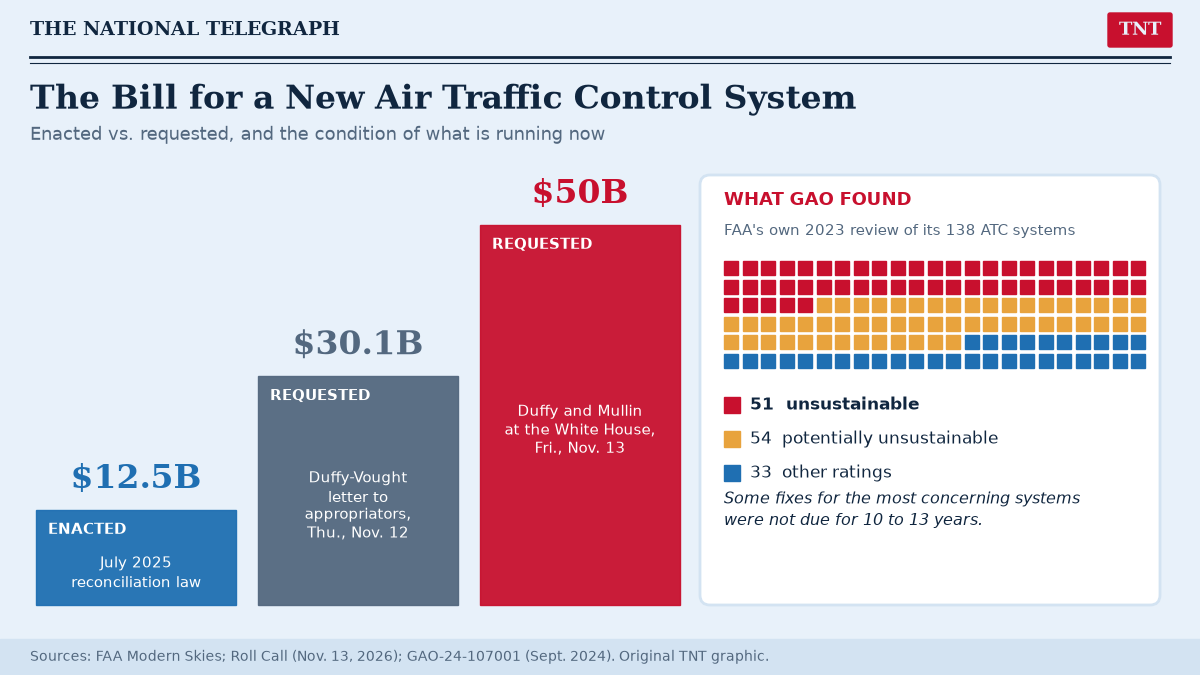
“This is an emergency,” Duffy said. “I want Congress to give us emergency funding. This is bipartisan. This is American. I want $50 billion.” He warned that without a full rebuild, “you will have more of these. You will have more of them unless the American people and the Congress tell us to build.”
“Nickel and diming it together does not work,” Mullin added.
Senate Commerce Committee Republicans pointed out that the reconciliation law already includes $1.9 billion to upgrade the route centers, and said the last time a new one was built, Lyndon Johnson was president. House Transportation and Infrastructure Chairman Sam Graves, R-Mo., and ranking member Rick Larsen, D-Wash., called the failures “concerning” and promised to “thoroughly review” what happened. Sen. Maria Cantwell, D-Wash., who is expected to take over the Commerce Committee when Democrats assume the Senate majority in January, said her panel would look at the FAA’s telecommunications too.
Reviews are fine. But Congress has had GAO’s warnings in hand for more than two years and its own hearings on air traffic control for decades. What it hasn’t done is pay to finish the job. The administration has a plan, a contractor base and a down payment already being spent. Lawmakers now have a lame-duck session and a weekend of stranded travelers to decide whether they would rather hold hearings about the next outage or fund the system that prevents it.
Sources: FAA statement on nationwide ground stop (Nov. 13, 2026); DHS, “ICYMI: Secretary Mullin and Secretary Duffy Address Nationwide FAA Ground Stop of All Flights” (Nov. 13, 2026); FAA Modern Skies program page; GAO-24-107001 (Sept. 2024) and GAO-24-105254 (Nov. 2023); The Air Current, Roll Call, Fox Business (Nov. 13, 2026).

 November 14, 2026 November 13, 2026
Leave a Reply