[…] Trump also repeated claims about Kansas and Michigan races that fact-checkers have challenged. Those include an unsupported suggestion that…

Written By TNT Staff, Posted on October 24, 2026
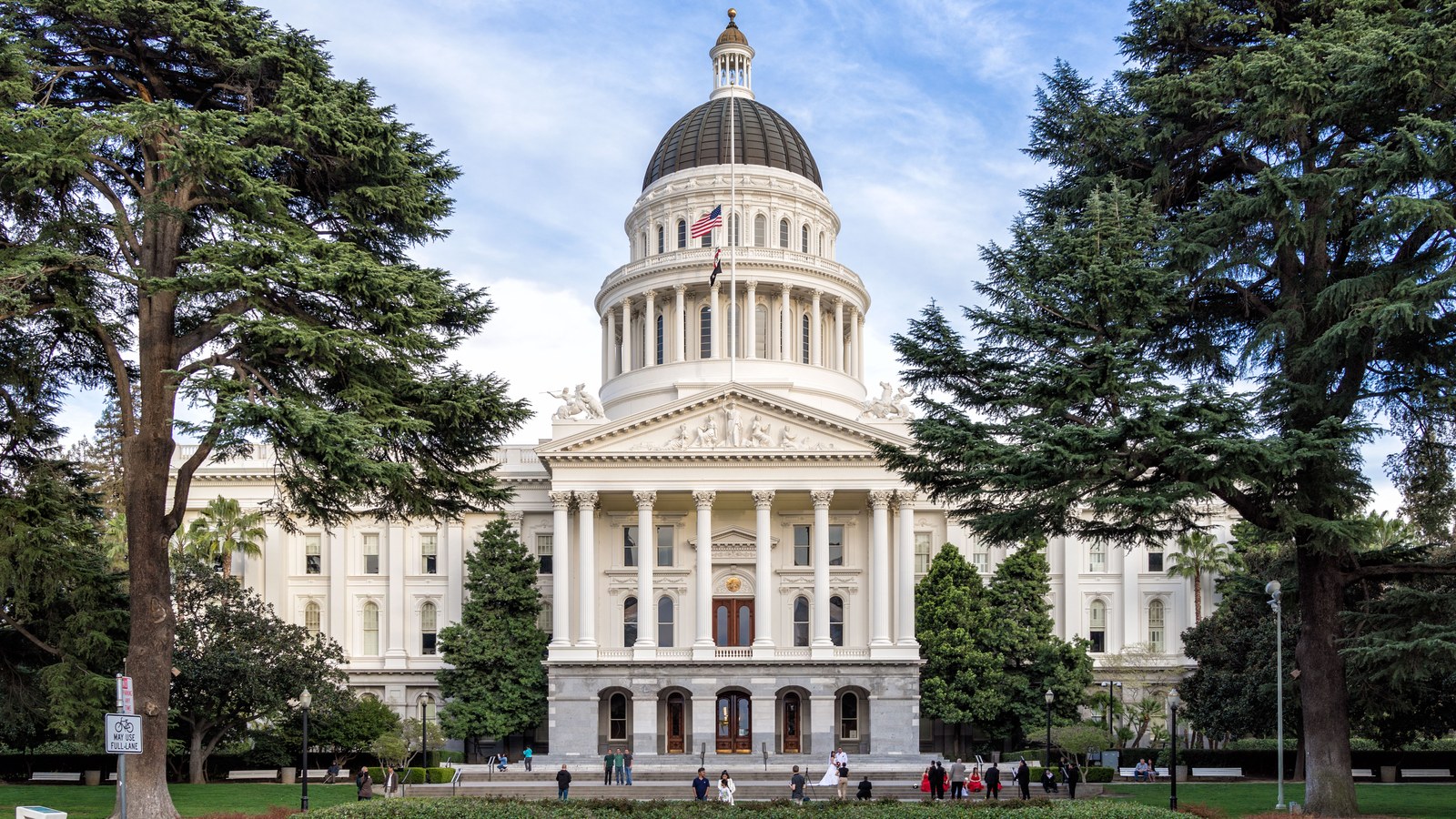
Featured photo: The California State Capitol in Sacramento. Photo: Andre m, CC BY-SA 3.0, via Wikimedia Commons.
The federal government handed California a list of more than 20,000 names. According to the Justice Department, each belongs to a likely noncitizen who was mailed a ballot for the Nov. 3 federal election. Washington asked the state to check those names and set aside any returned ballots until citizenship could be confirmed. California refused.
Now the Ninth Circuit Court of Appeals has ordered California and Los Angeles County to answer the Justice Department’s emergency motion by noon Pacific time today, Saturday, Oct. 24. That is 3 p.m. Eastern.
The request is narrow. In its Oct. 15 complaint in United States v. California (C.D. Cal. No. 2:26-cv-12025), the department asks the court to order California to do two things: set aside mail ballots from people federal agencies identified as likely noncitizens, and verify their citizenship, alone or with federal help, “before tabulating” those ballots.
Nobody’s ballot gets thrown out under that request. It gets held until someone confirms the voter is a citizen. Federal law, 18 U.S.C. § 611, already makes it a crime for noncitizens to vote in federal elections.
“We’re not asking California to take any drastic steps other than to sequester the ballots from the suspected noncitizens,” First Assistant U.S. Attorney Bill Essayli told Fox News. “We believe it’s at a minimum of 20,000. That’s the floor.”
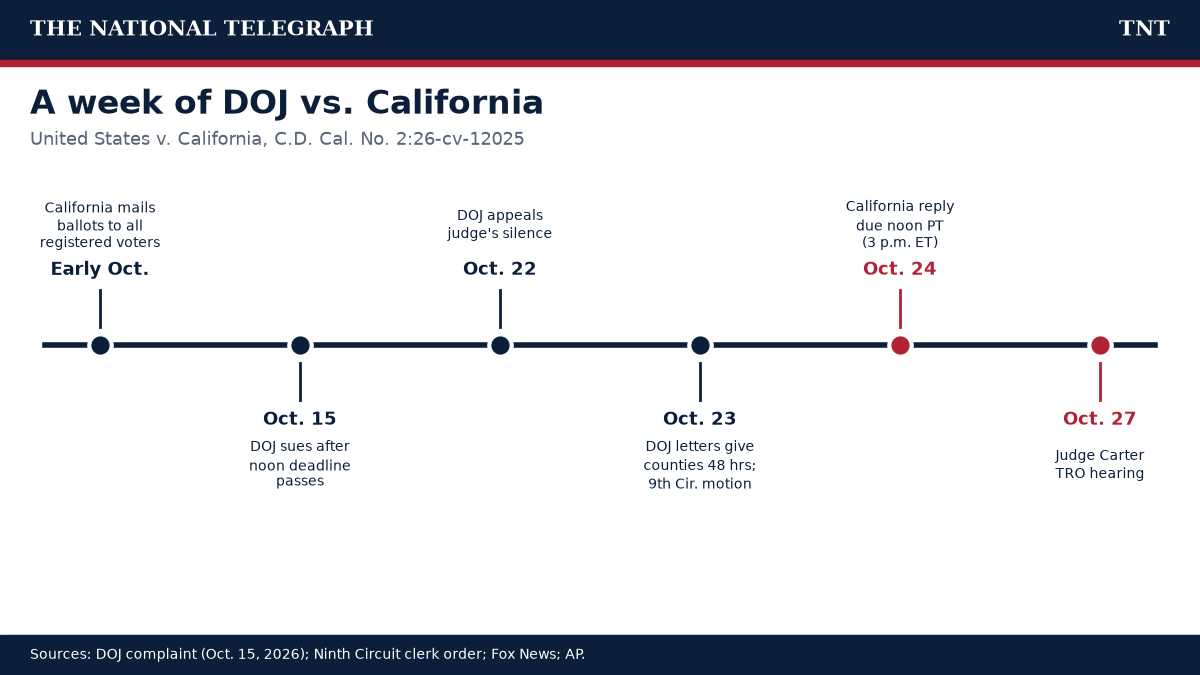
According to the complaint, federal officials warned California’s secretary of state months before ballots went out that a preliminary review had turned up “numerous likely noncitizens” on the rolls. They asked the state to work with them. California “made no serious effort to do so,” the complaint says, and mailed ballots to every registered voter in early October, as state law requires.
The complaint also says that instead of answering, the Los Angeles County registrar put out a press release saying her office had turned away “an encrypted thumb drive from a federal agent that identified likely noncitizen voters.”
California’s lawyers say county election offices lack the authority and the federal records to verify citizenship. They also say ballots that have already been processed can’t be pulled back out. Once a signature is verified, the ballot is separated from its envelope. Los Angeles County alone had processed 331,000 ballots, according to court records cited by Fox News.
That argument works against the state. If ballots can’t be traced once they are counted, the time to set questioned ones aside is before they are counted. That is exactly what DOJ asked for.
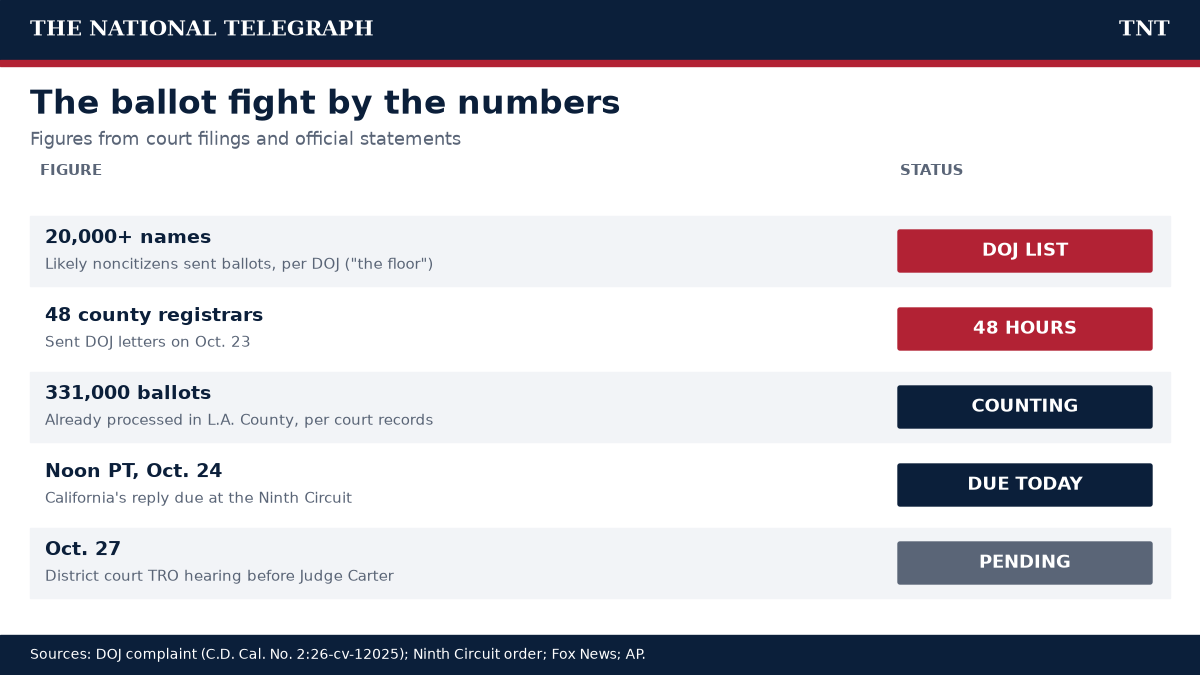
U.S. District Judge David O. Carter set a temporary restraining order hearing for Tuesday, Oct. 27. DOJ asked him to rule sooner, and he didn’t. On Oct. 22 the department treated that silence as a denial and appealed. On Friday it went to the Ninth Circuit for an injunction pending appeal, telling the court that officials “are presently counting potentially noncitizen ballots.”
“Every minute of processing that occurs without segregating the ballots of suspected non-eligible voters causes untraceable disenfranchisement and dilution of the votes of United States citizens,” the filing says.
On Friday DOJ also sent letters to county registrars across the state, giving them 48 hours to set aside the flagged ballots, the AP reported.
California argues there is nothing to appeal yet because the trial judge hasn’t ruled. Election law professor Rick Hasen called the Ninth Circuit’s Saturday deadline “a huge concession to the government.”
The federal government says it has names. It is offering to help verify them. All it asks is that a few thousand envelopes wait in a box until citizenship is confirmed. A citizen on that list loses nothing but a few days. A noncitizen on that list cancels out a citizen’s vote.
So why won’t Sacramento check?
As of Saturday morning, California’s response to the Ninth Circuit had not been filed. TNT will update this story when it is.

[…] Trump also repeated claims about Kansas and Michigan races that fact-checkers have challenged. Those include an unsupported suggestion that…
[…] TNT reported Oct. 15, Omar’s official birth year used to be 1981. Emails reported by the New York Post…

Very well presented. Every quote was awesome and thanks for sharing the content. Keep sharing and keep motivating others.
 October 24, 2026 October 23, 2026
Leave a Reply