[…] Treasury’s Nov. 20 designations of four Iranian oil trustees, which The National Telegraph reported this week. Both were carried…

Written By TNT Staff, Posted on November 25, 2026
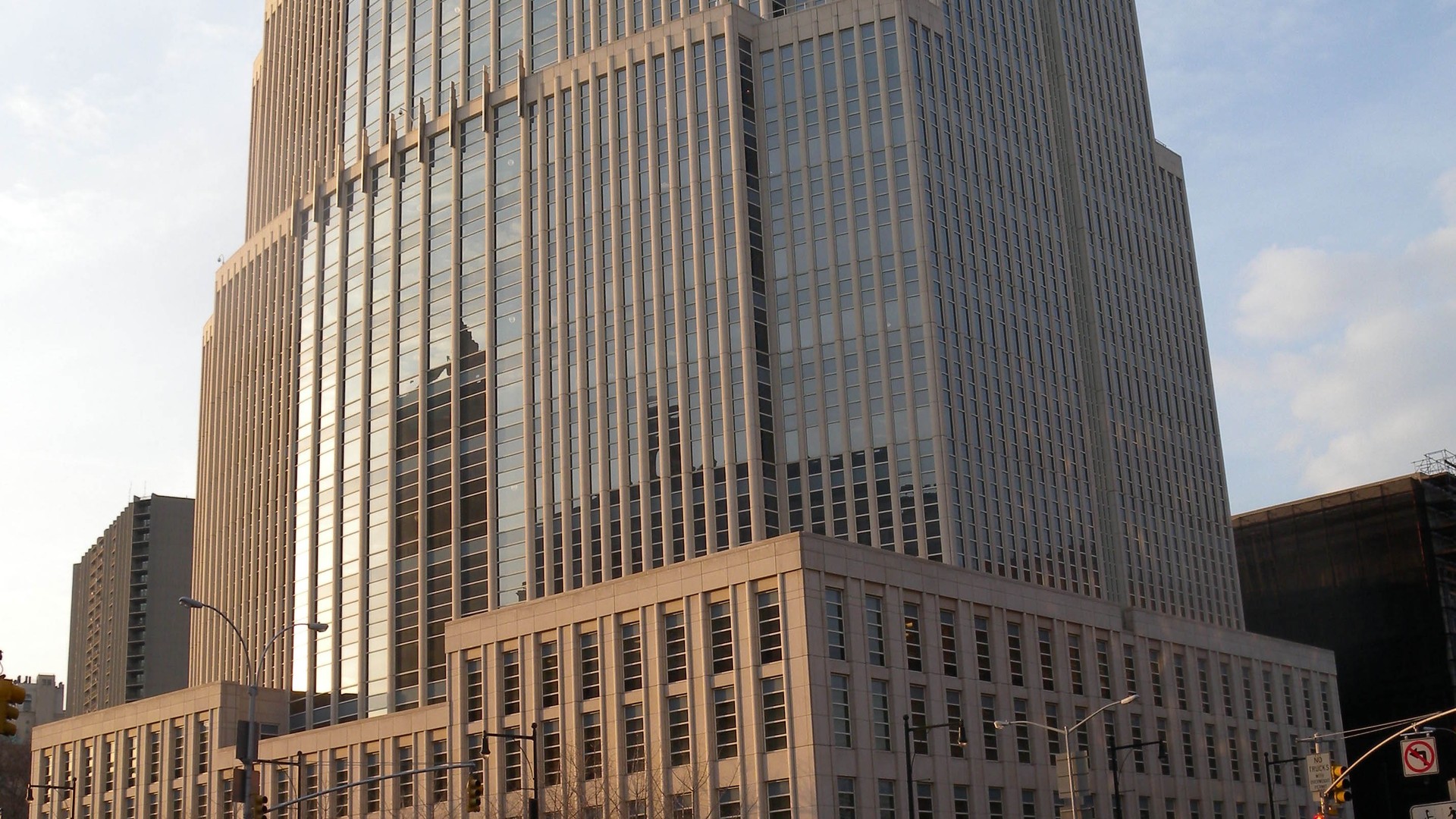
A federal jury in Brooklyn convicted Huawei Technologies and three of its subsidiaries on Nov. 24 of violating U.S. sanctions on Iran, lying to banks, stealing trade secrets from American companies, and laundering money, the Justice Department said, after a three-month trial in the Eastern District of New York.
The subsidiaries named in the announcement are the Chinese firm Huawei Device Co. Ltd. and the U.S. firms Futurewei Technologies Inc. and Huawei Device USA Inc. The department said the companies “engaged in a decades-long scheme to enrich Huawei and grow its telecommunications business, including in the United States, through criminal activities.”
“No person or company is above the law,” Attorney General Todd Blanche said. “For decades, Huawei and three of its subsidiaries conducted their business in the United States on the basis of lies and theft.”
U.S. Attorney Joseph Nocella Jr. for the Eastern District of New York said the case included “yearslong collaboration with sanctioned entities in Iran, repeated lies to banks, and blatant thefts from U.S. technology companies.”
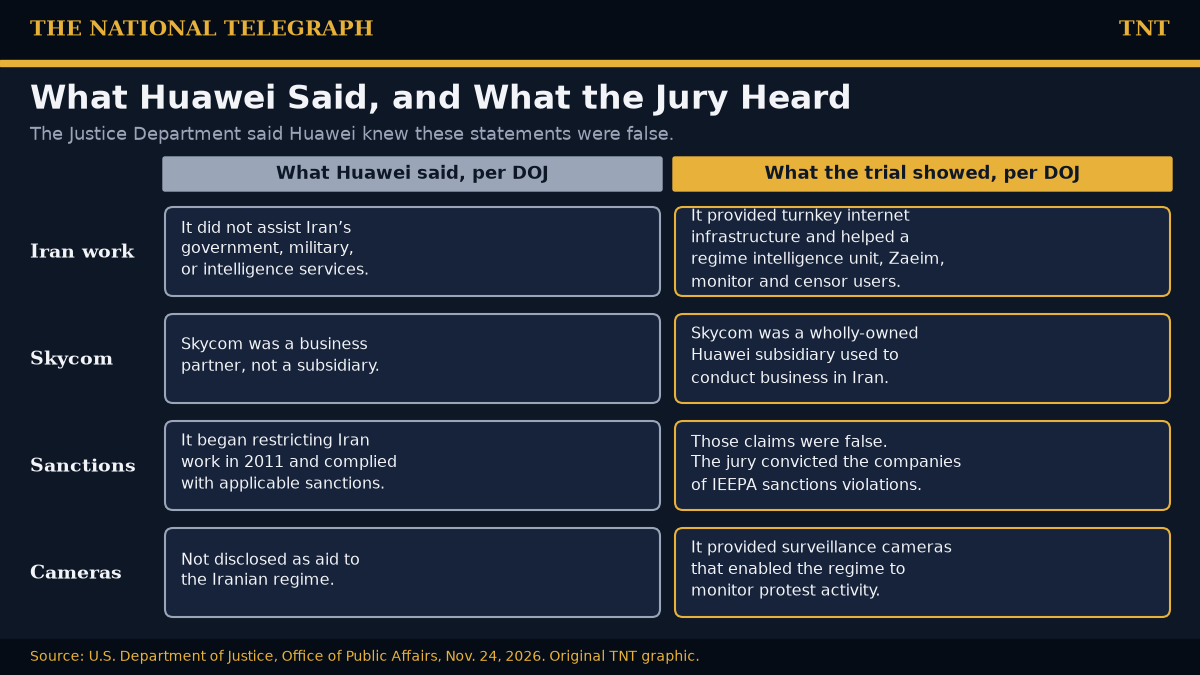
The Justice Department said Huawei assisted the Iranian government by providing turnkey services for an internet backbone and broader mobile-network access in the country. It also “helped the Iranian regime and a component of the Iranian intelligence apparatus, Zaeim, to monitor and censor its users’ access to the internet.” Testimony at trial, the department said, established that Huawei provided surveillance cameras that enabled the regime to monitor protest activity.
Huawei conducted that business in Iran under the name “Skycom,” the department said, and repeatedly lied about it. According to prosecutors, the company falsely told banks, journalists, and the U.S. government that it did not assist Iran’s government, military, or intelligence services; that it began restricting its Iran business in 2011; that Skycom was a business partner rather than a wholly-owned subsidiary; and that it complied with all applicable sanctions. “Huawei knew that all of those statements were materially false and misleading,” the announcement said.
The department said Huawei lied about its Iran work to banks in order to obtain “billions of U.S. dollars and access to U.S.-dollar clearing services.”
The jury also heard a long-running conspiracy to steal intellectual property from U.S. companies, including competitors and some purported business partners, the department said. The stolen material included trade secrets and copyrighted works such as source code and user manuals for internet routers, antenna technology, and robot testing technology.
Among the examples the department said were proved at trial:
Huawei signed a nondisclosure agreement with T-Mobile covering Tappy, a testing robot the carrier used to assess touch-screen responsiveness, “fully intending to violate the agreement.” Employees in the United States sent photographs and technical details of the robot back to China. When that was not enough, a Huawei employee “stole a part of the robot in his backpack and carried it out of T-Mobile’s controlled laboratory.”
Huawei copied source code used on Cisco routers, which the department said was identified as the “crown jewel” of Cisco technology. In what prosecutors called “a poorly conceived effort to hide their theft,” Huawei engineers left Cisco’s notes in the code, referred to Cisco backwards as “ocsic,” and described portions of the code as remaining as they existed in the “ocsic” code.
A Huawei employee caught photographing proprietary Fujitsu equipment, the department said, had a badge that identified him as an employee of “Weihua,” rather than Huawei.
When CNEX, a U.S. technology company, would not collaborate with Huawei directly, Huawei hired a university researcher to arrange the collaboration without disclosing that he was doing so for Huawei. That researcher then shared confidential information, including access to CNEX’s proprietary hardware, the department said.
Huawei also obtained confidential information from Quintel, a U.S. antenna manufacturer, under a nondisclosure agreement and “almost immediately” filed a patent application incorporating Quintel’s idea, attaching a confidential Quintel slide to the application, according to the department.
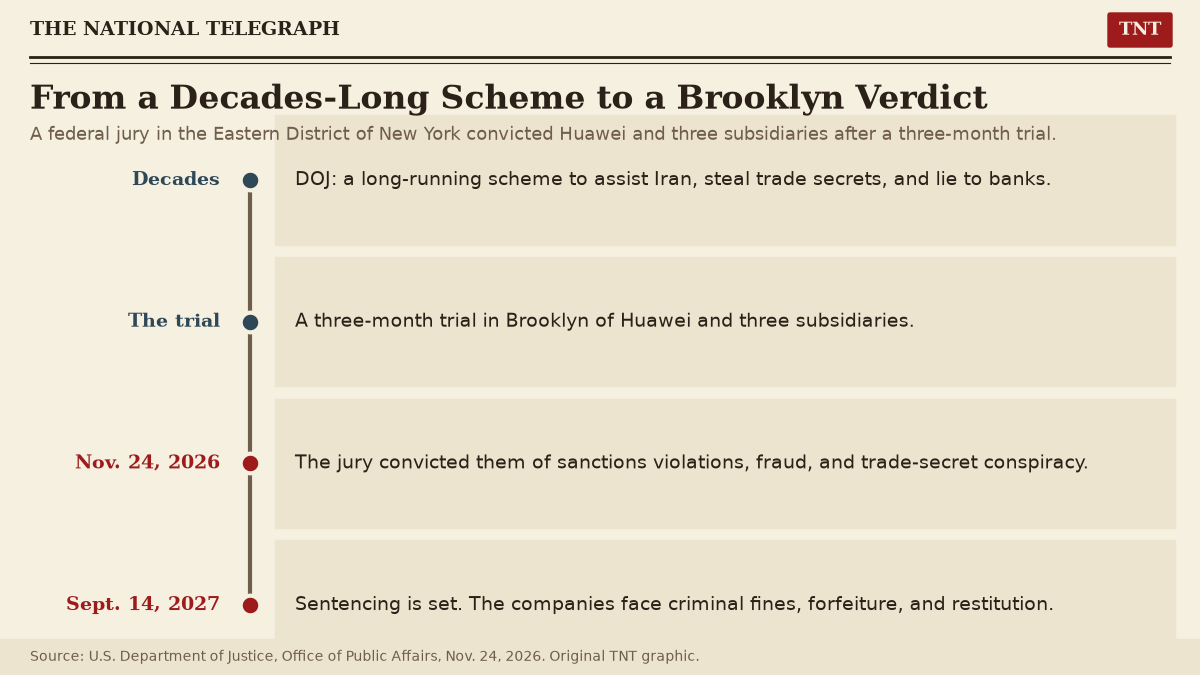
The jury convicted Huawei and the three subsidiaries of conspiracy to steal trade secrets; conspiracy to commit wire and bank fraud; wire fraud; bank fraud; conspiracy to defraud the United States; conspiracy to violate the International Emergency Economic Powers Act, and substantive IEEPA violations; and money-laundering conspiracy.
Sentencing is set for Sept. 14, 2027. The department said the defendants face financial penalties including criminal fines, forfeiture, and restitution. A federal district judge will determine any sentence after considering the U.S. Sentencing Guidelines and other statutory factors.
Assistant Director Roman Rozhavsky of the FBI’s Counterintelligence and Espionage Division called the case “a stark reminder that the Chinese government continues to pose a serious threat to our economic and national security.”
Sources: U.S. Department of Justice, Office of Public Affairs, “Chinese Tech Giant Huawei and Subsidiaries Convicted of Sanctions Violations, Fraud, Conspiracy to Steal Trade Secrets, and Money Laundering,” Nov. 24, 2026.

 November 25, 2026 November 25, 2026
Leave a Reply