[…] Desmond Domenico of Colorado to the U.S. Court of Appeals for the 10th Circuit, 51-46, the vote The National…

Written By TNT Staff, Posted on November 17, 2026
The U.S. Senate voted 70-27 Monday night to end debate on a bipartisan bill that would speed federal permits for energy, mining and infrastructure — the first major item on President Donald Trump’s lame-duck checklist to clear the 60-vote bar.
The vote was not final passage. It was cloture on substitute amendment No. 6883, offered for Sen. Shelley Moore Capito, R-W.Va., which replaces the text of H.R. 2347 with the Senate’s permitting-reform package, titled the Bipartisan American Affordability and Jobs Act of 2026. The Senate returns to that amendment this morning, post-cloture. A later cloture vote on the underlying bill still sits on the calendar. Because the vehicle is a House-passed bill, any Senate-passed version would have to go back to the House before it could reach the president’s desk — and it has to do so before Jan. 3, when the new Congress convenes.
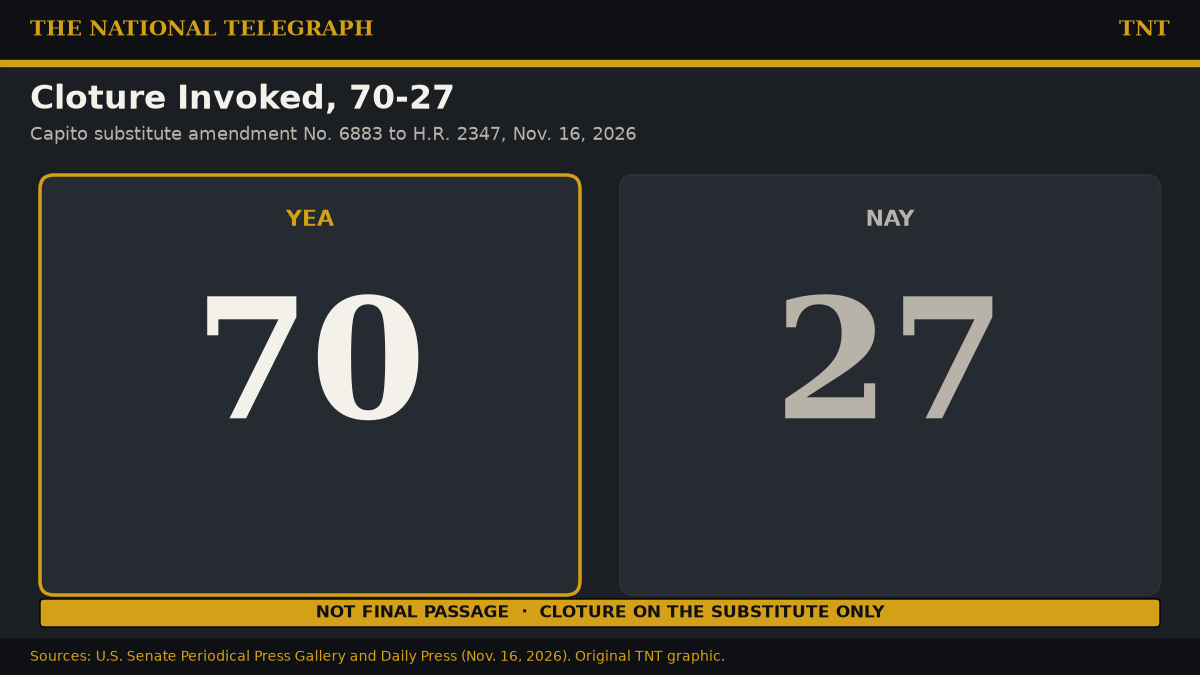
The Senate convened at 3 p.m. It first confirmed Daniel Desmond Domenico of Colorado to the U.S. Court of Appeals for the 10th Circuit, 51-46, the vote The National Telegraph reported Friday was set for 5:30 p.m. The cloture roll call on the Capito substitute began about 6:28 p.m. By 7 p.m., 70 senators had voted to invoke cloture, against 27 opposed. The Senate adjourned at 7:21 p.m.
The bill had already cleared two earlier tests. The Senate invoked cloture on the motion to proceed 73-25 on Nov. 9, then agreed to proceed 62-21 on Nov. 10. That night, Majority Leader John Thune, R-S.D., called up the Capito substitute for himself, Capito, Sen. Mike Lee, R-Utah, and Sens. Sheldon Whitehouse, D-R.I., and Martin Heinrich, D-N.M., according to the Congressional Record. On Nov. 11, Thune filed cloture on both the substitute and the underlying bill.
Seventy votes is 10 more than the Senate needed to break a filibuster. That is the point of a lame-duck session with a 60-vote threshold still in force: if this bill is going to become law, it has to do it now, with a bipartisan majority, before the new Congress convenes.
Capito, who chairs the Environment and Public Works Committee, released the substitute on Nov. 7 with Lee, the Energy and Natural Resources chairman, and the two committees’ Democratic ranking members, Whitehouse and Heinrich. The four had introduced the bill on Sept. 30.
“We have spent months working across party lines on both sides of Capitol Hill and with President Trump to deliver permitting reform that makes it easier to build in America,” Lee said when the substitute was released. “Our permitting system takes too long, costs too much, and leaves too much uncertainty for the people trying to build what our country needs. We have an opportunity to lower costs for American families, and get America building again.”
Capito said the substitute “preserves the foundation” of that bill, with “targeted changes based on feedback from our members and stakeholders to further build support.” She urged “swift passage of BAAJA to make life more affordable for American families.”
As introduced, the bill would change timelines and procedures under the National Environmental Policy Act, the Clean Water Act and the Endangered Species Act, and rewrite how the federal government permits electric transmission. Heinrich said the package “makes sure data centers pay for the energy they use and the grid upgrades they cause, instead of passing those costs on to New Mexico families.” The sponsors said the substitute kept that framework. The Senate is voting on the substitute, not on the September introduction draft word for word.
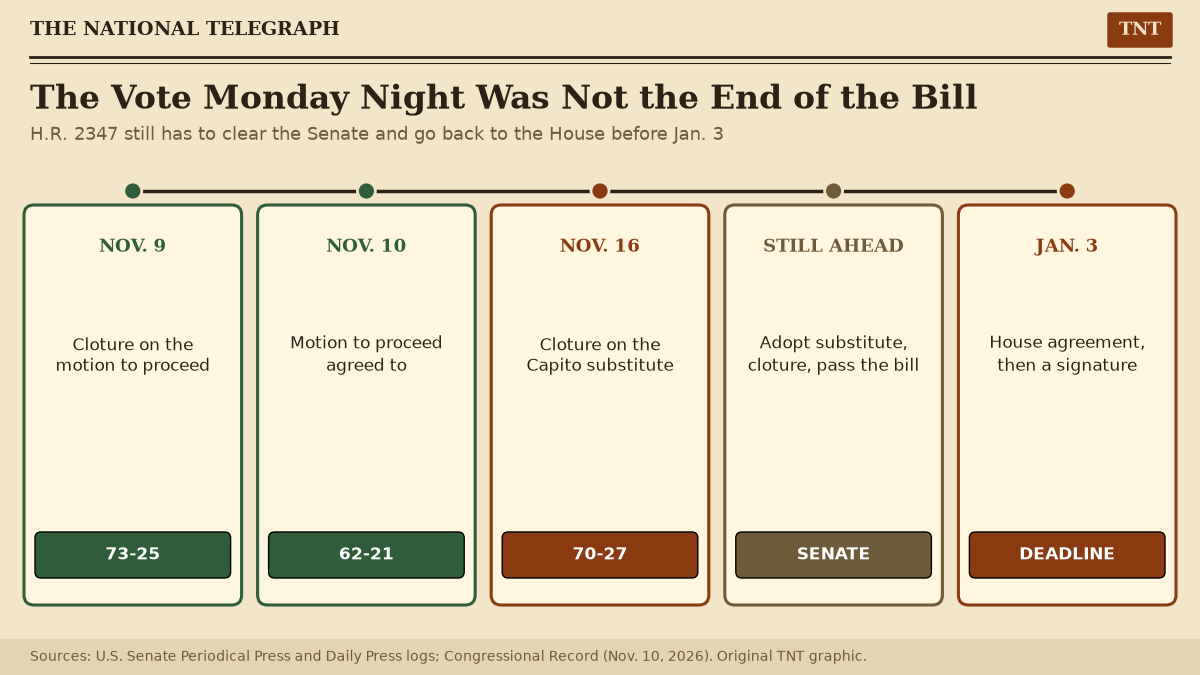
This morning the Senate convenes at 10 a.m. After leader remarks, it will resume consideration of the Capito substitute post-cloture. It will recess from 12:30 p.m. to 2:15 p.m. for the weekly party lunches. At 2:15 p.m., it is scheduled to vote on confirming Anna St. John to the 5th Circuit. The permitting bill will still need the Senate to adopt the substitute, invoke cloture on the bill itself, and pass it.
Then the House has to act. H.R. 2347 left the House as a tax bill. The Senate is using it as the vehicle for permitting reform. Whatever text the Senate passes has to go back to the House for agreement before it can reach the president. Trump put that bill near the top of a 50-day lame-duck checklist he posted Saturday, a list he attributed to Sen. John Kennedy, R-La., as The National Telegraph reported Sunday.
Seventy senators have now said the Senate should finish the debate and vote. A cloture vote is not a law. The House still has to finish the job, and it has to do it before January.
Sources: U.S. Senate Periodical Press Gallery and Daily Press floor logs (Nov. 9, 10, 11 and 16, 2026); Congressional Record (Nov. 10, 2026); Senate Committee on Environment and Public Works, release of the Capito-Lee-Whitehouse-Heinrich substitute (Nov. 7, 2026); S. 5653 as introduced (Sept. 30, 2026).

 November 17, 2026 November 16, 2026
Leave a Reply