[…] reported Wednesday on the Nov. 9 incident aboard United Flight 2174 from Newark to New Orleans. Authorities say […]
Written By TNT Staff, Posted on November 14, 2026
Mexico’s cartels don’t move cocaine to the U.S. border on their own. They rely on local partners who control the roads, airstrips, warehouses and border crossings farther south. On Friday, the Trump administration went after three of those partners in Guatemala, and it used terrorism authorities to do it.
The Treasury Department’s Office of Foreign Assets Control (OFAC) sanctioned the Los Mendoza and Los Huistas drug trafficking organizations on Nov. 13 for providing material support to the Sinaloa Cartel and, in Los Huistas’ case, the Cartel de Jalisco Nueva Generación (CJNG). At the same time, Secretary of State Marco Rubio designated a third clan, Los Lorenzanas, as a Foreign Terrorist Organization (FTO) and Specially Designated Global Terrorist (SDGT).
“Today’s action exposes the ties between politically influential Guatemalan criminal organizations and Mexican foreign terrorist organizations that facilitate the flow of deadly narcotics into the United States,” said Treasury Secretary Scott Bessent.
According to Treasury, both groups control strategic trafficking corridors along Guatemala’s borders with Honduras and Mexico, which makes them “indispensable logistics partners” for the two Mexican cartels. They handle the receipt, storage, protection and cross-border movement of drugs headed for Mexico and then the United States.
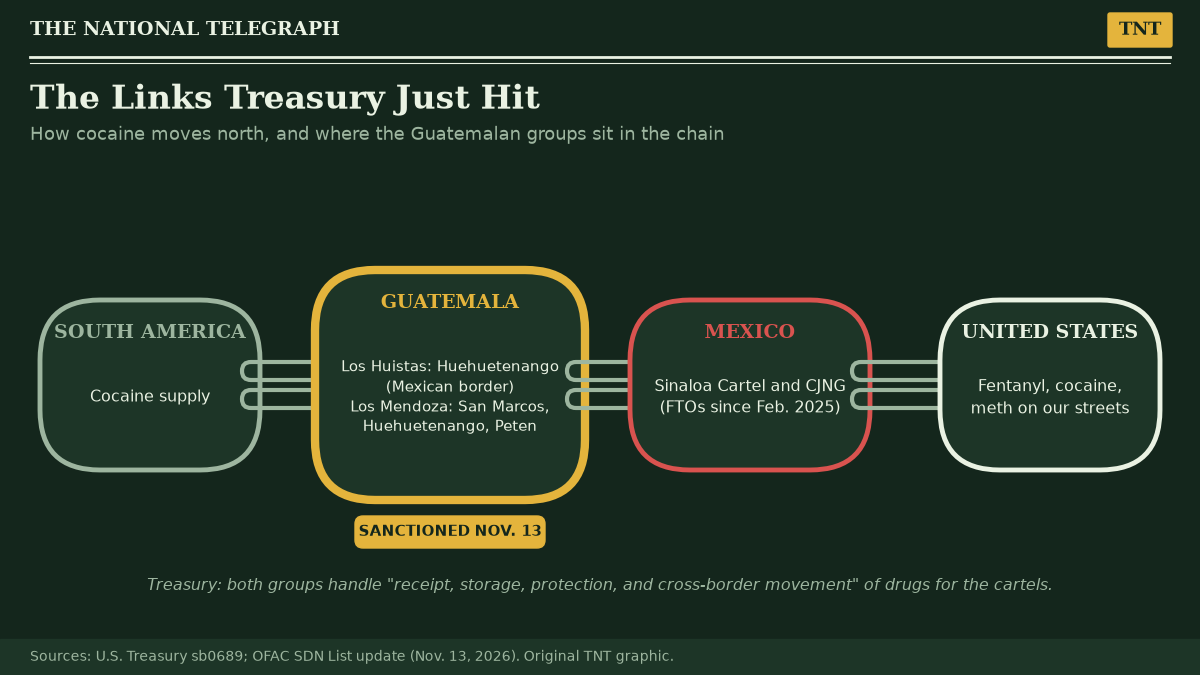
Los Mendoza, founded in the 1980s, is described by Treasury as one of Guatemala’s oldest and most powerful criminal organizations. The family-based group works as a transportation and logistics intermediary for the Sinaloa Cartel, giving it access to border crossings, clandestine airstrips, storage facilities and local protection networks in the departments of San Marcos, Huehuetenango and Petén. Treasury says the group is also involved in contract killings and money laundering, and has built up land, cattle ranching, agricultural and real estate holdings across Petén, Izabal and the Mexican border region, in part through land dispossession. OFAC’s listing places it in Guatemala, Honduras and Belize.
Los Huistas, active since the 1990s, is what Treasury calls “a critical link in the cocaine trafficking supply chain from South America through Mexico and ultimately into the United States.” OFAC lists it in Santa Ana Huista, San Antonio Huista and La Democracia in Huehuetenango, along the Mexican border, and links it to both Sinaloa and CJNG.
The most important line in the release may be the one about protection. Treasury says Los Huistas’ “longstanding ties to local businessmen, law enforcement officials, and politicians” let it dominate parts of northwestern Guatemala, and that the group “cultivated political influence and institutional access” that helped shield it from law enforcement.
Treasury did not name any officials. But the State Department made the same point more sharply: “We will not stand by while these foreign terrorist organizations corrupt Guatemala’s institutions.” For anyone in Guatemala’s political or business class who has been doing favors for these groups, the message is that Washington is now watching who sits on the other side of the table.
This is where the administration’s decision to treat cartels as terrorists pays off. Los Huistas is not new to OFAC. Treasury sanctioned it under a drug-trafficking order back in March 2022. What changed on Friday is the legal toolkit.
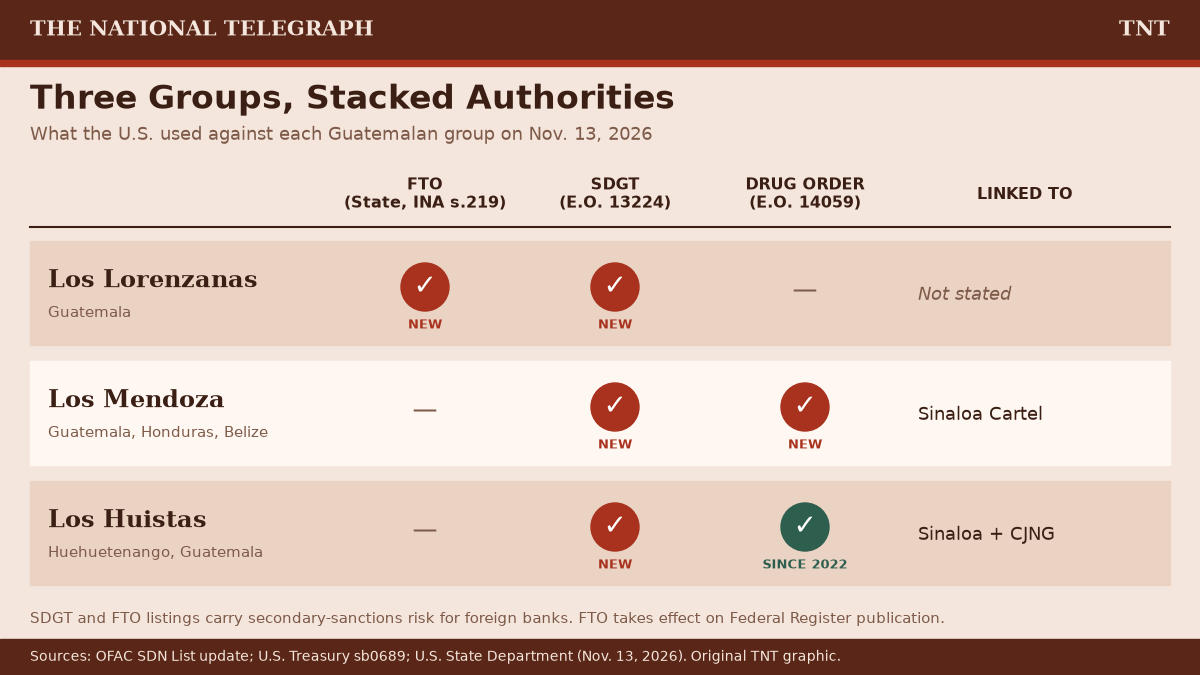
Because the Sinaloa Cartel and CJNG were designated as FTOs and SDGTs on Feb. 20, 2025, the groups that supply them can now be targeted under Executive Order 13224, the counterterrorism order, for providing “material support.” The OFAC listings for both Los Mendoza and Los Huistas now carry a “secondary sanctions risk.” That means a foreign bank that knowingly handles a significant transaction for them can be barred from, or put under strict conditions on, the U.S. correspondent accounts it needs to move dollars. For groups that launder money through land, cattle and real estate, that is a real threat.
The FTO designation of Los Lorenzanas, which takes effect once it is published in the Federal Register, goes further. Under U.S. law, knowingly providing material support to a designated FTO is a federal crime. State describes Los Lorenzanas as one of Guatemala’s most powerful drug clans, “responsible for numerous acts of violence against civilians, government officials, and military forces.”
All property of the designated groups in the United States or held by U.S. persons is now blocked, and Americans are generally barred from doing business with them.
Friday’s actions show what treating cartels as terrorists looks like in practice. Washington is no longer only going after the cartel bosses in Sinaloa and Jalisco. It is going after the trucking, storage and protection networks two borders south, using the same tools it built to choke off funding for al-Qaeda and Hezbollah.
“The Trump Administration will continue to use all available tools to protect our nation by keeping illicit drugs off our streets and disrupting the revenue streams funding violent narcoterrorists,” Rubio said.
The next step to watch is the names. Treasury has now said publicly that these organizations have friends in Guatemalan politics and law enforcement. If the U.S. follows the money, individual designations of the officials who protected these routes would be the logical next move.
Sources: U.S. Department of the Treasury press release sb0689 (Nov. 13, 2026); OFAC Recent Actions, Counter Narcotics and Counter Terrorism Designations (Nov. 13, 2026); U.S. Department of State, “Foreign Terrorist Designations of Guatemalan Groups” (Nov. 13, 2026).

 November 14, 2026 November 14, 2026
Leave a Reply