[…] that some Democratic members had already called him. We covered why the Founders built that veto in “Mr. Veto”…
Written By B.J. Dichter, Posted on November 7, 2026
The U.S. Treasury Department has sanctioned eight Canadian money services businesses that it says helped the Iranian regime move money around the world. Expect some commentators to make this a story about Bitcoin. It isn’t.
On Nov. 6, Treasury’s Office of Foreign Assets Control (OFAC) designated the eight firms, based in Ontario and British Columbia, as part of what it calls Operation Economic Outcast. According to Treasury, the businesses exchanged Iranian rials and other currencies for digital assets so that transactions involving Iran could move across borders. Many of them dealt with Iranian crypto exchanges the U.S. had already sanctioned, and with digital asset addresses tied to Iran’s Islamic Revolutionary Guard Corps (IRGC).
“Canada cannot be a safe haven for illicit financial facilitators that provide sanctions evasion services to the Iranian regime and its proxies,” said Treasury Secretary Scott Bessent. “Treasury will pursue and disrupt the Iranian regime’s financial channels anywhere in the world.”
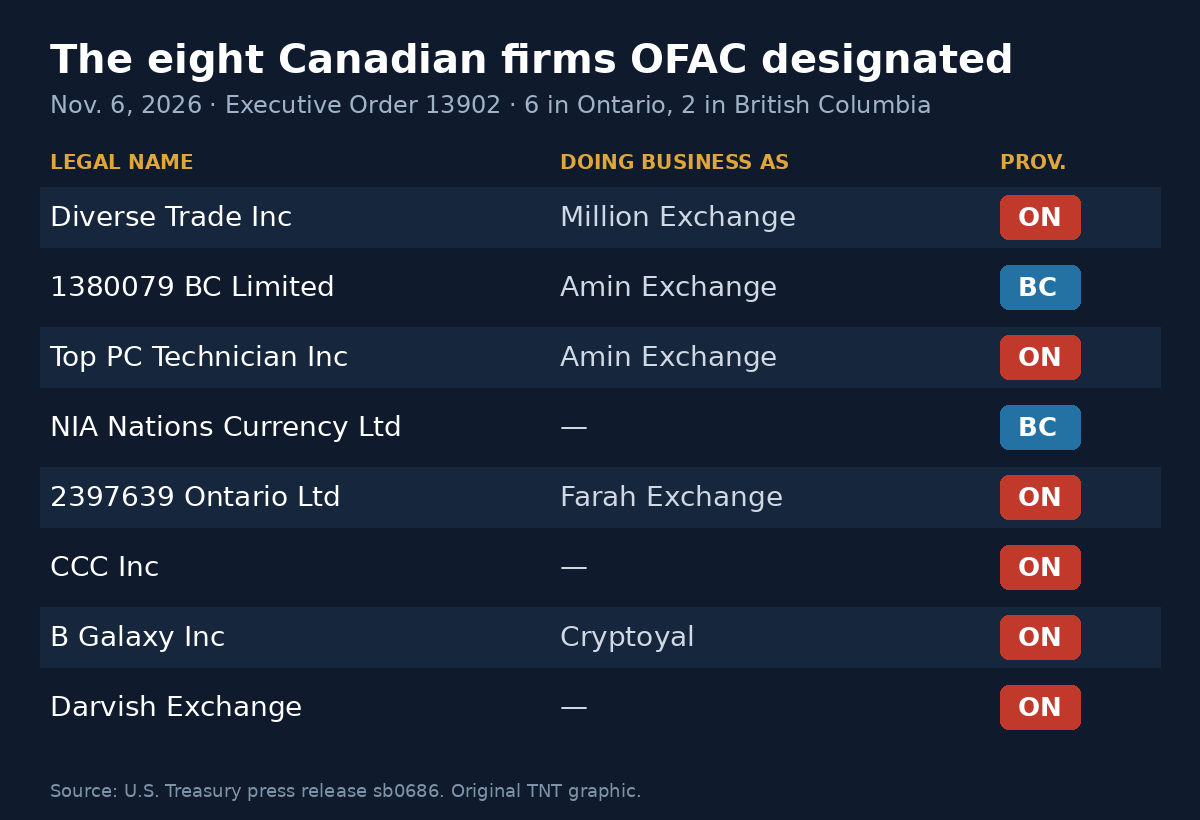
According to the Treasury release:
Treasury says several of the firms changed their business names and addresses to avoid detection. It also says that even though Canadian and international media had flagged the risks, the businesses “remain operational.”
The action was coordinated with FinCEN, Canada’s financial intelligence unit FINTRAC and the Drug Enforcement Administration. The designations were made under Executive Order 13902. Any of the firms’ property in the U.S. or held by U.S. persons is now blocked, and Americans are generally barred from dealing with them.
Several of the firms also worked with Ryan Wedding, the former Olympic snowboarder turned OFAC-sanctioned drug trafficker. Treasury says Wedding used money exchange businesses around Vancouver and Toronto to launder billions of dollars in drug proceeds. Couriers carried bulk cash to the shops, which converted it to digital assets and sent it abroad. Wedding was apprehended in January 2026.
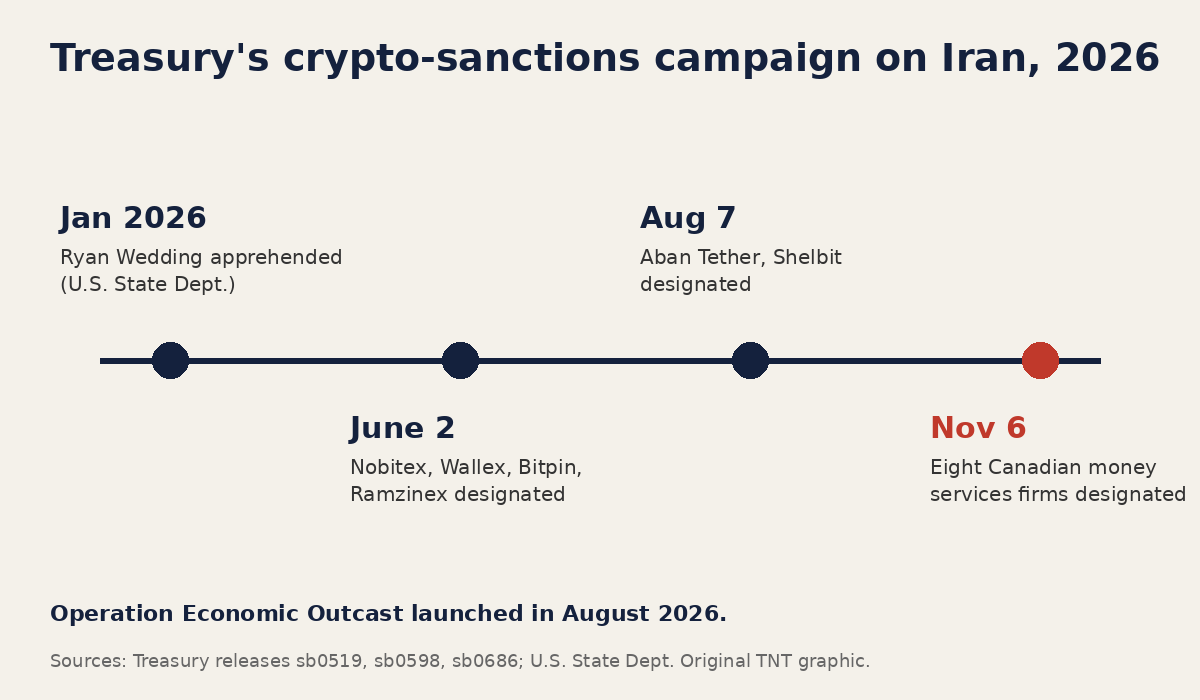
The Canadian action follows Treasury’s June 2 designations of Iranian exchanges Nobitex, Wallex, Bitpin and Ramzinex, and its Aug. 7 designations of Aban Tether Exchange and Shelbit.
Bitcoin is just an asset, much like the U.S. dollar is just the currency most drug dealers and organized criminals use. The problem here is the institutions: storefront exchanges operating openly, with Iranian branding, while moving money for the IRGC and drug traffickers.
In my view, that is the result of a lack of due diligence by Canada and by Canadian politicians who have allowed IRGC terrorists into the country to build infrastructure meant to subvert Western nations and attack the United States. Treasury itself notes that Canada is home to hundreds of money services businesses that move funds into and out of Iran. Some had already been flagged in the media, and they are still open for business. That is a failure of oversight, not of technology.
It’s worth remembering who Ottawa went after the last time it got serious about money. During the 2022 Freedom Convoy, the Trudeau government was locking people in their homes and freezing bank accounts. For peaceful, working-class Canadians who had never been charged with a crime, Bitcoin was the only way to receive crowdfunded donations from people all over the world.
So the same country that could find and freeze truckers’ bank accounts could not, or would not, shut down exchange shops that Treasury says were moving money for the IRGC.
The lesson is not to fear Bitcoin. It’s to demand that Canada police the institutions that serve the regime in Tehran with the same energy it once used against its own citizens.
B.J. Dichter is a contributor to TNT.
Sources: U.S. Treasury press release sb0686 (Nov. 6, 2026); OFAC recent actions, Nov. 6, 2026; Treasury releases sb0519 and sb0598; U.S. State Department, Ryan Wedding.

B.J. Dichter is a contributor to The National Telegraph and the producer and creator of Not On Record, a weekly podcast on politics and culture. He produces Open College with philosopher Stephen Hicks and hosts Coffee with BJ, his live show. A former trucker, he was a spokesperson for the 2022 Freedom Convoy and wrote about it in Honking For Freedom. He writes from a classical liberal, libertarian conservative perspective on free speech, Canadian and US politics, Israel and Bitcoin.
 November 7, 2026 November 7, 2026
Leave a Reply