[…] Every court said no. U.S. District Judge David Carter rejected the request first. Then a divided 9th Circuit panel…

Written By TNT Staff, Posted on November 3, 2026
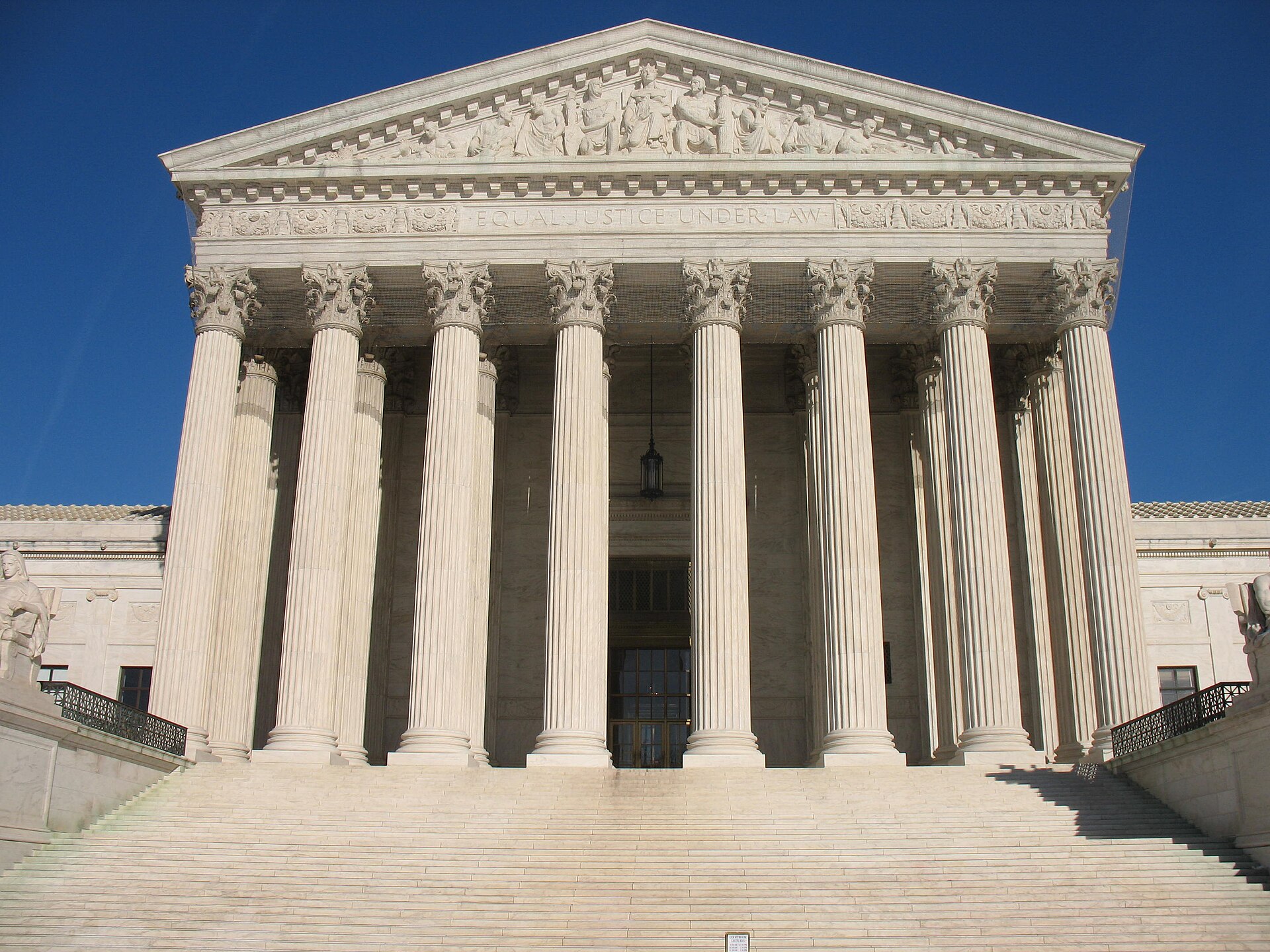
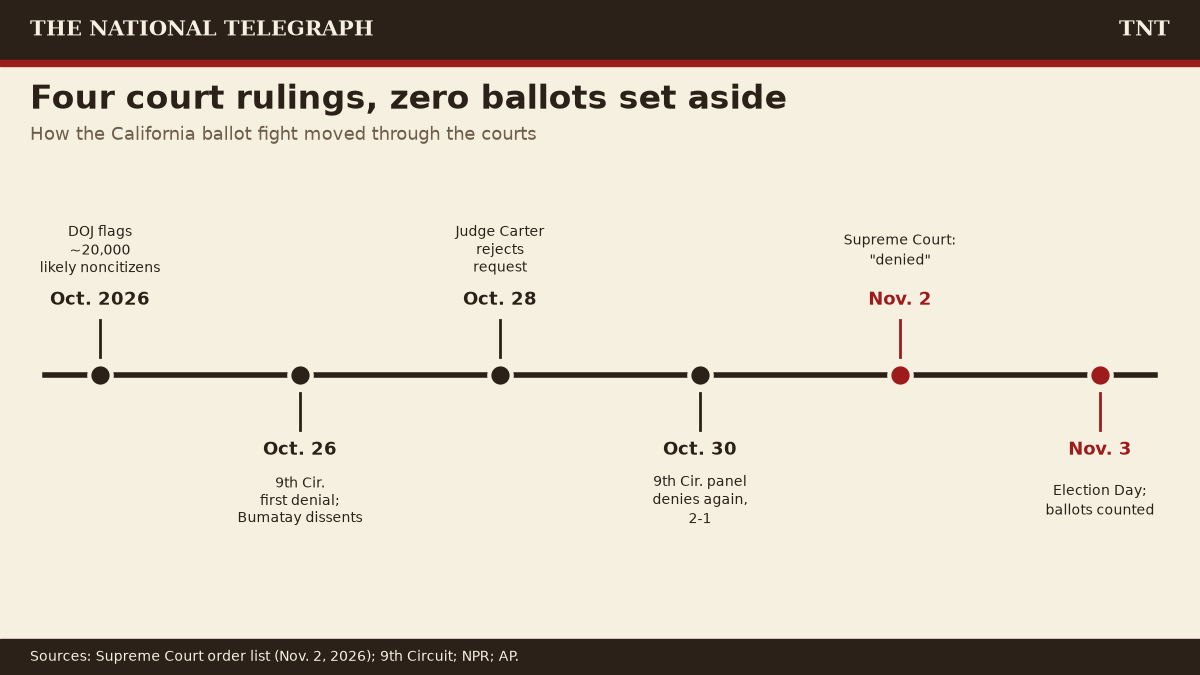
The Supreme Court on Monday night turned down the Justice Department’s last-ditch request to make California set aside mail ballots from roughly 20,000 people the federal government flagged as likely noncitizens. The order in United States v. California (No. 26A624) is one sentence long: the application, “presented to Justice Kagan and by her referred to the Court is denied.” No justice noted a dissent, and none explained the decision, which is normal for emergency applications.
So the ballots get counted today with everyone else’s. Once they are opened and mixed in, nobody will be able to pull them back out.
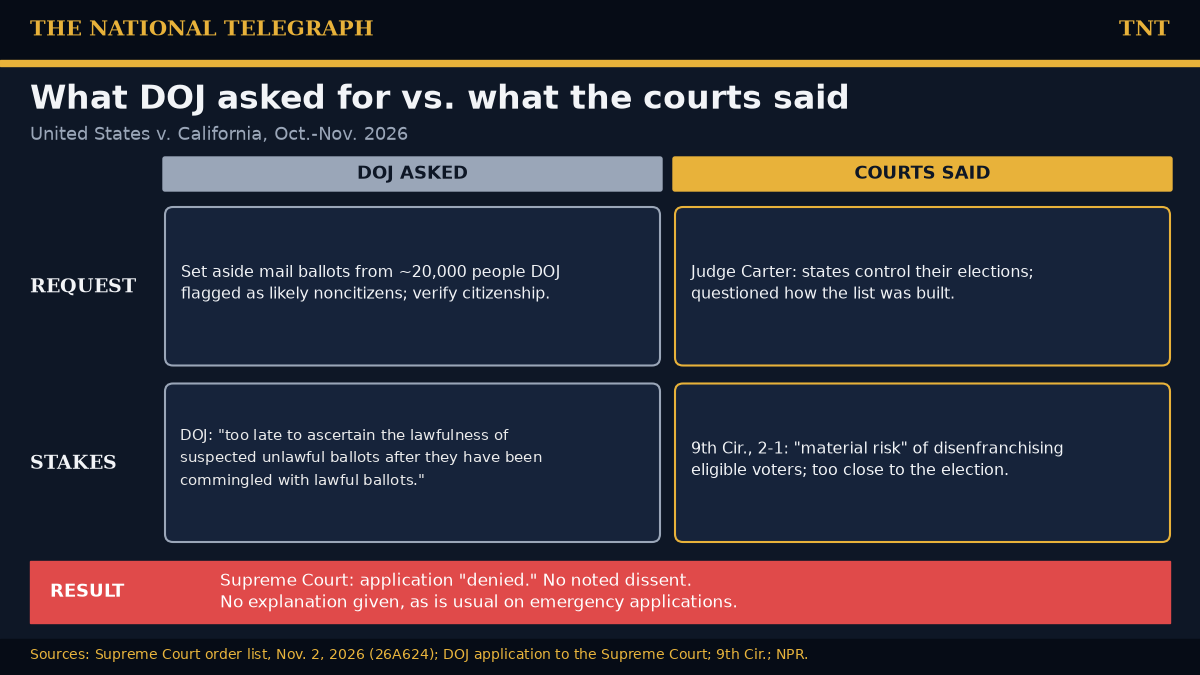
The Justice Department was not asking California to throw out votes. It asked the state and Los Angeles County to set aside ballots from people on its list until their citizenship could be checked. Counting first would make it “too late to ascertain the lawfulness of suspected unlawful ballots after they have been commingled with lawful ballots,” DOJ wrote in its application to the Supreme Court.
Every court said no. U.S. District Judge David Carter rejected the request first. Then a divided 9th Circuit panel ruled that there was a “material risk that granting the United States its requested relief would result in disenfranchisement and could jeopardize the County’s entire election.” Judge Patrick Bumatay, a Trump appointee, dissented. He called setting ballots aside a “modest” remedy, as TNT reported Friday.
The list has problems. NPR reports that UCLA’s Voting Rights Project got the list through a court order in a separate case and found that 42% of the names do not appear on California’s current voter roll, and that some naturalized citizens are on it. County officials say many people on the list had no active registration and were never mailed a ballot, so the real number of disputed ballots is probably well under 20,000.
The courts also leaned on two old principles. The Purcell principle says judges should not change election rules on the eve of an election. And the Constitution gives states the power to run their own elections. The National Voter Registration Act also bars states from systematically removing voters within 90 days of a federal election.
Those are fair points, and the timing is on Washington. If the government thought thousands of noncitizens were on California’s rolls, it should have pressed the issue months ago, not in the last weeks before Election Day.
Here is the real problem. Federal law already makes it a crime for noncitizens to vote in federal elections (18 U.S.C. 611). But no federal law requires anyone to prove citizenship before registering. The federal registration form asks applicants to attest that they meet the requirements, including citizenship, and sign under penalty of perjury. That puts the burden on catching problems after the fact, and as this case shows, after the fact is often too late.
A court can’t fix that, and it shouldn’t try to on the night before an election. A judge who orders thousands of ballots set aside with days to go is rewriting election rules from the bench. That’s the kind of thing conservatives object to when the other side does it.
The fix belongs to Congress. The SAVE America Act would require documentary proof of citizenship, such as a passport or birth certificate, when someone registers to vote, plus photo ID to vote, PBS reports. The House passed it 218-213 on Feb. 11, 2026, according to the Congressional Research Service, but it has stalled in the Senate, where it needs 60 votes under the filibuster and a March 26 cloture vote on an amendment to it fell short, 53-47. Republicans hold 53 seats.
A rule written in advance, applied the same way in every state, and checked at registration instead of in an emergency filing would protect lawful voters and the count alike. Without it, every close race will produce another round of lists, lawsuits and late-night orders. And every time, the ballots will already be in the pile.

 November 3, 2026 November 3, 2026
Leave a Reply