[…] Trump also repeated claims about Kansas and Michigan races that fact-checkers have challenged. Those include an unsupported suggestion that…

Written By TNT Staff, Posted on October 28, 2026
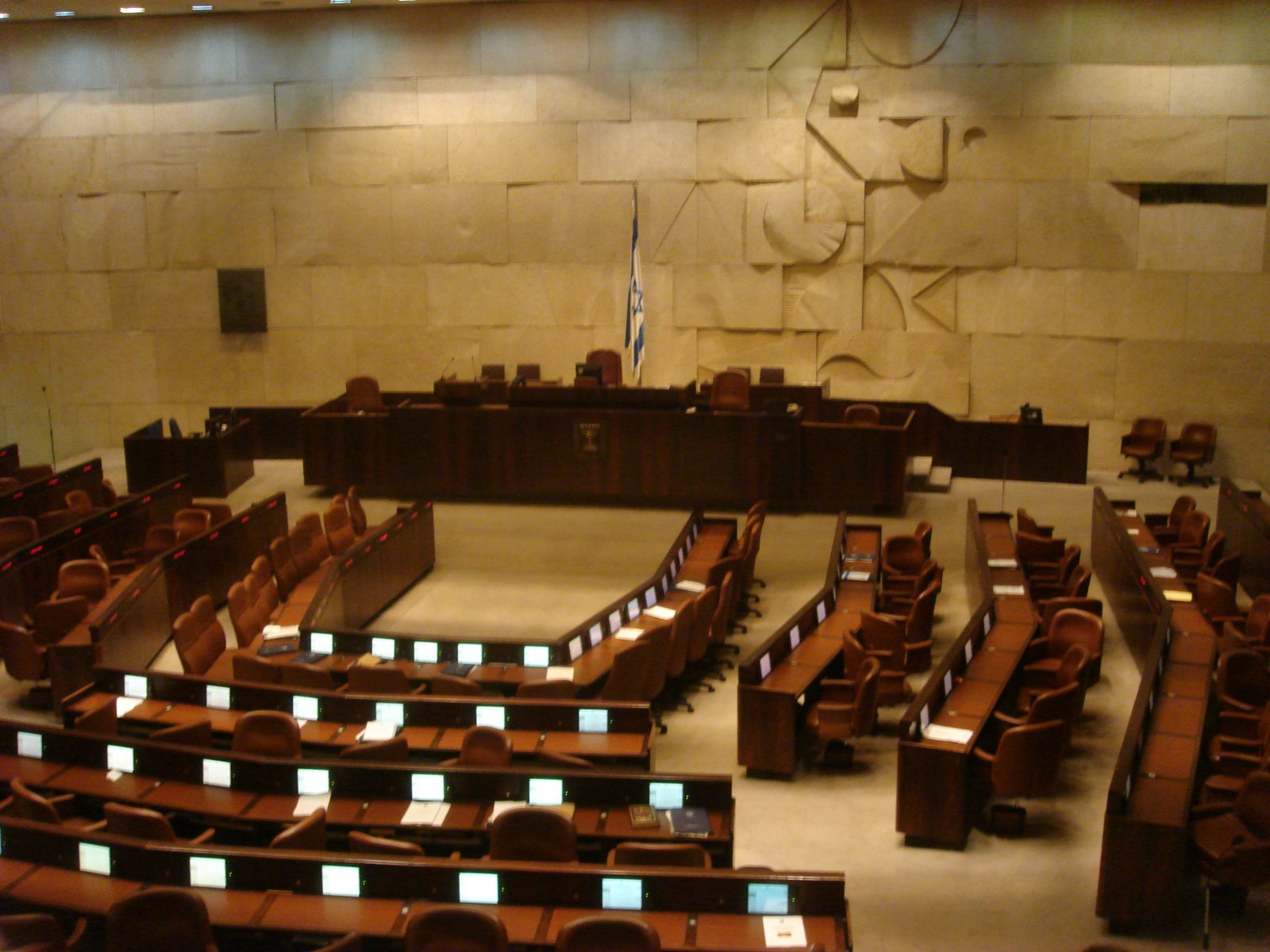
Featured photo: The Knesset plenum hall in Jerusalem. Photo by he.wikipedia user בית השלום, via Wikimedia Commons (attribution license).
Israel voted on Tuesday, and on Wednesday nobody had won. With 85.6% of votes counted as of 2:32 p.m. Israel time (8:32 a.m. ET), partial results from the Central Elections Committee give Prime Minister Benjamin Netanyahu’s bloc 53 seats and the bloc led by Gadi Eisenkot’s Yashar 48, The Times of Israel reported. A government needs 61 of the Knesset’s 120 seats. The two Arab-led lists, the Joint List and Ra’am, hold the remaining 19, a record, up from 10 in the outgoing Knesset.
Those are not final numbers. About 7% of ordinary ballots still need extra checks, and double-envelope ballots, cast mainly by soldiers, police, diplomats and prisoners, have not been counted. The Central Elections Committee now estimates 430,000 to 480,000 of them, fewer than the roughly 600,000 first reported and about 12 seats’ worth. It says the full count is due Thursday afternoon, with official results expected Nov. 4. The Times of Israel notes that these ballots have traditionally skewed away from Arab and Haredi parties, and its analysis says they are unlikely to break the stalemate.
Likud has already cried foul. It accused the Arab parties of having “stolen” the election through bribery, threats and fraud and demanded a police and Shin Bet investigation. A committee official dismissed fraud claims on Channel 12, and the committee said it would examine Likud’s complaint in its routine post-election review, Haaretz reported.
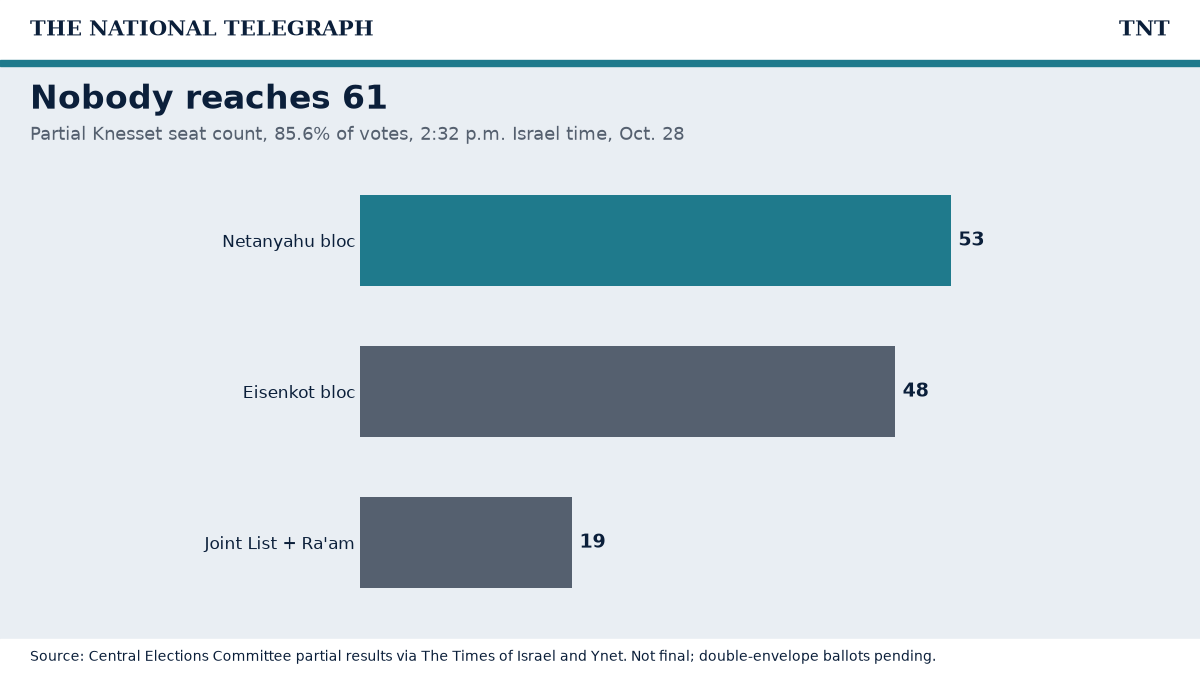
According to Ynet’s breakdown of the same count, Likud leads with 26 seats, followed by United Torah Judaism, Shas and Otzma Yehudit with 7 each and Religious Zionism with 6. On the other side, Yashar has 21, Naftali Bennett and Yair Lapid’s B’Yachad 12, Yair Golan’s Democrats 8 and Avigdor Liberman’s Yisrael Beytenu 7. The Joint List has 12 and Ra’am 7. Three lists are below the 3.25% threshold: the Reservists (2.6%), People of Israel (1.6%) and the Charedi Public (0.2%). Turnout was 77.7%, the Central Elections Committee said, up from 70.6% in 2022, according to The Times of Israel and the Jerusalem Post.
Exit polls Tuesday night had the blocs close to even, and opposition leaders declared victory. By Wednesday morning, Democrats leader Yair Golan was urging the anti-Netanyahu camp to do what most of it had promised not to: build a government with the Arab parties.
“Netanyahu lost. I know how to count to 120. 65 is more than 55,” Golan wrote on X, calling for “a government of change in partnership with Israel’s Arab citizens.”
Golan’s arithmetic used an earlier count. On the latest figures, the anti-Netanyahu lists plus both Arab-led lists add up to 67.
The rest of his bloc is not there. Eisenkot has rejected serving under Netanyahu, but he has said neither Arab-led list meets his conditions for joining a coalition, and Bennett has ruled out a partnership with them, The Times of Israel reported. Liberman said on Oct. 15 that Yisrael Beytenu would not sit with Ra’am or the Joint List or back a minority government that leans on them, Channel 14 reported. Without Liberman’s 7 seats, an Eisenkot-led coalition with both Arab lists would have 60, one short of a majority.
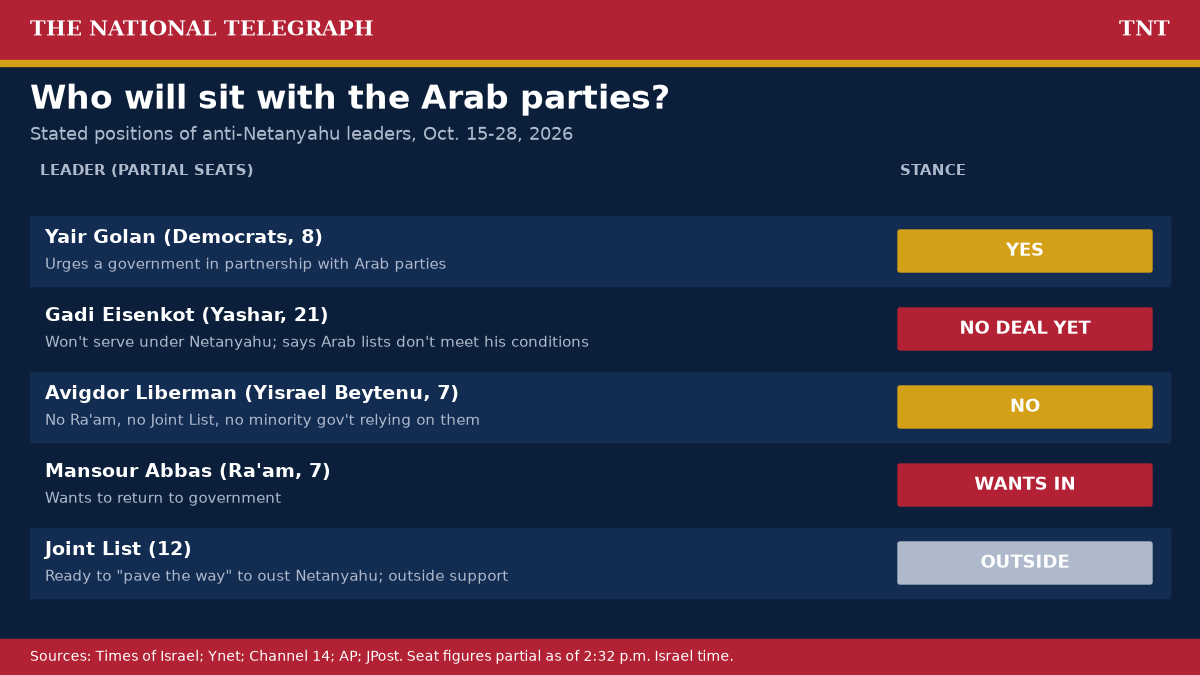
The two Arab-led lists are not interchangeable. Ra’am, led by Mansour Abbas, is the political arm of the Southern Branch of Israel’s Islamic Movement, which traces its ideology to the Muslim Brotherhood. In 2021 it became the first Arab party to join an Israeli governing coalition, in the Bennett-Lapid government, and Abbas has said he wants back in. The Joint List has generally stayed out of coalitions. Its chairman, Yousef Jabareen, said any party that wants to replace Netanyahu “will have to engage” with his faction and that the list is “ready to pave the way to oust the Netanyahu government,” according to The Times of Israel.
Abbas has spent years arguing for Arab citizens to work inside the Israeli system, and that is to his credit. But a party’s voters and its stated ideology are not the same thing, and its seats would now carry a price in any coalition deal.
That is the real question for Israel and for Washington. Israel is still fighting Iran and its proxies. A coalition that needs 19 votes from parties opposed to much of that campaign would have to bargain for each military decision. A minority government kept alive from outside by the Joint List could fall in any vote on war funding, Gaza or Lebanon.
Eisenkot has already told the security chiefs that Netanyahu is “now a caretaker prime minister” and warned him not to “use security for political purposes,” the Jerusalem Post reported. Eisenkot is a former IDF chief of staff, and he has every right to make that case. But a government that owes its survival to the Arab lists would have a harder time making the opposite case to Hezbollah, the Houthis and Tehran.
President Trump has taken credit for Netanyahu’s late gains after endorsing him, saying the “whole tide turned,” The Times of Israel reported. His administration has backed Israel through this war, and that backing works best with a stable government in Jerusalem. Neither side looks able to form one yet. Unity talks look unlikely, the Arab-party option splits the opposition, and the Jerusalem Post noted that the deadlock could end in another election.
The double-envelope ballots will settle the final seat count, with the full tally due Thursday and official results on Nov. 4. Until then, Israel’s next government may depend on who is willing to make a deal with Mansour Abbas.
Seat figures are partial Central Elections Committee results as of 2:32 p.m. Israel time, Oct. 28 (85.6% of votes counted), and will change as counting continues.

[…] Trump also repeated claims about Kansas and Michigan races that fact-checkers have challenged. Those include an unsupported suggestion that…
[…] TNT reported Oct. 15, Omar’s official birth year used to be 1981. Emails reported by the New York Post…

Very well presented. Every quote was awesome and thanks for sharing the content. Keep sharing and keep motivating others.
 October 28, 2026
 October 28, 2026
Leave a Reply