[…] Trump also repeated claims about Kansas and Michigan races that fact-checkers have challenged. Those include an unsupported suggestion that…

Written By TNT Staff, Posted on October 23, 2026

Featured photo: U.S. Steel’s Gary Works on Lake Michigan in Gary, Indiana, July 2025. Photo: Grešla, CC BY-SA 4.0, via Wikimedia Commons.
“We thought government control of the means of production was what we were fighting against!”
That line did not come from a progressive. It came from the Committee to Unleash Prosperity, the free-market group co-founded by economist Stephen Moore, a longtime Trump adviser. In an Oct. 21 memo titled “Stop Buying Companies,” the group told the Trump administration it is heading the wrong way.
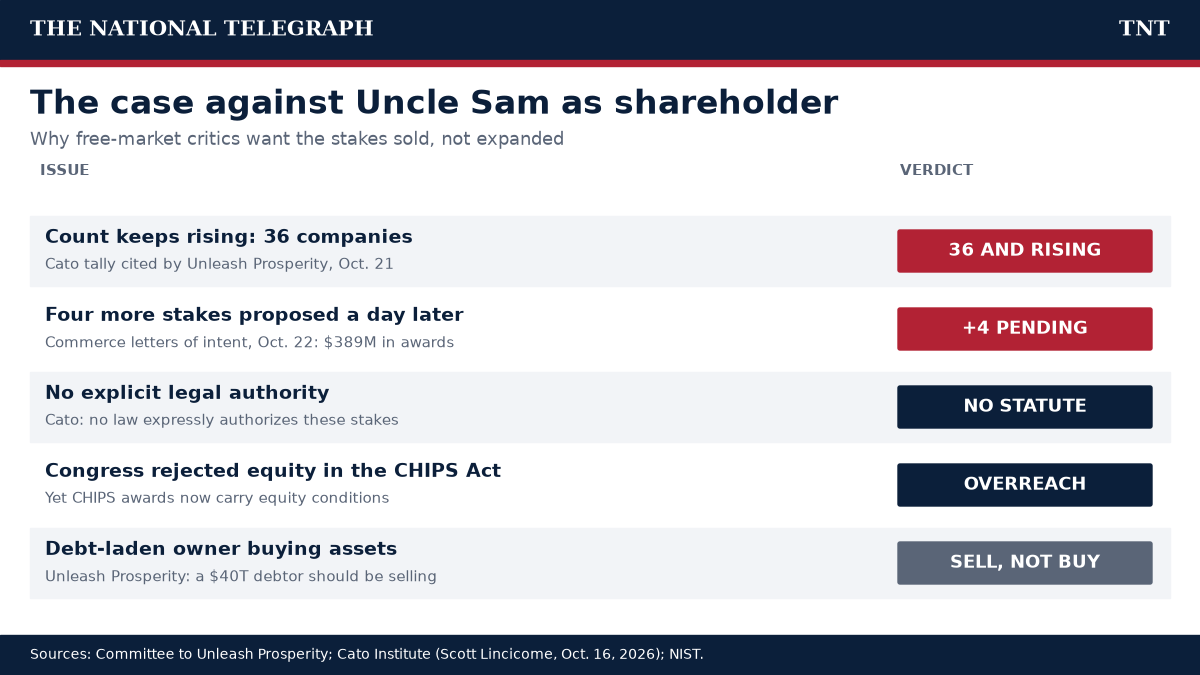
“An institution that is $40 trillion in debt should be SELLING assets not buying them,” the memo says. It counts federal ownership stakes in 36 companies “across a swath of different industries,” and calls this “the dark flipside” of Trump’s push to get more Americans investing in U.S. companies.
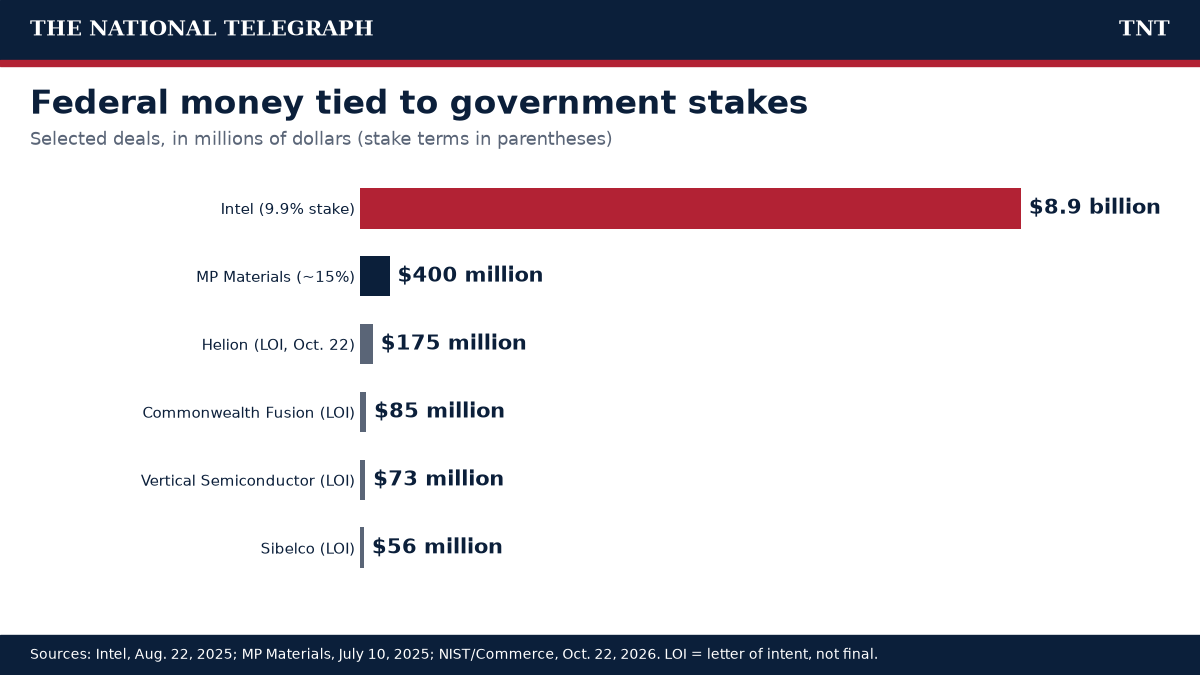
The biggest deal is Intel. In August 2025, the government agreed to take a 9.9% stake in the chipmaker, buying 433.3 million shares at $20.47 each for $8.9 billion, largely funded by CHIPS Act grants Intel had already been awarded, according to Intel.
A month earlier, the Pentagon agreed to buy $400 million of preferred stock in rare-earth producer MP Materials, along with warrants, making the Defense Department its largest shareholder at about 15% on a converted basis, MP Materials said. In the U.S. Steel sale to Nippon Steel, the government took a “golden share” with veto rights over certain business decisions.
The list keeps growing. The Cato Institute’s ownership dashboard, which the memo points readers to, tracks stakes, warrants and control rights taken since January 2025. Cato counted 35 companies on Oct. 16.
One day after the memo, the Commerce Department announced letters of intent for $389 million in CHIPS research awards to four more companies: Helion, Commonwealth Fusion Systems, Vertical Semiconductor and Sibelco. “The Department will receive a minority, non-controlling and non-voting equity stake in each company as a condition for making the awards,” NIST said. Those deals are not final.
Cato trade scholar Scott Lincicome argues the stakes rest on a “distressingly weak legal foundation.” The administration has cited several laws, but “none of them expressly authorize the executive branch to take an ownership stake in a private US company,” he wrote on Oct. 16.
When Congress has wanted the government to hold equity, it has said so, as it did with TARP and the CARES Act. It “rejected equity authority in the CHIPS Act,” Lincicome wrote. Now CHIPS awards routinely come with equity strings attached.
Conservatives have spent decades warning about government picking winners and losers. Owning shares makes Washington a player, not a referee. A government that owns part of a company also regulates it, buys from it and decides which of its competitors get grants. That is a conflict of interest no private investor would be allowed to have.
It also changes how capital moves. When the federal government holds a stake, the company’s success becomes a political project, and its rivals compete against the Treasury. Investment starts to follow Washington’s priorities instead of customers.
Supporters argue these deals protect supply chains in chips and critical minerals and give taxpayers a return on subsidies they were already paying. Those are real goals. But the classical liberal answer has always been that the government should set fair rules and get out of the way, not take a seat at the table.
The memo’s point is simple. A government with a $40 trillion debt, by the group’s count, should be selling what it owns, not buying more.

[…] Trump also repeated claims about Kansas and Michigan races that fact-checkers have challenged. Those include an unsupported suggestion that…
[…] TNT reported Oct. 15, Omar’s official birth year used to be 1981. Emails reported by the New York Post…

Very well presented. Every quote was awesome and thanks for sharing the content. Keep sharing and keep motivating others.
 October 23, 2026 October 23, 2026
Leave a Reply