[…] Confirmations are the one piece of the list a hostile House cannot undo. A federal judge seated this month…
Written By TNT Staff, Posted on November 15, 2026
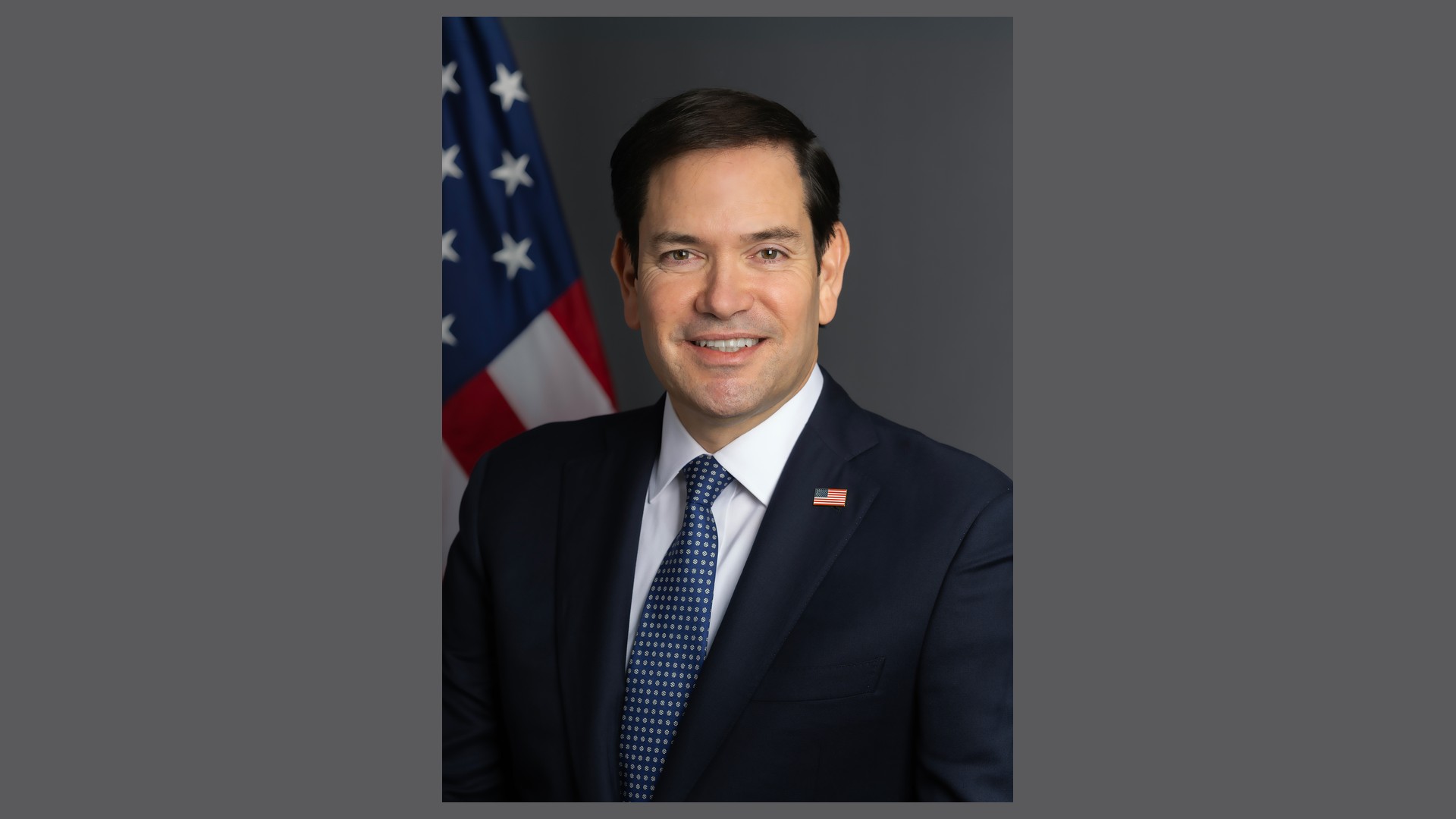
Secretary of State Marco Rubio met Honduran President Nasry Asfura in Washington on Friday and thanked him for a partnership that now includes a step Washington has been urging across the hemisphere: treating the region’s most violent gangs as terrorist organizations, not merely as street criminals.
According to a State Department readout, Rubio “commended President Asfura’s leadership in the Shield of the Americas and the Americas Counter Cartel Coalition, and Honduras’s recent designation of MS-13 and Barrio 18 as terrorist associations.” The two leaders also discussed expanding bilateral trade and U.S. investment, and Rubio “reaffirmed U.S. support for the Honduran people as they face drought conditions caused by El Niño.” Both, the department said, “committed to deepening cooperation for a safer, stronger, and more prosperous hemisphere.”
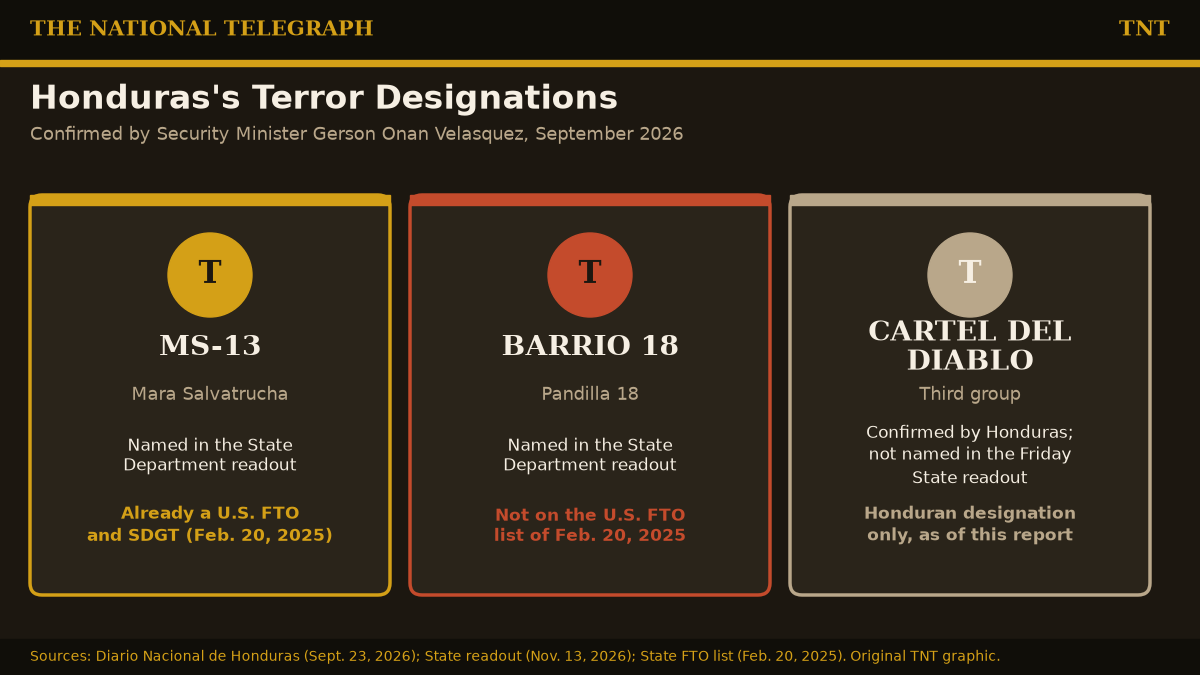
The designation itself came in September. Honduras’s National Defense and Security Council declared MS-13, Barrio 18 — known locally as Pandilla 18 — and a third group, the Cartel del Diablo, to be terrorist associations, Security Minister Gerson Onán Velásquez confirmed to the government’s Diario Nacional de Honduras. The State Department’s Friday readout named the first two. Velásquez said the groups are tied mainly to drug trafficking, murder, contract killing and extortion, and that some of their members had continued to issue orders from prison.
Washington already calls MS-13 a terrorist group. On Feb. 20, 2025, the State Department designated Mara Salvatrucha, along with Tren de Aragua and six Mexican cartels, as Foreign Terrorist Organizations and Specially Designated Global Terrorists. Barrio 18 was not on that list. What Honduras has done is write the terrorist label into its own law and apply it to both of the country’s dominant gangs, plus the Cartel del Diablo. That gives Honduran prosecutors and prison authorities a different set of tools at home, and it aligns Tegucigalpa with the American view that these groups are not ordinary street crime.
Honduras is not a late arrival to that argument. In a Sept. 15 Independence Day message, Rubio called Honduras “a founding member of the Shield of the Americas, defending democratic sovereignty across our hemisphere,” and commended Asfura’s “steadfast leadership” on border security, transnational crime and economic opportunity.
A week later, on Sept. 22, the United States, Honduras and 13 other governments issued a joint statement in New York announcing the Shield’s first collective action: their intention, “as applicable and in accordance with” each country’s laws, to impose asset freezes, immigration and visa restrictions, and criminal liability for people who knowingly provide material support to 24 named “narco-terrorist” organizations. MS-13 and Barrio 18 are both on that list. So are Tren de Aragua, the Sinaloa Cartel, Cártel de Jalisco Nueva Generación and Cartel de Los Soles, among others.
The statement is a declaration of intent, not itself a sanctions package. Friday’s meeting is what the follow-through looks like: a Central American president in Washington, praised by the secretary of state for having used his own government’s authorities to designate the gangs, and for showing up in both the Shield and the Americas Counter Cartel Coalition.
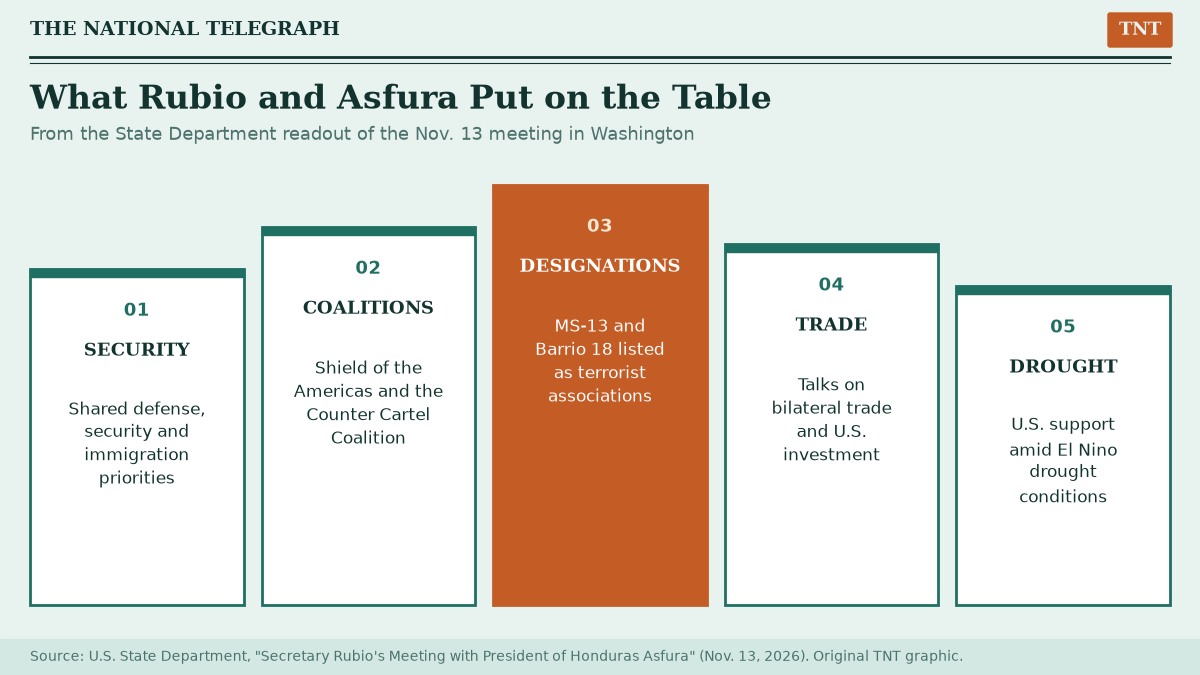
The readout is short, and it does not announce new U.S. designations, new deployments or a new aid figure. What it does announce is a political fact. A Honduran government has put MS-13 and Barrio 18 in the same category the United States uses for terrorist organizations, and the secretary of state treated that decision as a qualification for deeper partnership — on security, on immigration, on trade and on drought relief — rather than as a favor to be repaid later.
That is the bet behind the administration’s hemisphere policy. Cartels and transnational gangs do not respect borders, as Rubio told Shield leaders in September. The countries that want to stay sovereign have to coordinate the way the gangs already do. Honduras has now done so in law, not only in a joint communiqué. Friday’s meeting was Washington taking notice.
Sources: U.S. State Department, “Secretary Rubio’s Meeting with President of Honduras Asfura” (Nov. 13, 2026); Diario Nacional de Honduras, “Estas son las tres estructuras criminales declaradas terroristas en Honduras” (Sept. 23, 2026); Secretary Rubio, “Terrorist Designations of International Cartels” (Feb. 20, 2025); “Honduras National Day” (Sept. 15, 2026); “Joint Statement on Defending Hemispheric Sovereignty” (Sept. 22, 2026).

 November 15, 2026 November 15, 2026
Leave a Reply