[…] Trump also repeated claims about Kansas and Michigan races that fact-checkers have challenged. Those include an unsupported suggestion that…
Written By B.J. Dichter, Posted on October 28, 2026
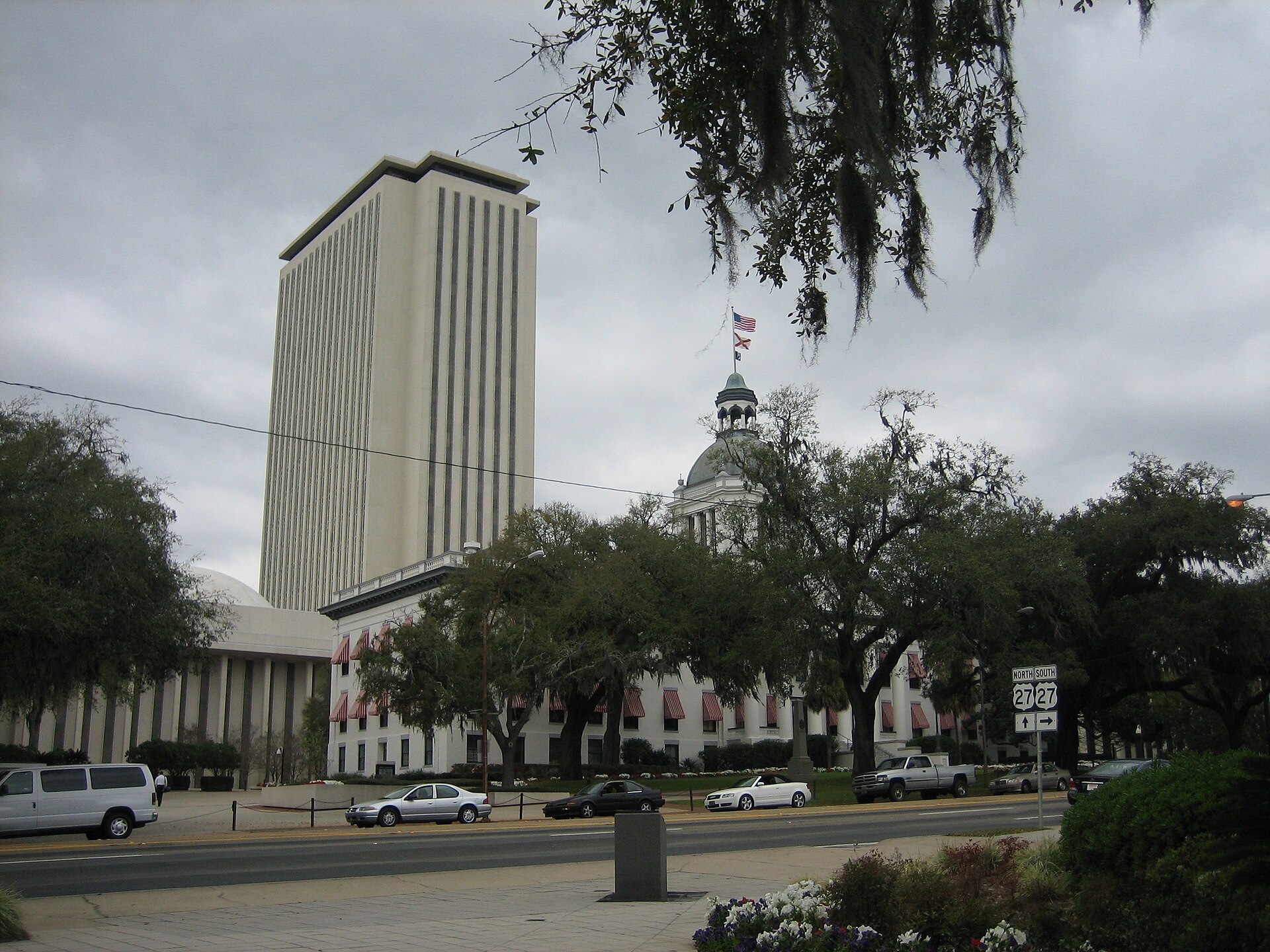
Featured photo: Florida’s Historic Capitol and the State Capitol tower in Tallahassee. Infrogmation of New Orleans, CC BY 2.5, via Wikimedia Commons.
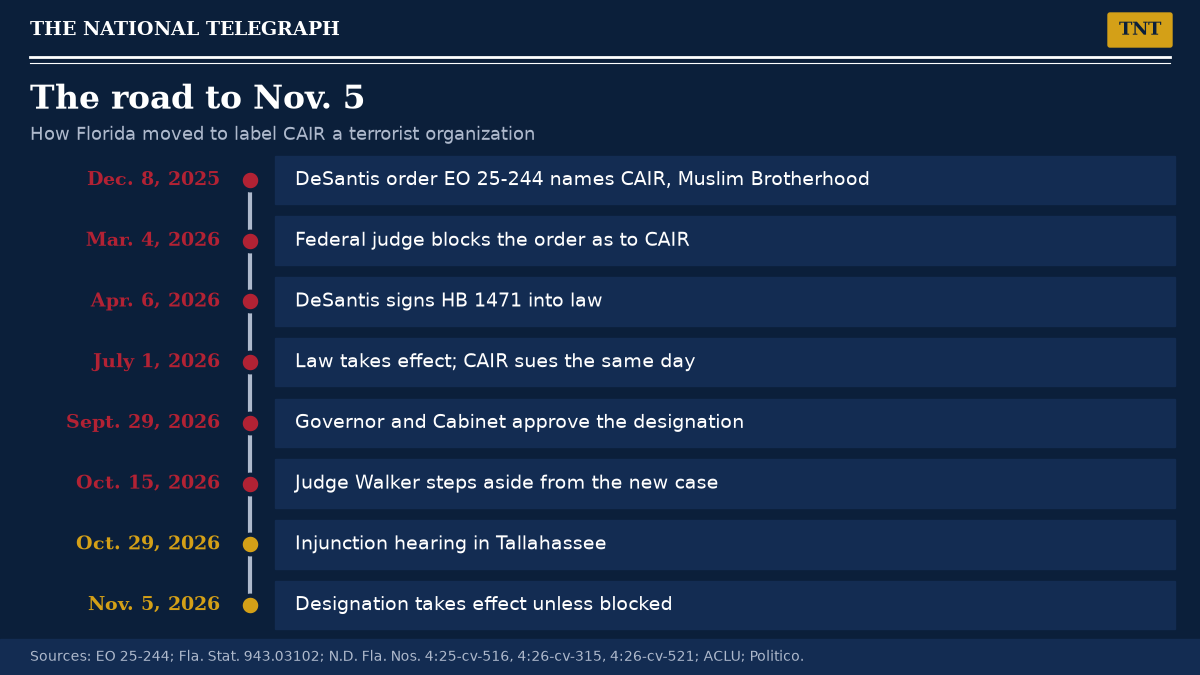
The Council on American-Islamic Relations gets one more shot in court before Florida’s terrorism label lands. CAIR and its Florida chapter are due in federal court in Tallahassee on Thursday afternoon, asking a judge to block their designation as “domestic terrorist organizations,” Politico reports. Unless a court steps in, the designation takes effect on Nov. 5.
Gov. Ron DeSantis and the Cabinet approved it on Sept. 29 under HB 1471, the law he signed in April. The same vote covered the Muslim Brotherhood, antifa and more than 90 groups already on the federal terror list, CBS Miami reported.
This is CAIR’s third lawsuit against the state this year. DeSantis first named CAIR and the Muslim Brotherhood in Executive Order 25-244 on Dec. 8, 2025. U.S. District Judge Mark Walker blocked that order as to CAIR on March 4, and the state’s appeal is pending at the Eleventh Circuit. The Legislature then wrote the designation process into law. HB 1471 took effect July 1, and CAIR sued the same day. That case was dismissed for lack of standing. The group filed again on Oct. 1, after the Cabinet vote.
Walker denied CAIR’s emergency request on Oct. 6, noting the label does not take effect until Nov. 5, JNS reported. On Oct. 15 he stepped aside. The state had argued he was biased, an argument he called “meritless and nothing but rank judge shopping.” He said he was leaving anyway so the fight over his seat would not become “a distraction from the weighty legal issues” in the case. Another judge of the Northern District now has it.
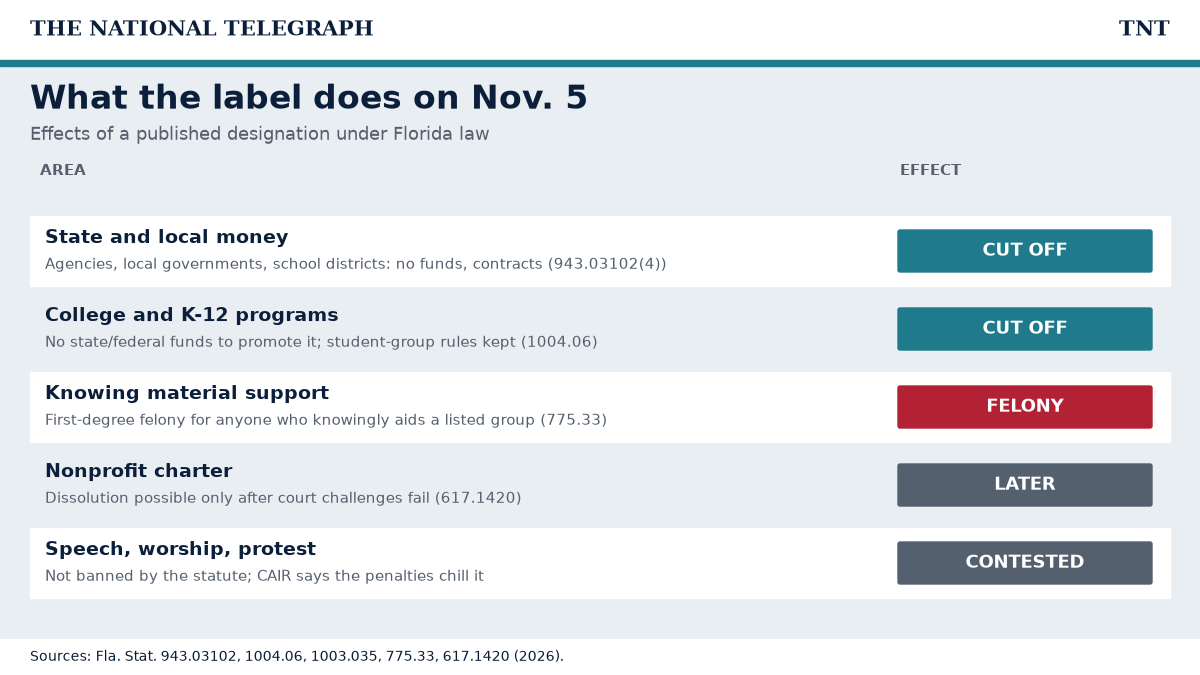
Read the statutes, not the press releases from either side. Once the designation is published, Section 943.03102(4) bars state agencies, local governments and public school districts from spending public money to support CAIR or its members, from contracting with it, and from accepting its money. Under Section 1004.06, public colleges and universities may not use state or federal funds on programs or campus activities that promote a designated group, and Section 1003.035 does the same for K-12 schools. The college law expressly keeps student-fee funding and facility use for student groups under neutral written policies, “notwithstanding any speech or expressive activity.”
The criminal side is heavier. Section 775.33 makes it a first-degree felony to knowingly provide “material support or resources” to a designated domestic terrorist organization. The definition covers money, services, “personnel” and “expert advice or assistance.” It excludes medicine and religious materials, and says the law should be read in line with the federal material-support statutes. Under Section 617.1420, the state may also administratively dissolve a designated nonprofit, but only after any timely court challenge is resolved against it. The group has 30 days after publication to challenge the designation in Leon County circuit court.
CAIR says it is a civil-rights group that does not engage in terrorism. In its emergency motion, filed with the ACLU, the ACLU of Florida, the Southern Poverty Law Center and Bondurant Mixson & Elmore, it argues that the designation would force it to “shut their doors in Florida” and expose employees, board members and volunteers to criminal penalties. It also argues that HB 1471 lets five officials label a U.S. nonprofit without charges, a trial or a jury.
The due-process complaint is not frivolous. The law says the written findings behind a designation do not have to be shared with the group, and it shields security-sensitive material from public records. At the Sept. 29 meeting, an ACLU lawyer asked to speak and was not recognized, and the vote took about 30 seconds, according to the ACLU.
The following is opinion.
CAIR’s record is not a clean slate. In the 2008 Holy Land Foundation case, the largest terror-financing prosecution in U.S. history, federal prosecutors listed CAIR as an unindicted co-conspirator. In 2009 U.S. District Judge Jorge Solis found the government had “produced ample evidence to establish the associations of CAIR, ISNA and NAIT with HLF, the Islamic Association for Palestine (‘IAP’), and with Hamas,” and he refused to strike CAIR’s name (order, Doc. 1356). In fairness to CAIR, the same order said the public naming had violated the groups’ Fifth Amendment rights and should have been filed under seal, and CAIR has never been charged with a crime. Still, no taxpayer in Florida should have to fund, contract with or hand classroom time to an organization with that history. On that point, Florida is right.
A libertarian should also be honest about the rest of the law. Cutting off public money is not censorship. CAIR can still speak, sue, raise private money and lobby in Tallahassee, and the college statute protects its student chapters’ equal access. But a felony for “knowingly” giving “expert advice” or “personnel” to a group the state has listed reaches past the treasury. Florida should defend that part in open court, with evidence. The test should be what CAIR has done, not what the Cabinet calls it. Federal law already covers the Muslim Brotherhood’s foreign branches, and if the evidence against CAIR is as strong as its critics say, the state should not mind showing it.
The hearing is CAIR’s last scheduled chance to stop the label before Nov. 5. Expect the judge to weigh whether the designation targets conduct or advocacy, whether CAIR got enough notice and a chance to be heard, and whether the federal material-support framework preempts Florida’s version. The parties had asked for a ruling by Nov. 2 so either side could seek emergency appellate review. TNT will follow up after the ruling.

B.J. Dichter is a contributor to The National Telegraph and the producer and creator of Not On Record, a weekly podcast on politics and culture. He produces Open College with philosopher Stephen Hicks and hosts Coffee with BJ, his live show. A former trucker, he was a spokesperson for the 2022 Freedom Convoy and wrote about it in Honking For Freedom. He writes from a classical liberal, libertarian conservative perspective on free speech, Canadian and US politics, Israel and Bitcoin.
[…] Trump also repeated claims about Kansas and Michigan races that fact-checkers have challenged. Those include an unsupported suggestion that…
[…] TNT reported Oct. 15, Omar’s official birth year used to be 1981. Emails reported by the New York Post…

Very well presented. Every quote was awesome and thanks for sharing the content. Keep sharing and keep motivating others.
 October 28, 2026 October 28, 2026
Leave a Reply