[…] Trump also repeated claims about Kansas and Michigan races that fact-checkers have challenged. Those include an unsupported suggestion that…

Written By B.J. Dichter, Posted on October 26, 2026
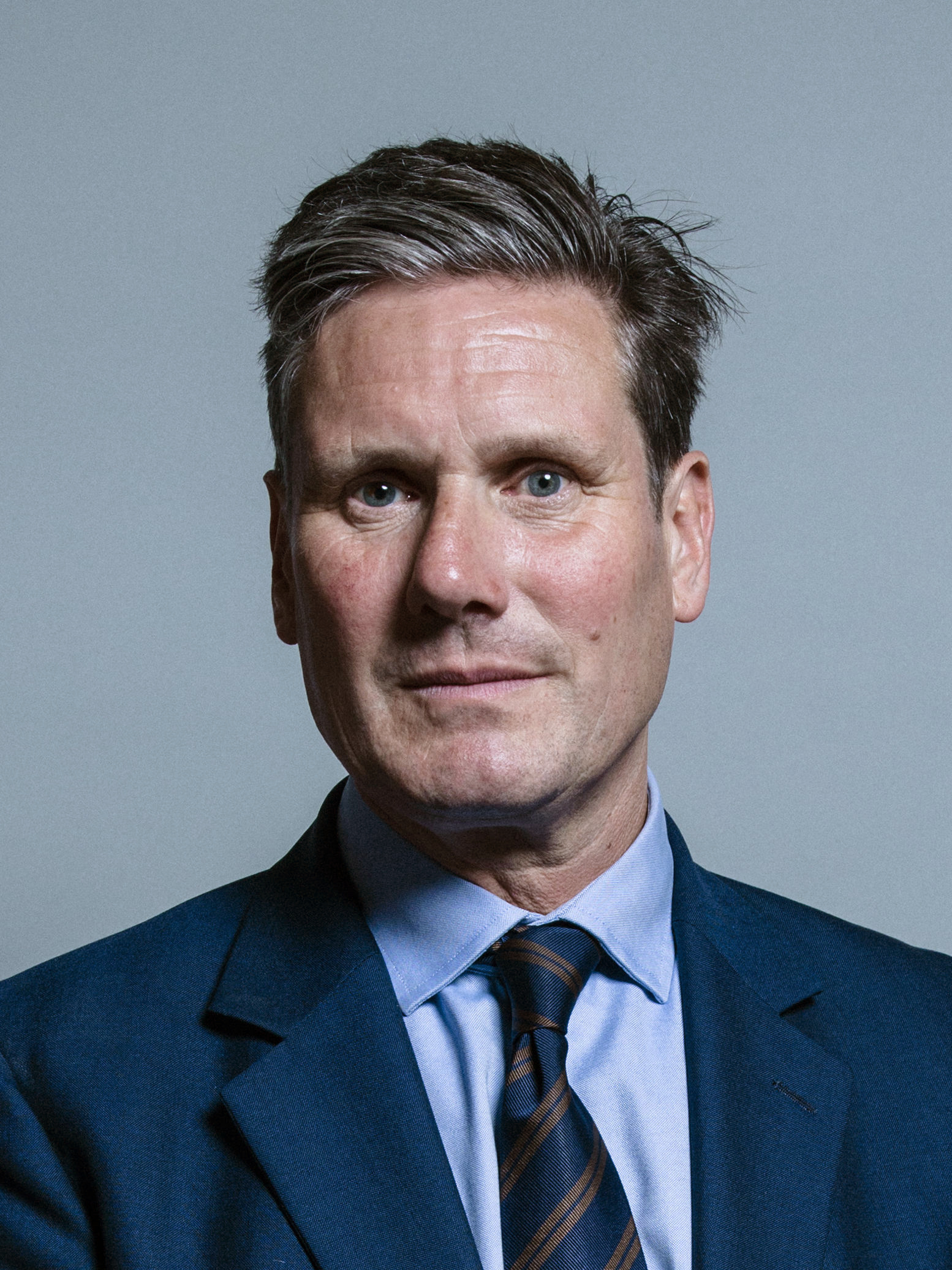
Featured photo: Sir Keir Starmer, official parliamentary portrait. Photo: Chris McAndrew/UK Parliament, CC BY 3.0, via Wikimedia Commons.
For years, the men and women who ran Britain’s justice system treated the grooming gang scandal as somebody else’s failure. Now one of them, the man who led the country’s prosecutors for five of the worst years and later moved into Downing Street, is on the list of people the national inquiry intends to hold to account.
The Statutory Independent Inquiry into Grooming Gangs published its list of core participants on Oct. 22. Sir Keir Starmer, Director of Public Prosecutions from 2008 to 2013 and prime minister until July, is on it. GB News first reported the listing and said it understands he will be summoned to give evidence. PJ Media’s Robert Spencer seized on the news as proof that the rot in this scandal reaches the top.
The distinction matters, so it is worth being precise. Under the Inquiries Act 2005, a core participant is a person or body with a significant interest in the inquiry’s work. Core participants get access to the evidence, can be legally represented, and can propose lines of questioning. Being listed is not an accusation, and it is not the same thing as being ordered to testify.
As The Telegraph noted, the designation “does not automatically mean he will be required to give evidence,” though many core participants are asked or compelled to. The inquiry, chaired by former children’s commissioner Baroness Anne Longfield, can force witnesses to appear and documents to be handed over. GB News says Starmer is expected to testify in the hearings’ institutional phase. The inquiry itself has not announced its witness list.
He is in large company. The core participant list also names survivors, whistleblowers Maggie Oliver and Jayne Senior, the Crown Prosecution Service he once ran, the Metropolitan Police, Manchester City Council, the Welsh Government and a string of Whitehall departments.
The National Accountability Hearings open in London in the weeks of Dec. 14, 2026 and Jan. 11, 2027, with more sessions in March and April 2027. They begin with victims and survivors, move to what earlier inquiries found, and end with the institutions themselves.
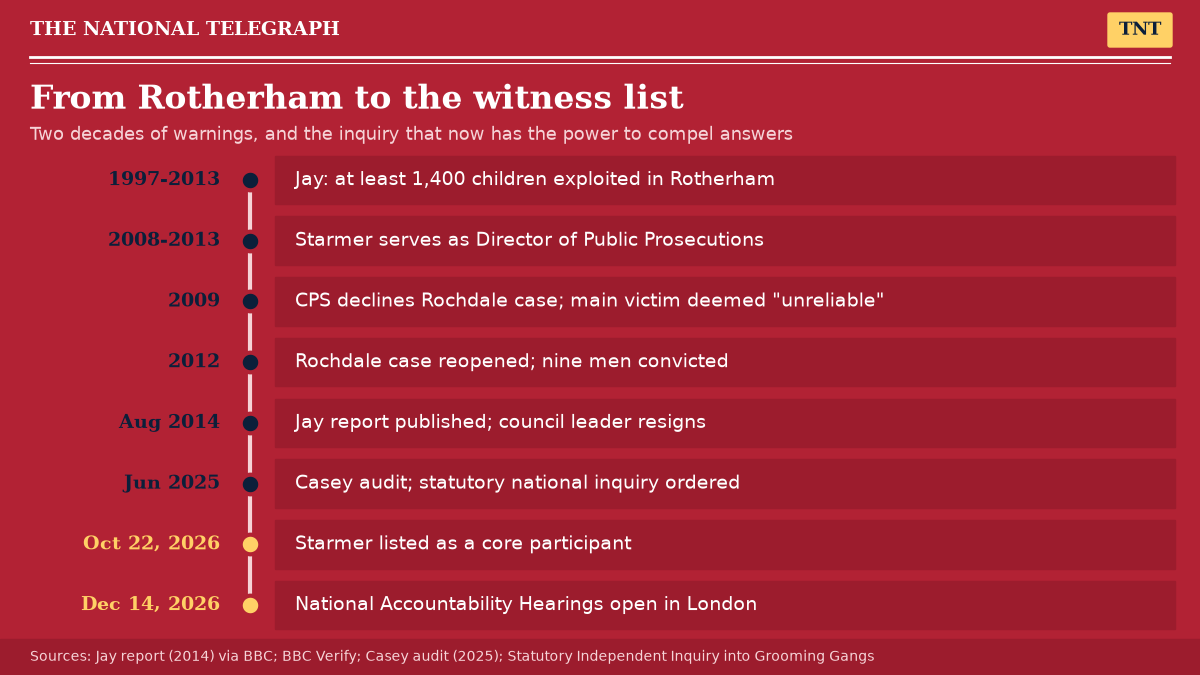
The facts on the record are bad enough without embellishment. Professor Alexis Jay’s 2014 report for Rotherham council estimated, conservatively, that at least 1,400 children in that one town were sexually exploited between 1997 and 2013. According to the BBC’s account of the report, children as young as 11 were raped by multiple men, trafficked to other cities, beaten and threatened, some doused in petrol and threatened with being set alight.
The authorities knew. Jay found that three earlier reports had warned of the problem; one was “effectively suppressed” and two were ignored. South Yorkshire Police “regarded many child victims with contempt.” And the report recorded why so many looked away: “Several staff described their nervousness about identifying the ethnic origins of perpetrators for fear of being thought as racist; others remembered clear direction from their managers not to do so.” Victims described most of their abusers as “Asian” men.
Baroness Louise Casey’s 2025 national audit confirmed the pattern where data existed. Ethnicity was “shied away from” and not recorded for two-thirds of perpetrators nationally, she wrote, but police data in Greater Manchester, South Yorkshire and West Yorkshire showed “disproportionate numbers of men from Asian ethnic backgrounds” among suspects. Presenting the audit, the Home Secretary told Parliament it found over-representation of Asian and Pakistani-heritage men among suspects in those areas, and “organisations avoiding the topic altogether for fear of appearing racist or raising community tensions.”
That is the heart of it. Not a community, since the overwhelming majority of British Pakistanis are as appalled as anyone, but an establishment that decided its own reputation for sensitivity mattered more than the girls in front of it.
How many girls in all? Nobody knows. The “250,000 victims” figure Spencer cites comes from a campaign site built around an unofficial, survivor-led inquiry chaired by MP Rupert Lowe. It is an estimate, not an official finding; the same site’s own sourced estimate is “153,070+” since the 1950s. Casey found the national data too poor to support any reliable count, which is itself an indictment.
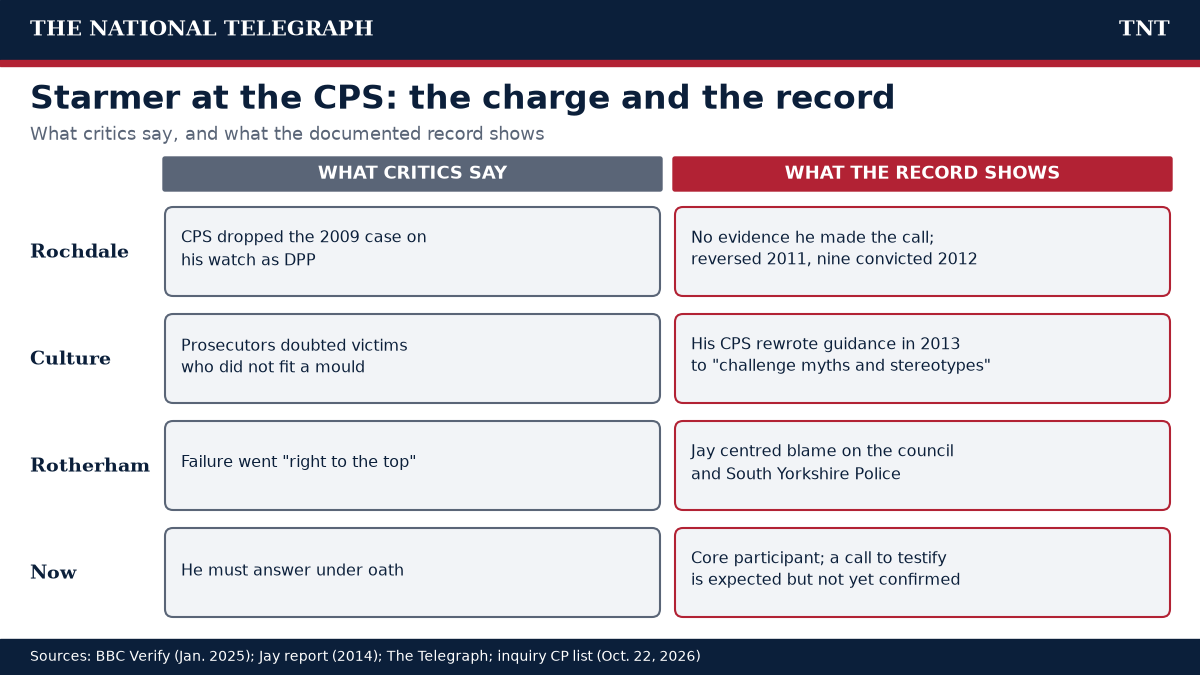
Critics, from Elon Musk to Spencer, argue that Starmer had five years at the head of the CPS while the gangs operated and failed the victims. Spencer calls it “criminal negligence.” No court or inquiry has found that, and TNT will not state it as fact.
Here is what the record shows. In 2009, on Starmer’s watch, the CPS declined to prosecute a Rochdale case after deciding the main victim was “unreliable.” BBC Verify found no evidence he took that decision personally. In 2011, Nazir Afzal, whom Starmer had appointed chief prosecutor for north-west England, reversed it; nine men were convicted in 2012. Afzal has said Starmer was “100% behind” publicly admitting the CPS had got it wrong. In 2013 Starmer’s CPS issued new guidance on child sexual abuse to stop prosecutors dismissing victims who did not fit a stereotype, and set up a panel that reopened closed cases.
Starmer has defended that record forcefully. In January 2025 he said he had changed the approach to “challenge myths and stereotypes,” reopened cases, and left with the highest number of child sex abuse prosecutions on record. BBC Verify judged the guidance claim correct, but noted that the prosecution peak covered all child sexual abuse cases, not grooming gangs specifically. He also accused his critics of spreading “lies and misinformation.”
And the Rotherham failures Jay documented were chiefly those of the council and South Yorkshire Police, not the DPP’s office, although she did note police often blamed a reluctant CPS in the early years.
None of that clears Starmer. It sharpens the questions. Why did it take until 2011 for a prosecutor to believe a Rochdale girl? Why did guidance fit for purpose arrive only in 2013, years after the patterns were visible? Why, as prime minister, did his government resist a national inquiry until Casey’s audit forced its hand? Those are fair questions for a man who has spent his career claiming to stand for the vulnerable.
The deeper failure belongs to a whole governing class. Councils, police chiefs, social workers and prosecutors absorbed the idea that naming an uncomfortable truth was worse than tolerating a crime. That is what happens when institutions value ideological comfort over equal protection under the law. Children paid for it.
A free society depends on one standard of justice for everyone, whatever the race or religion of the victim or the offender, and whatever the rank of the official who looked away. If this inquiry applies that standard to the powerful, it will have done something British institutions have avoided for 25 years.

B.J. Dichter is a contributor to The National Telegraph and the producer and creator of Not On Record, a weekly podcast on politics and culture. He produces Open College with philosopher Stephen Hicks and hosts Coffee with BJ, his live show. A former trucker, he was a spokesperson for the 2022 Freedom Convoy and wrote about it in Honking For Freedom. He writes from a classical liberal, libertarian conservative perspective on free speech, Canadian and US politics, Israel and Bitcoin.
[…] Trump also repeated claims about Kansas and Michigan races that fact-checkers have challenged. Those include an unsupported suggestion that…
[…] TNT reported Oct. 15, Omar’s official birth year used to be 1981. Emails reported by the New York Post…

Very well presented. Every quote was awesome and thanks for sharing the content. Keep sharing and keep motivating others.
 October 26, 2026 October 26, 2026

Leave a Reply