[…] Trump also repeated claims about Kansas and Michigan races that fact-checkers have challenged. Those include an unsupported suggestion that…

Written By TNT Staff, Posted on October 23, 2026
Featured photo: A “Vote Here” sign outside a polling place in Minneapolis, Nov. 3, 2020. Photo: Tony Webster, CC BY 2.0, via Wikimedia Commons.
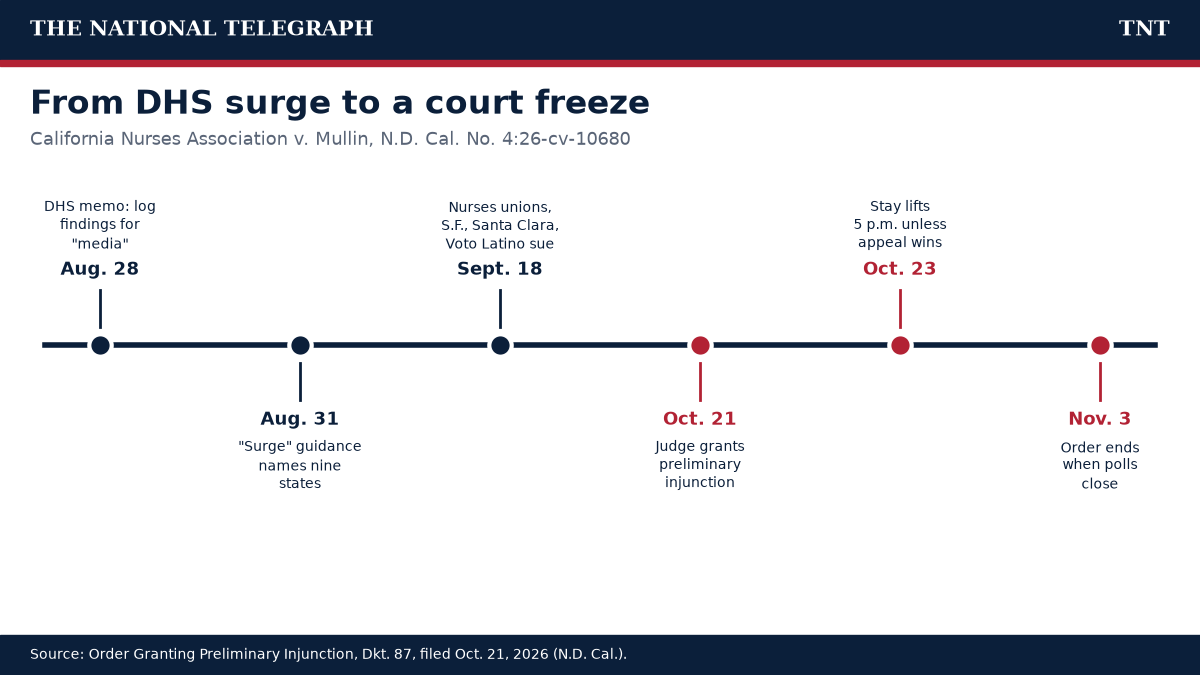
A federal judge in California has ordered the Department of Homeland Security to stop election-related door-knocks and field interviews in nine states until the polls close on Nov. 3. The ruling lands 11 days before Election Day, in the middle of early voting.
U.S. District Judge Araceli Martínez-Olguín, an appointee of President Joe Biden, issued the 19-page preliminary injunction late Wednesday in California Nurses Association v. Mullin. She put it on hold until 5 p.m. Friday, Oct. 23, to give the administration time to appeal. Unless a higher court steps in, the freeze takes effect tonight.
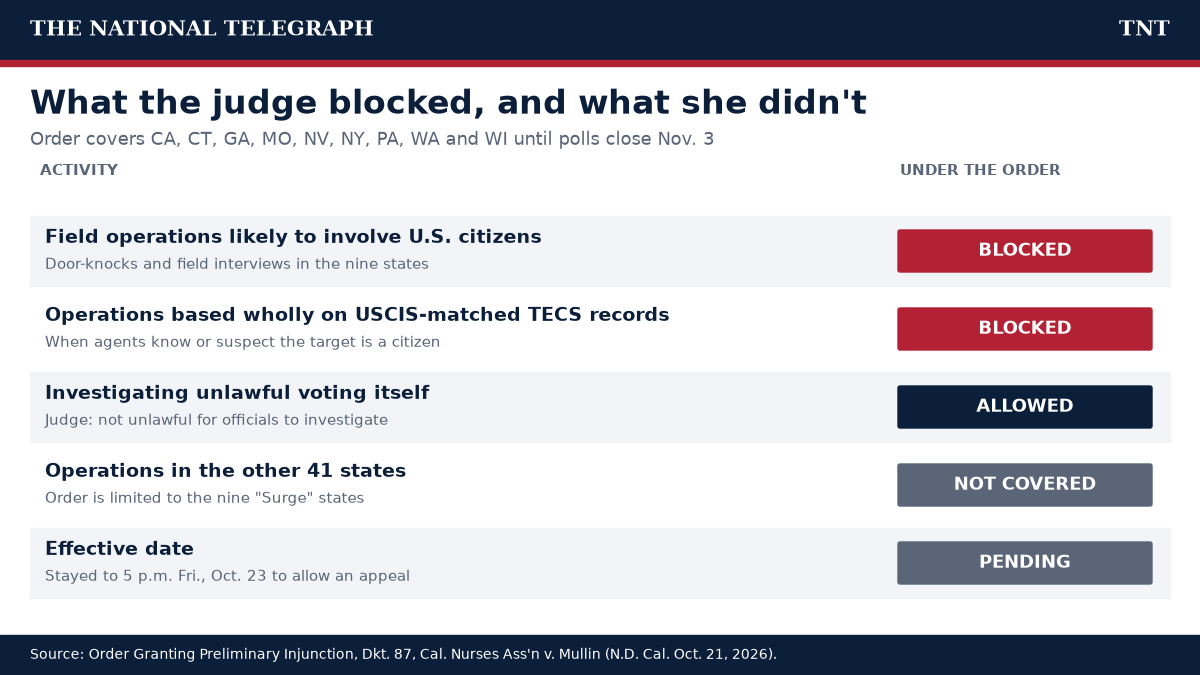
The order covers California, Connecticut, Georgia, Missouri, Nevada, New York, Pennsylvania, Washington and Wisconsin. In those states, it bars DHS from “elections-related field operations and field interviews” that involve, or are likely to involve, people officials “know, suspect, or should reasonably know or suspect are U.S. citizens.”
It also bars field operations based “wholly” on TECS records produced by DHS’s voter-matching process when the target is known or suspected to be a citizen. The order stays in force until 8 p.m. on Nov. 3 or until polls close, according to the court record.
The plaintiffs are the California Nurses Association and National Nurses United, the City and County of San Francisco, Santa Clara County and the Voto Latino Foundation. They sued on Sept. 18 and were represented in part by the left-leaning group Protect Democracy.
The plaintiffs brought seven claims. The judge did not accept most of them. She found the unions had not shown standing to bring voter-intimidation claims under the Voting Rights Act or the constitutional right to vote, and she declined to rule on their Administrative Procedure Act claims because they had not identified a “final agency action.”
What survived was a single theory: that DHS’s operations intimidate union members who help other people vote, in violation of Section 11(b) of the Voting Rights Act. On that one claim, the court froze the program across nine states for the rest of the election.
Even the judge conceded the government has a job to do. “Plaintiffs do not claim, nor does the Court find, that it is unlawful for federal officials to undertake investigations into unlawful voting in federal elections,” she wrote.
According to the order, DHS launched an “Unlawful Voter Initiative” in August. U.S. Citizenship and Immigration Services builds lists of people who may have registered or voted illegally, and Homeland Security Investigations agents follow up in person. An Aug. 31 “Surge Initiative Guidance” told agents to prioritize field interviews in the nine states.
The judge leaned on the government’s own admissions about error. USCIS acknowledged in a court filing that mistakes can result from “similar names, incomplete records, outdated citizenship information, clerical errors, and other circumstances.” There is no federal database of citizenship status, the order notes. The court also cited a whistleblower disclosure released by Sens. Chuck Schumer and Alex Padilla.
DHS says citizens are not the target. The department is “laser focused on identifying, prosecuting, and removing aliens who vote and dilute the votes of U.S. citizens,” it said in a statement to CBS News, and has “no plans to question or investigate people we believe to be U.S. citizens.”
Noncitizen voting is a federal crime. Earlier this week, the Justice Department said it had arrested several dozen green card holders in California accused of illegally registering to vote in federal elections, CBS reported. Investigations like these depend on agents being able to knock on a door and ask questions.
An order that ties those agents’ hands for the last 11 days of a national election, in nine states that include California, Georgia, Pennsylvania and Wisconsin, is not a small thing. Those are the days when registration problems matter most and when the window to act before ballots are counted is closing.
The court’s own finding was narrow. The practical result is broad: federal election-integrity work in a large share of the country stops at the moment it counts most. That is a question for the Ninth Circuit, and it needs an answer before 5 p.m. today.
As of Friday morning, TNT had not found a public appellate ruling on the stay.

[…] Trump also repeated claims about Kansas and Michigan races that fact-checkers have challenged. Those include an unsupported suggestion that…
[…] TNT reported Oct. 15, Omar’s official birth year used to be 1981. Emails reported by the New York Post…

Very well presented. Every quote was awesome and thanks for sharing the content. Keep sharing and keep motivating others.
 October 23, 2026 October 22, 2026
Leave a Reply