Very well presented. Every quote was awesome and thanks for sharing the content. Keep sharing and keep motivating others.
Written By TNT Staff, Posted on October 17, 2026
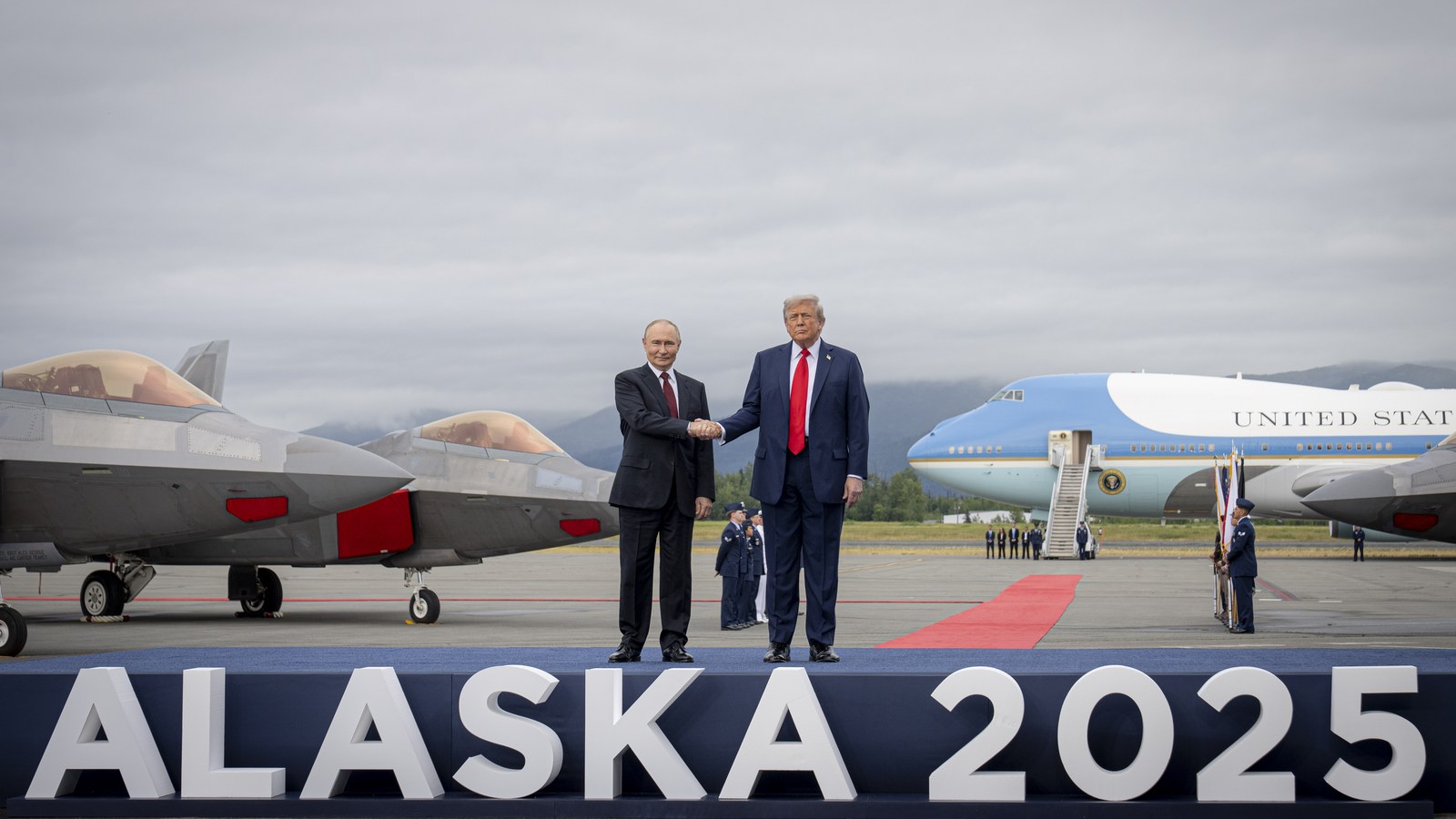
Featured photo: President Donald J. Trump welcomes Russian President Vladimir Putin to Joint Base Elmendorf-Richardson, Anchorage, Alaska, Aug. 15, 2025. Photo: Benjamin D. Applebaum, U.S. Department of Defense (public domain, via Wikimedia Commons).
Last month, President Trump signed a sweeping Russia sanctions law that passed Congress with huge bipartisan majorities. Late Friday night, two days before its biggest penalties were due to bite, he switched most of it off.
In an executive order dated Oct. 16, Trump used the waiver power written into the Lindsey O. Graham Sanctioning Russia and Iran Act of 2026 to suspend the law’s new tariffs on Russian goods, its tariffs on the biggest buyers of Russian oil and gas, and most of its new sanctions. “I have submitted to the Congress a certification that the issuance of such a waiver at this time is in the national interests of the United States,” the order says.
The details matter. The order first sets the duties the law demands: a 500% increase on goods from Russia, a 100% increase on goods from the five largest importers of Russian crude oil and natural gas if they keep buying on or after Oct. 18, and a 100% increase on goods from the top five countries that help Russia evade oil sanctions. Then, in Section 4, it waives every one of those duties.
It goes further. The order also waives the law’s codification of existing Russia sanctions (Section 102(d)) and a long list of new mandatory measures, Sections 102(a), 102(e), 103 through 111, and 117. Those include the law’s required sanctions on Russia’s central bank and big state banks, according to a summary of the act by the law firm Sullivan & Cromwell. The waivers stay in place until the President or the Secretary of State decides “further action is appropriate.” The U.S. Trade Representative is told to keep watching who buys Russian energy and who helps Moscow dodge sanctions, and to report back.
What survives: the order states that nothing in it affects sanctions already imposed under earlier executive orders on Russia’s “harmful foreign activities,” including on everyone already sanctioned under them. So the existing U.S. sanctions regime stays. What is gone, for now, is the new pressure Congress voted to add.
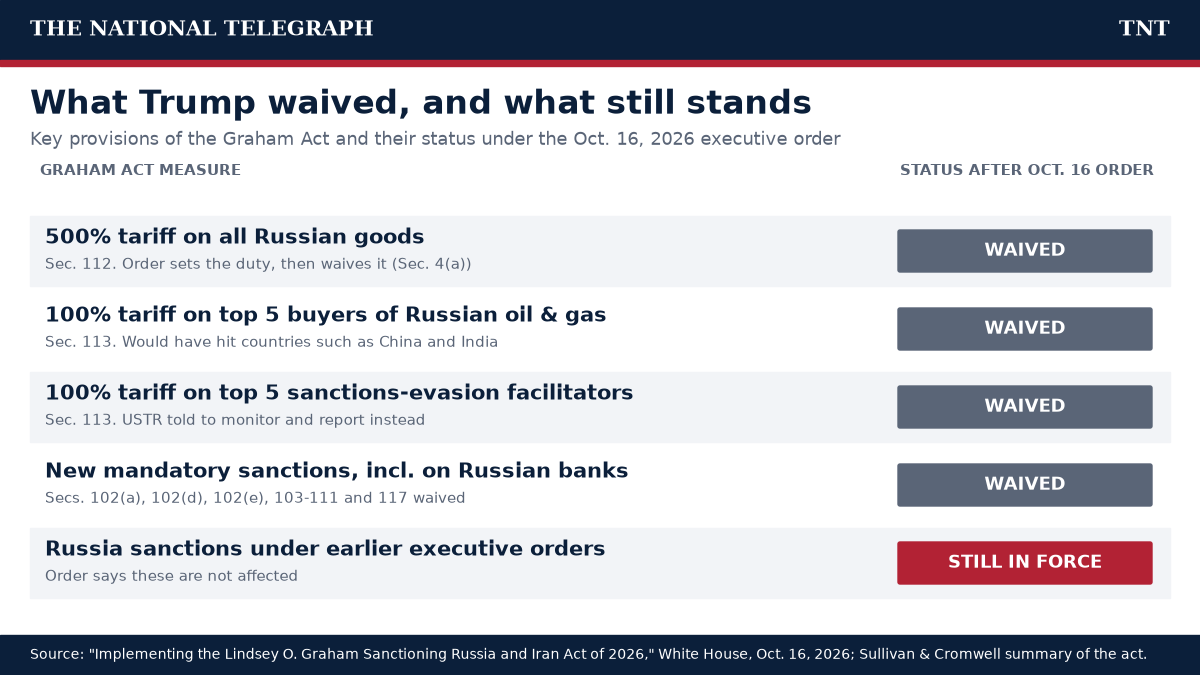
Source: White House executive order, Oct. 16, 2026; Sullivan & Cromwell summary of the Graham Act.
This was not a fringe bill. The Senate passed it 86-11 on Aug. 7, and the House passed it 262-159 on Sept. 16, with 58 Democrats joining nearly all Republicans, according to Sullivan & Cromwell. Trump signed it on Sept. 18. It is named for the late South Carolina Sen. Lindsey Graham, a staunch backer of Ukraine who died suddenly in July, Fox Business reported.
Congress also built in a waiver: Section 115 lets the President suspend any of the law’s sanctions or duties if he certifies to Congress that doing so is in the national interest and explains why. Trump did exactly that. The move is legal. Critics who call it a reversal are still right.
Four days after signing the law, Trump told the United Nations General Assembly that it gave him “enormous new tariff authorities” and that “if necessary, [he] will have to use them,” as Sullivan & Cromwell noted. Less than four weeks later, he decided it wasn’t necessary.
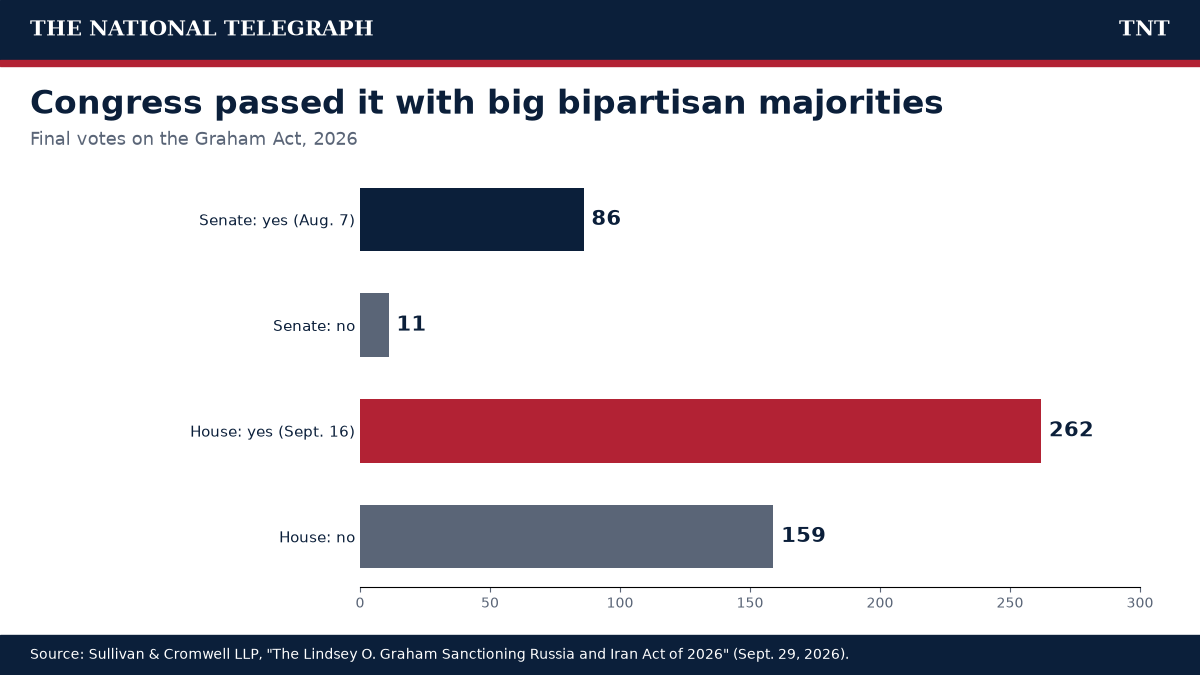
Source: Sullivan & Cromwell LLP, “The Lindsey O. Graham Sanctioning Russia and Iran Act of 2026,” Sept. 29, 2026.
The waiver did not come out of nowhere. On Friday, Oct. 9, Trump announced a deal with Vladimir Putin to buy Russian diesel: more than 300,000 tons right away, 500,000 tons in November and 1 million tons after that, according to CBS News. CNBC reports the administration also temporarily waived sanctions on Russian diesel exports through April 2027 to ease a supply crunch caused by the war in Iran.
The next day, Trump turned on Ukraine’s president. “I suggest they get a new leader who can make a deal,” he told reporters, Axios reported. “And I think it’s time for Ukraine to get a new president.” He has blamed Ukrainian strikes on Russian oil refineries for high fuel prices. A U.S. official told Axios the diesel deal came after Volodymyr Zelensky ignored half a dozen U.S. requests to stop those strikes.
On Oct. 11, Trump announced an “energy ceasefire” on Truth Social. Zelensky said Ukraine would stop if Russia did. After further Russian attacks, Kyiv resumed its strikes on Russian refineries, the BBC reported, and Trump called those strikes a “disgrace.”
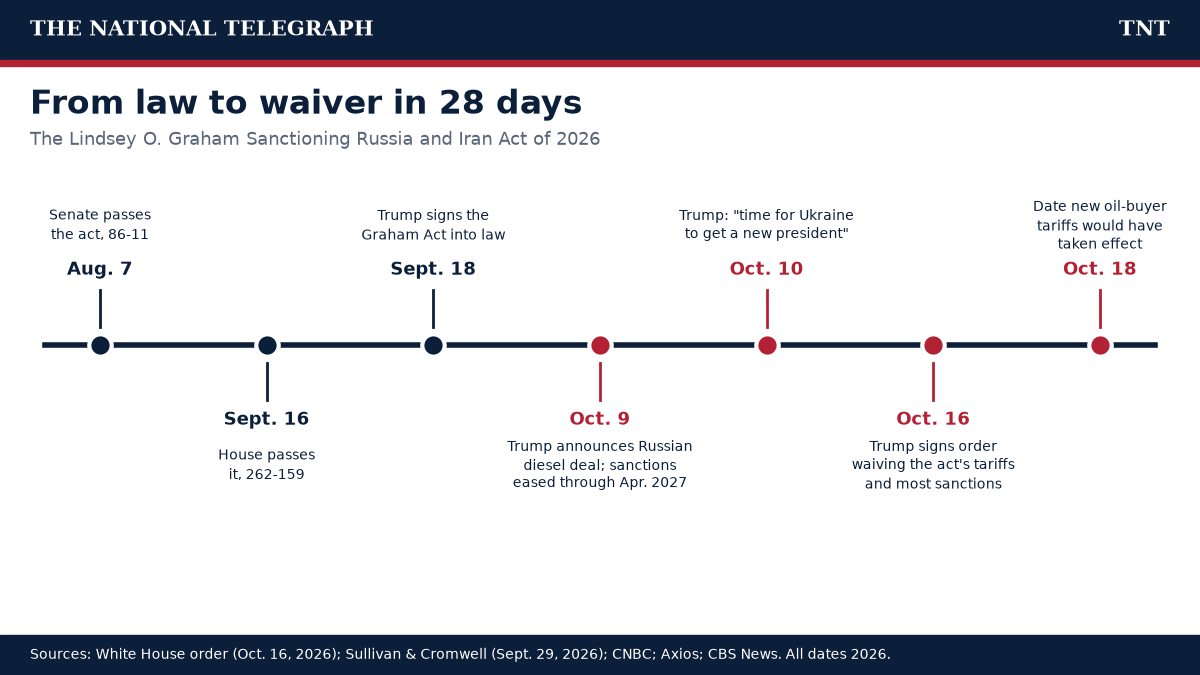
Sources: White House (Oct. 16, 2026); Sullivan & Cromwell; CNBC; Axios; CBS News.
There is an America First argument here, and it deserves a fair hearing. Fuel prices have soared during the Iran war, and diesel prices hit truckers, farmers and every family that buys groceries. Midterm elections are Nov. 3, and Republicans hold only narrow majorities in both chambers, CNBC notes. A 100% tariff on everything from China and India, two of the biggest buyers of Russian oil, would have landed on American shoppers too. A President who puts American wallets first is doing his job. And Trump kept his options open: the duties are set on paper, existing sanctions stand, and the waiver can be lifted at any time.
But leverage you never use is not leverage, and Moscow knows it. The first reaction to the waiver came from the Kremlin’s side. Kirill Dmitriev, Putin’s economic envoy, called it “an important and truly historic moment” and said “peacemaking efforts will continue,” CNBC reported.
When the Russian side is celebrating, the deal is not working for us. Zelensky called the decision “unfortunate,” saying the law “could have helped enormously.” “A U.S. sanctions blackout, easing pressure on the aggressor, financial rewards for Putin – all of this only encourages him to keep attacking,” he wrote, according to CBS News. Overnight, Russia struck 15 Ukrainian energy facilities, causing power cuts in several regions, Zelensky said, according to the BBC.
Opposition is not just coming from Democrats such as Sen. Richard Blumenthal, who helped draft the bill. Republican Sens. Susan Collins, Lisa Murkowski, Thom Tillis and John Curtis joined two Democrats last weekend in demanding that the administration “immediately reverse course” on the diesel deal, CBS News reported. A bipartisan group of senators then urged Trump to enforce the Graham Act. “These authorities require you to apply economic pressure on Russia and the chief enablers of its war, in particular China, and thereby enhance your negotiating position to bring a swift end to this ruinous conflict,” they wrote.
That is the conservative case, and it is a strong one. Reagan didn’t win the Cold War by easing pressure on Moscow to get a better price on fuel. He won it by making the Soviet economy pay for its aggression. Russia started this war. Russia can end it tomorrow. A peace deal that comes from squeezing Kyiv while giving Putin a break will not last, and it tells every aggressor watching, from Beijing to Tehran, that American pressure fades as soon as it costs something.
Trump wants this war over, and he is right to. Peace through strength is still the best plan, and Congress handed him the tools. The question now is whether he will use that leverage on the aggressor, or keep spending it on the victim.
TNT will follow the certification and report the White House sent Congress, and any move by lawmakers to respond.


Very well presented. Every quote was awesome and thanks for sharing the content. Keep sharing and keep motivating others.

This was a fantastic read – I really appreciated the section where you mentioned how consistency beats motivation. It reminded…

Swet blog! I found it while searching oon Yahoo News. Do you have any tips on how to get listed…
 October 17, 2026
 October 17, 2026
Leave a Reply