Very well presented. Every quote was awesome and thanks for sharing the content. Keep sharing and keep motivating others.

Written By B.J. Dichter, Posted on October 16, 2026
By TNT Staff | October 16, 2026
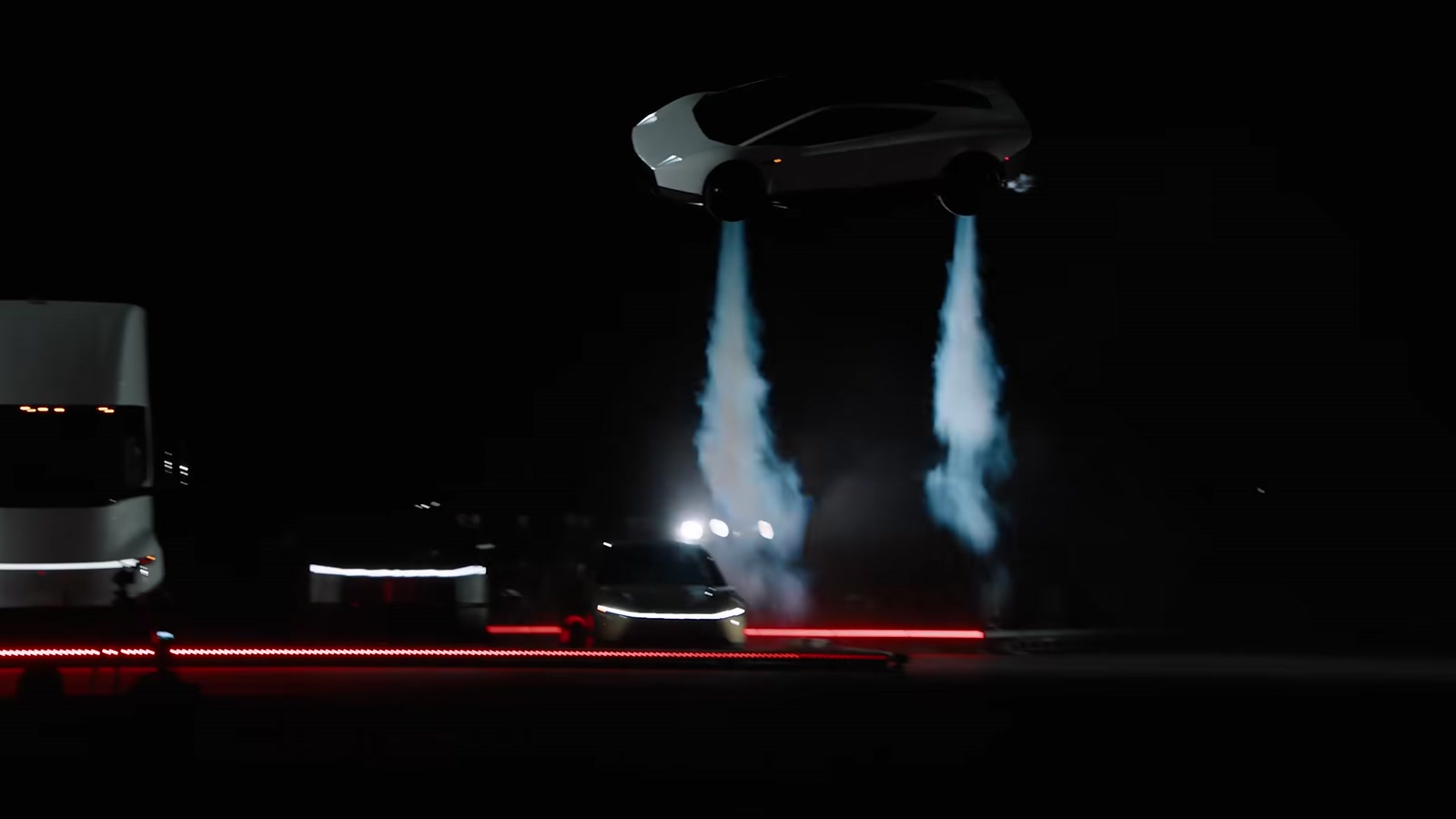
Featured image: The Tesla Roadster airborne on its cold-gas thrusters at the Oct. 15, 2026 unveil. Image: Tesla, "The Kickflip | Roadster" unveil video (Oct. 15, 2026 event), screen capture for news reporting.
Nine years after Tesla first rolled out a next-generation Roadster prototype and promised it would be on the road by 2020, the car finally reappeared Thursday night, and it did not just drive. At a SpaceX test site in McGregor, Texas, near Waco, a white, wedge-shaped two-seater drove partway up a curved ramp, held itself upside down with fans, then launched off, flipped and used built-in thrusters to land on its wheels. Later it jumped over a row of Teslas, including a Semi.
“That unveiling was pretty wild,” B.J. Dichter, publisher of The National Telegraph, said on his Coffee with BJ livestream Friday. “I think it shows very much what Elon Musk is.”
Dichter, a lifelong car enthusiast, compared the ramp to the loop-the-loop tracks kids build for their toy cars. “I had one of those as a little kid, and he probably had it too, because we’re around the same age,” he said. “We’d do loop-to-loops and stuff like that. That’s exactly what he builds, right?”
Dichter was careful not to oversell what the car does. “It’s not a flying car,” he said. “It can’t even hover, it’s got thrusters, right? So it can thrust up for a second. Okay, it’s cool. Well, it can do more than just that.”
To him, the point is bigger than the hardware. “The idea of a flying car is, this is just him moving the needle of society. I think that’s why it’s a cultural shift,” he said. “And he’s been doing that his entire life. And he’s been using a lot of sci-fi to do it, which I think is a great tactic, and I encourage him to do more of it.”
He called the event a publicity stunt, and said that was the point. “Yes, it was a publicity stunt, but it got everybody to say, what did I just watch?” Dichter said. Roadster fans had heard about thrusters for years, he noted, “but we didn’t expect it to go to that level. But if you look at what’s been happening with SpaceX, it’s no surprise that, of course, they’re going to do it.”
The livestream itself, which The Verge clocked at under 30 minutes, was light on details. Tesla posted the specifics afterward, in a thread on its X account and on its updated Roadster page. There are three versions, which Tesla treats as a base car plus two “augments”:
All of these figures are Tesla’s claims for a car that is not in production. None has been independently tested. Yahoo Finance reported that Tesla ran a 0-60 test at the event that came in at 0.81 seconds; that was a company demonstration, not an independent measurement. Musk also suggested the production car could go far faster than 230 mph, telling the crowd, “I think you’ve got to crack halfway to the speed of sound,” according to Reuters. That is an aspiration, not a spec.
The SpaceX connection is real hardware, by Tesla’s account. The company says the cold-gas thrusters had to be re-engineered to work in the atmosphere instead of a vacuum, and that every usable void in the car holds carbon-fiber overwrapped pressure vessels (COPVs) storing the compressed gas. Tesla claims the thrusters produce four to five times the force the tires can handle, which is how it gets around the traction limit that caps every other car’s launch. The fans do the opposite job, sucking the car down hard enough, Tesla says, to hold it upside down even when stationary. In Track Mode, active wings driven by actuators developed for the Optimus robot deploy, and Tesla claims downforce “approaching F1 levels.”
Dichter singled that out. “The biggest thing was the downforce, right? Like if you’ve been on a track, you know why that’s significant,” he said.
He also noticed what had changed since 2017. “Remember the original Roadster was four seats? Notice this is two seats?” he said, pointing to a mid-engine-style silhouette that he said “looks similar to a Corvette C8 or a Lamborghini… and modern Ferraris.” As for what is behind the seats, “apparently it’s a big massive air tank,” he said. (Tesla has not published the tank pressure.)
On acceleration, Dichter thinks the race is over. “The whole zero to 60 thing is done. It’s over with,” he said. “Anything faster, I think, kills you… too many G-forces. So that’s it. We’ve hit maximum zero to 60. So now they can have the car, you know, flying around doing little dances.”
The comparison bears that out, at least on paper. The Rimac Nevera, the Croatian electric hypercar limited to 150 units, is rated by Rimac at 1.74 seconds to 60 mph (with a one-foot rollout) and set a verified 258 mph (412 km/h) top speed, a record for a production electric car. Its price is listed at about $2.2 million by the spec site EVspecs. Tesla’s own Model S Plaid is rated by Tesla at 1.99 seconds, also “with rollout subtracted”; Edmunds and MotorTrend have noted that figure was set on a prepped drag strip. Even the base Roadster’s claim beats both, and the Thrust and Rocket figures are, as Electrek put it, “well beyond anything on the market.” But the Nevera is a car people can buy today. The Roadster is not.
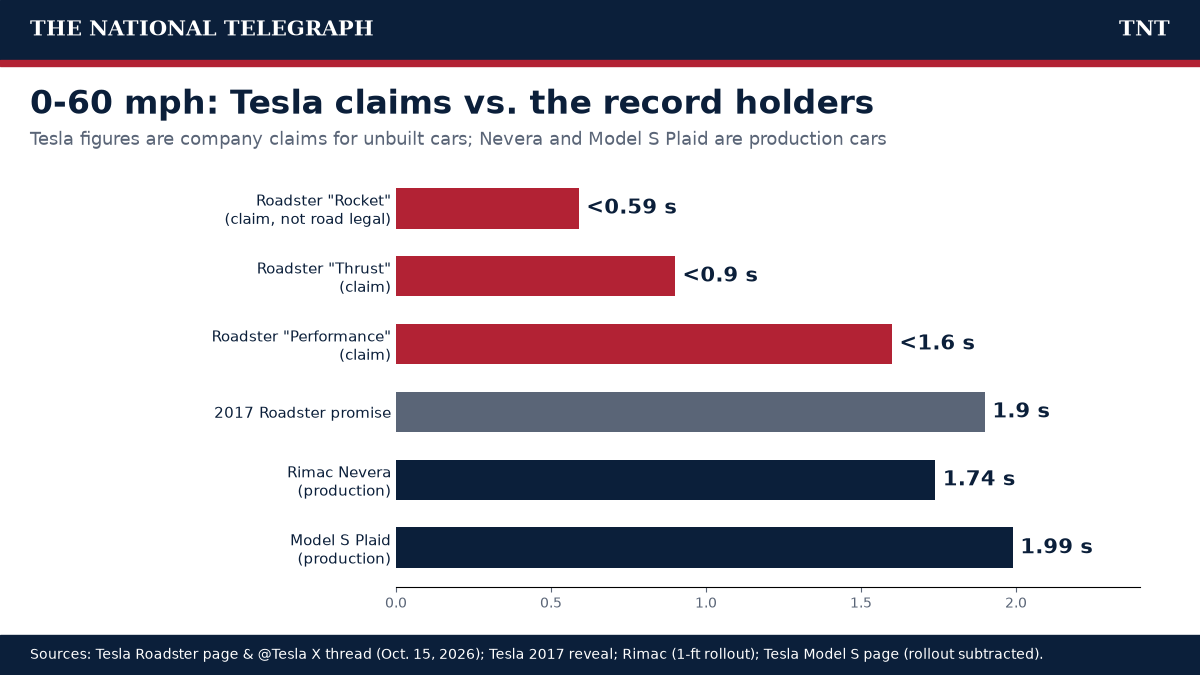
TNT graphic. Sources: Tesla, Rimac.
Tesla did not announce a price for any version. In 2017 it quoted a $200,000 base price. Reservations are open again: $5,000 due up front, which Tesla calls fully refundable, and $45,000 more within 10 days or the reservation is canceled, for $50,000 total on the Performance car. Reuters and Engadget report the Thrust package requires a $250,000 deposit. Rocket is invite-only.
The only timeline is Musk’s: production in “2028, actually,” as Electrek quoted him. Tesla’s track record on this car is the reason for skepticism. The 2017 prototype promised 620 miles of range, a top speed above 250 mph, a 1.9-second 0-60 and 2+2 seating, with deliveries in 2020. On June 9, 2018, Musk tweeted that a “SpaceX option package for new Tesla Roadster will include ~10 small rocket thrusters arranged seamlessly around car… Maybe they will even allow a Tesla to fly,” later clarifying they would run on “ultra high pressure air in a SpaceX rocket COPV bottle,” as Electrek and Fortune reported at the time. Then the dates slipped, year after year. This year alone, Electrek counts promised unveilings in April, late April, August and October 1; Tesla blamed weather at the test site for the last two-week delay. The new car’s range claim is roughly half the 2017 figure, and it has lost two seats.
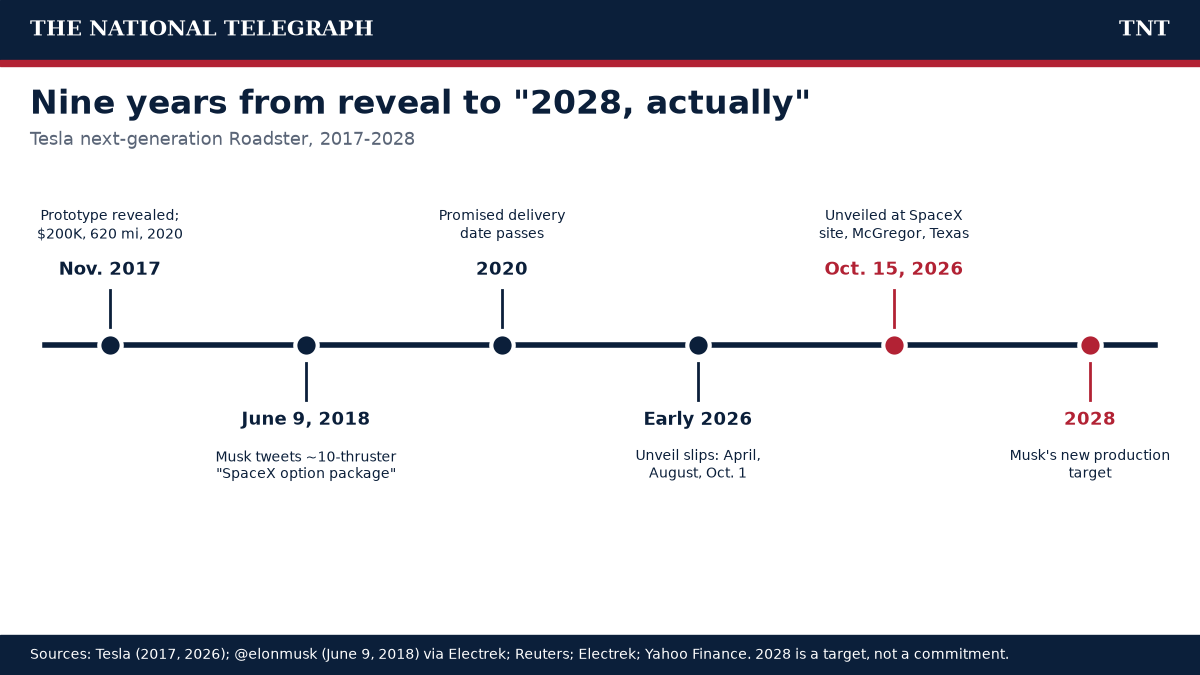
TNT graphic. Sources: Tesla, Reuters, Electrek, Yahoo Finance.
Dichter does not expect many to be built. “He’s going after the people who are buying million-dollar cars,” he said. “I’m willing to bet that there’s going to be very few of those… It’s going to be a very limited production car.”
And he won’t be lining up. “Would you want one? I’m like, yeah, no, not at all, not for me,” said Dichter, who prefers “a little four-cylinder turbo on the track,” a big V8 or an executive car. The fixed seats bolted to the chassis are “really not for me,” he said, “but car people will love that.”
Investors were impressed for a few hours. Tesla shares rose as much as 5.4% in premarket trading Friday, Yahoo Finance reported, then gave it back. By early afternoon the stock was around $351, down about 3% from Thursday, according to Investing.com, amid a broad selloff in tech stocks. JPMorgan kept its Neutral rating and $415 target, noting Tesla “did not reveal the final price, battery capacity, range or planned production volumes,” as Bloomberg LÃnea reported.
Gene Munster of Deepwater Asset Management called it “an engineering flex with no commercial value beyond embarrassing traditional car makers,” adding, “Elon can’t wait to bring Tesla and SpaceX together.” Electrek, often critical of Musk, called the engineering “real” but predicted Tesla would sell only “a handful” of the stunt-capable versions. Analysts at Barclays wrote this week that a Tesla-SpaceX merger “has increasingly become the consensus expectation,” and Tesla reports earnings on Oct. 21.
Dichter’s read is that the Roadster is a stepping stone. “I think it might be a bridge, just to get people emotionally accepting of thrusters on a car, that a car can hover for a split second and do kind of wild acrobatic things,” he said.
The next step, he predicted, is cyclorotors: wheel-like rims whose spokes are articulating airfoils pushing air downward, a technology he said already exists in online demos. “Who’s going to be able to drive a flying car with cyclorotors and these thrusters? Well, if you have an autonomous car with FSD, no one’s driving. The car is driving you. And I think that’s what he’s looking at.” (That is Dichter’s analysis; Tesla has announced no such product.)
He tied it back to optimism. “This is why I like Elon Musk. It’s the aspirational thinking,” he said, while crediting the “whole massive engineering team” behind the car. “This is why I get really frustrated when people are like, AI is gonna destroy the world… We have so many good, amazing things happening in the world.”
Peter Thiel once complained, “We wanted flying cars, instead we got 140 characters.” On Thursday night, Tesla came a step closer to the flying-car half of that complaint, even if, as Dichter put it, it can’t even hover.

Author Honking For Freedom, Podcaster, Speaker, Trucker #FreedomConvoy Spokesperson. #Bitcoin http://HonkingForFreedom.com | http://BenjaminJDichter.com

Very well presented. Every quote was awesome and thanks for sharing the content. Keep sharing and keep motivating others.

This was a fantastic read – I really appreciated the section where you mentioned how consistency beats motivation. It reminded…

Swet blog! I found it while searching oon Yahoo News. Do you have any tips on how to get listed…
 October 16, 2026 October 16, 2026
Leave a Reply