Very well presented. Every quote was awesome and thanks for sharing the content. Keep sharing and keep motivating others.

Written By TNT Staff, Posted on October 16, 2026
By TNT Staff | October 16, 2026
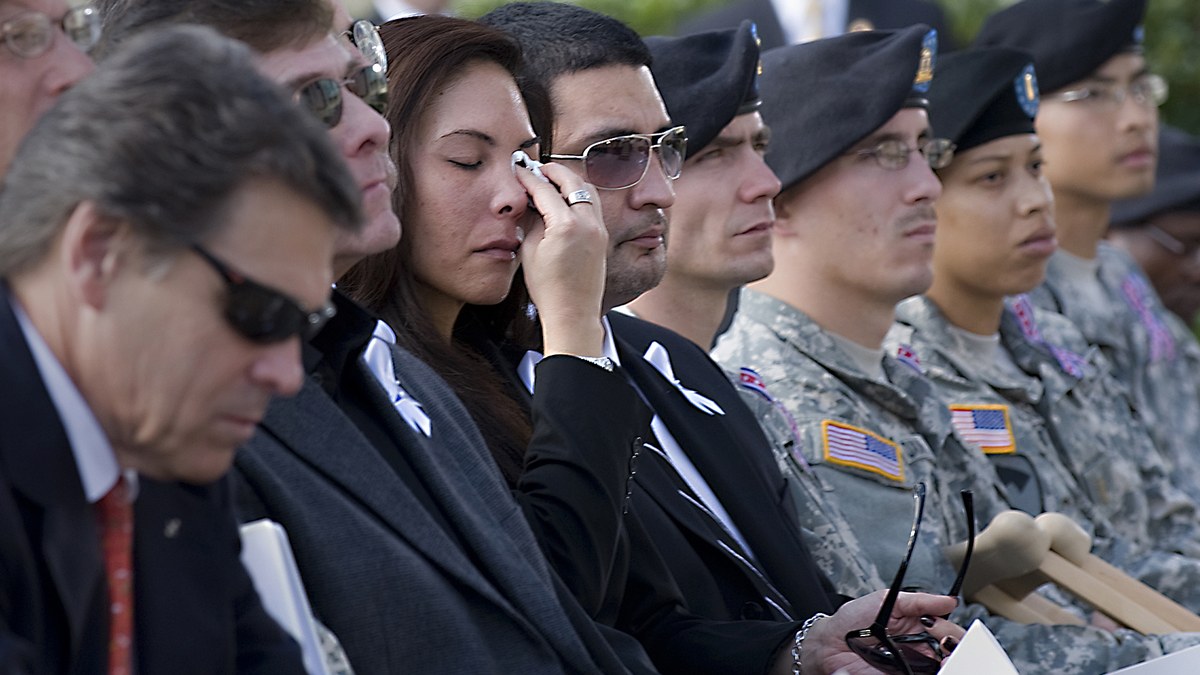
Featured photo: Families at the Fort Hood memorial service, Nov. 10, 2009. Photo: U.S. Army (public domain, via Wikimedia Commons).
Nidal Malik Hasan will still face a firing squad on Dec. 3. The world just won’t be watching it online.
The date is set. According to the Army, President Trump approved Hasan’s death sentence on Oct. 2, after the Supreme Court declined to hear his appeal in March 2025, and Acting Army Secretary Adam Telle directed on Oct. 6 that the execution take place at Fort Hood at 1 p.m. Central on Dec. 3, 2026. It will be the military’s first execution since 1961, CBS News reports.
President Trump on Thursday reversed Defense Secretary Pete Hegseth’s plan to livestream the execution of the former Army major who murdered 13 people at Fort Hood, Texas, in 2009. “I think streaming the execution for all to see might have been a strong deterrent for the World to witness how America deals with Terrorists and SCUM like Hasan but, many very good and well meaning people would rather not watch him die, through streaming, or through any other visual device,” Trump wrote on Truth Social. “He will die, as scheduled, by firing squad, but this event will not be streamed. That said, the execution may be viewed in person by the immediate families of the victims, if they so choose. They deserve to witness JUSTICE!”
It was the right call, and it was made for the right reasons.
Hours before Trump’s post, an ABC News/Washington Post/Ipsos poll found that 80% of Americans said the execution should not be livestreamed, against 18% who said it should. That included 64% of Republicans, 83% of independents and 91% of Democrats. The same poll found a 53% majority supporting Hasan’s execution by firing squad, with 42% opposed. The poll surveyed 2,545 adults from Oct. 9 to 13 and has a margin of error of plus or minus 2 points.
In other words, Americans want justice done. They don’t want it turned into content.
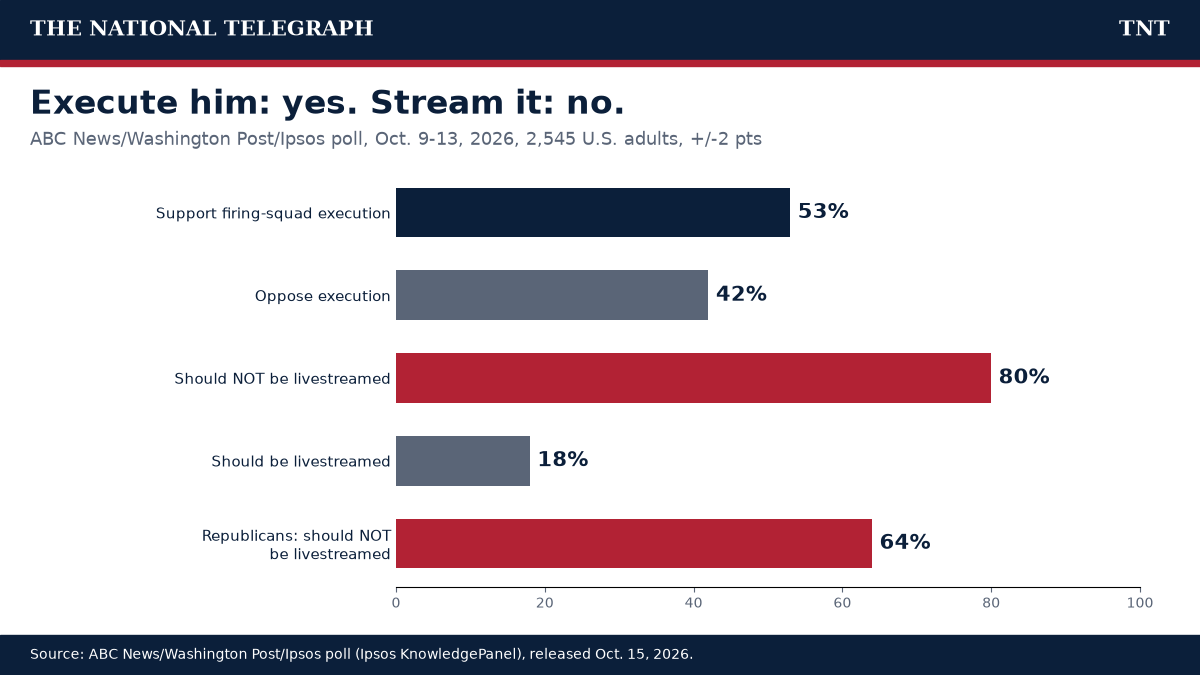
TNT graphic. Source: ABC/WaPo/Ipsos, Oct. 9-13, 2026.
Source: ABC News/Washington Post/Ipsos poll, Oct. 9-13, 2026, 2,545 U.S. adults, margin of error +/-2 points.
Hegseth had pledged last week to make the execution public, and the Pentagon said as late as Tuesday that “it will be live streamed.” ABC News reported, citing sources, that Trump and his advisers worried a broadcast could hand anti-American propaganda to the very jihadists it was meant to deter. Pentagon spokesman Sean Parnell said Thursday that the two men spoke before the announcement and that “the Secretary supports the President’s decision, and they are completely aligned.”
That is how this is supposed to work. A cabinet secretary pushed a bold idea, the public weighed in, and the president made the final decision. A streamed killing would have been the first public execution in America since the 1930s. It would have been clipped, remixed and posted on terrorist channels within the hour. It would have made Hasan the star of his own death. The Fort Hood families get to see justice done in person. The rest of us get to know that it was done.
On Nov. 5, 2009, Hasan, an Army psychiatrist, walked into the Soldier Readiness Processing Center at Fort Hood, where unarmed soldiers were getting ready to deploy. According to the FBI’s Webster Commission report, he jumped on a desk, shouted “Allahu Akbar!” and opened fire. He killed 13 people: 12 soldiers and one civilian, Michael Cahill. More than 30 others were wounded. Among the dead was Pvt. Francheska Velez, 21, who was pregnant; witnesses testified that she cried out, “My baby! My baby!” On Aug. 23, 2013, a military jury convicted him on all 13 counts of premeditated murder and 32 counts of attempted premeditated murder. Five days later, it sentenced him to death.
For years, Obama’s Defense Department treated the massacre as “workplace violence” rather than terrorism, and it denied the victims the Purple Heart, the AP and ABC News reported. As late as 2013, a Pentagon position paper opposed awarding it. Congress finally changed the eligibility rules in the 2015 National Defense Authorization Act, signed Dec. 19, 2014. On Feb. 6, 2015, the Army approved Purple Hearts for the soldiers and the civilian Defense of Freedom medal for civilians. It was a long refusal to name what had happened, and an insult to the dead.
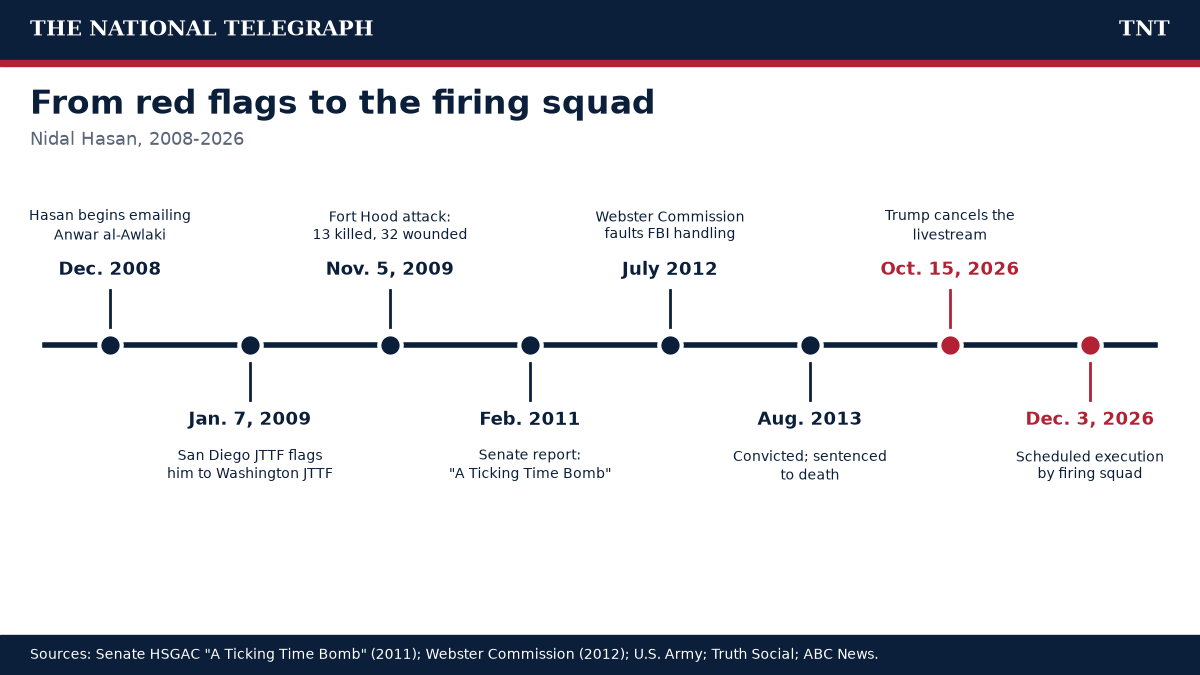
TNT graphic. Sources: HSGAC 2011; Webster 2012; Army; Truth Social; ABC.
Sources: Senate HSGAC, “A Ticking Time Bomb” (2011); Webster Commission final report (2012); U.S. Army; Truth Social; ABC News.
Trump’s post also reopened the uncomfortable part of the record: the government saw Hasan coming.
Beginning in December 2008, Hasan sent a series of emails to Anwar al-Awlaki, the American-born cleric who would later be described by U.S. officials as a leader of al-Qaeda in the Arabian Peninsula. The FBI’s San Diego Joint Terrorism Task Force, which was already monitoring al-Awlaki, intercepted them.
The Senate Homeland Security and Governmental Affairs Committee’s bipartisan 2011 report, A Ticking Time Bomb, led by Sens. Joe Lieberman and Susan Collins, laid out what happened next. On Jan. 7, 2009, San Diego sent a memo to the Washington JTTF about Hasan’s contacts with “a known terrorist already under investigation.” Washington waited more than six weeks to assign it. The analyst who got it then waited until the last day of the 90-day deadline and wrote his assessment in four hours, relying on Hasan’s “sanitized” officer evaluation reports. San Diego thought the inquiry was superficial but dropped it. FBI headquarters, the committee found, “was never informed of, and played no role, in the Hasan investigation.” The committee concluded that the Pentagon and the FBI “collectively had sufficient information to have detected Hasan’s radicalization to violent Islamist extremism but failed both to understand and to act on it.” It found “compelling evidence that Hasan embraced views so extreme that he did not belong in the military.”
The FBI’s own outside review, led by former FBI and CIA Director William Webster and released July 19, 2012, declassified the emails. It faulted the bureau for not interviewing Hasan or alerting his Army chain of command, and it cited inadequate training, poor database tools and weak coordination between task forces. Webster’s commission stopped short of saying the attack could definitely have been prevented, and it found no evidence anyone knew in advance of the specific plot. Lieberman and Collins responded that the Webster findings “reinforce many of the conclusions we reached,” including “the inadequacy of the investigation conducted by the FBI’s Washington Field Office.”
Al-Awlaki was killed on Sept. 30, 2011, when a CIA drone strike hit his convoy in Yemen. His sermons kept inspiring attackers long after.
The lesson of Fort Hood was never about cameras. It was about a government too timid and too politically careful to call radical Islamism by its name, even with the evidence in its own files. That failure cost 13 lives.
Seventeen years later, the sentence will be carried out. The families who waited through a delayed trial, years of appeals and a government that once called their loved ones’ murders “workplace violence” will be there to see it. That is the justice they were promised. It doesn’t need to be livestreamed to be real.


Very well presented. Every quote was awesome and thanks for sharing the content. Keep sharing and keep motivating others.

This was a fantastic read – I really appreciated the section where you mentioned how consistency beats motivation. It reminded…

Swet blog! I found it while searching oon Yahoo News. Do you have any tips on how to get listed…
 October 16, 2026 October 16, 2026
Leave a Reply